5kW vs 6kW vs 8kW Solar System Pakistan — Which Size Is Right for You?
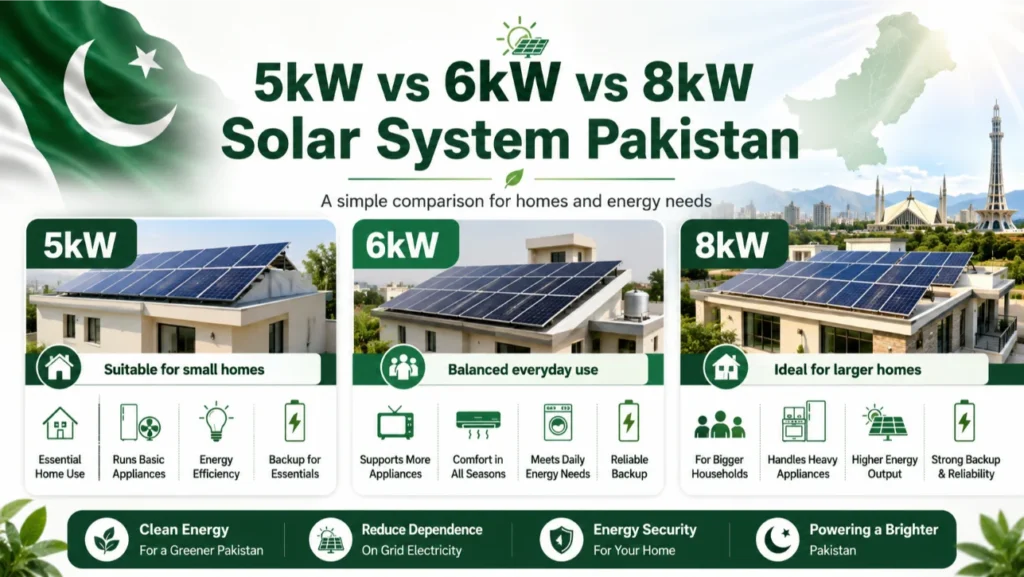
5kW vs 6kW vs 8kW — Quick Comparison
| Factor | 5kW System | 6kW System | 8kW System |
|---|---|---|---|
| Daily Generation (avg) | 20–25 kWh/day | 24–30 kWh/day | 32–40 kWh/day |
| Monthly Generation (avg) | 600–750 kWh | 720–900 kWh | 960–1,200 kWh |
| Typical Panel Count | 10 × 550W panels | 12 × 550W panels | 14–16 × 550W panels |
| ACs Supported | 1–2 ACs (1.5T) | 2 ACs (1.5T) | 2–3 ACs (1.5T) |
| Roof Space Needed | ~50 sq meters | ~60 sq meters | ~80 sq meters |
| Typical System Price | Rs. 650,000–850,000 | Rs. 800,000–1,050,000 | Rs. 1,050,000–1,350,000 |
| Payback Period | 3.5–5 years | 3.5–5 years | 3.5–5 years |
| Best for | 2–3 bed homes, 1 AC | 3–4 bed homes, 2 ACs | Large homes, 3+ ACs |
How to Know Which Size You Need
Step 1: Look at Your WAPDA Bill
Your monthly units consumed (kWh) on your bill is the single most important number. Divide your monthly units by 30 to get daily usage, then divide by 4–4.5 (Pakistan’s average peak sun hours) to estimate required system size.
| Monthly WAPDA Units | Recommended System |
|---|---|
| Under 500 units/month | 3kW or 5kW |
| 500–700 units/month | 5kW |
| 700–900 units/month | 6kW |
| 900–1,200 units/month | 8kW |
| 1,200+ units/month | 10kW+ |
Step 2: Count Your ACs
Air conditioners dominate summer electricity usage in Pakistan. As a rough rule: each 1.5-ton inverter AC draws 1.0–1.5kW while running. Two ACs running simultaneously = 2.0–3.0kW of your inverter’s capacity already used, leaving less for fans, lights, and appliances. A 5kW inverter can handle 2 ACs but will be near capacity. A 6kW gives comfortable headroom. An 8kW is needed for 3 ACs or heavy commercial-grade loads.
Step 3: Consider Net Metering
If you plan to export surplus to WAPDA via net metering, a slightly oversized system (6kW or 8kW for a 500-unit home) generates extra units in summer that reduce or eliminate your WAPDA bill. NEPRA allows net metering for systems up to the sanctioned load limit — typically 5kW for standard residential connections, with upgrades available.
5kW — Best For
- Homes consuming 500–700 units/month on WAPDA
- 2–3 bedroom homes with 1 AC and standard appliances
- Budget-conscious buyers — lowest system cost
- Net metering connections limited to 5kW sanction load
- Smaller rooftops with space for 10 panels only
6kW — Best For
- Homes consuming 700–900 units/month on WAPDA
- 3–4 bedroom homes with 2 ACs running simultaneously
- Buyers who want headroom for load growth (new appliances, EV charging)
- Best sweet-spot value — 20% more capacity for much less than 60% price increase
- Most popular system size among Pakistani solar buyers in 2026
8kW — Best For
- Homes consuming 900–1,200 units/month or higher
- Large homes with 3 ACs or heavy appliance loads
- Buyers with large rooftops wanting to maximize net metering exports
- Small business or shop owners
- Buyers planning to add EV charging in the next few years
Frequently Asked Questions
⚡ Get accurate solar system prices in Pakistan
5kW system prices → | 6kW system prices → | 8kW system prices →
Sources & references
Tariff, net-metering, and policy details on this page draw on the following official sources. Rates change often, so confirm current figures with the relevant authority or a licensed installer before you decide.
- NEPRA — National Electric Power Regulatory Authority: electricity tariffs and the 2026 shift from net metering to net billing.
- AEDB — Alternative Energy Development Board: solar policy, installer standards, and net-metering guidance.
- Your local distribution company (DISCO) — for example LESCO, K-Electric, IESCO, MEPCO, PESCO or QESCO — for area-specific tariffs and the net-metering application process.