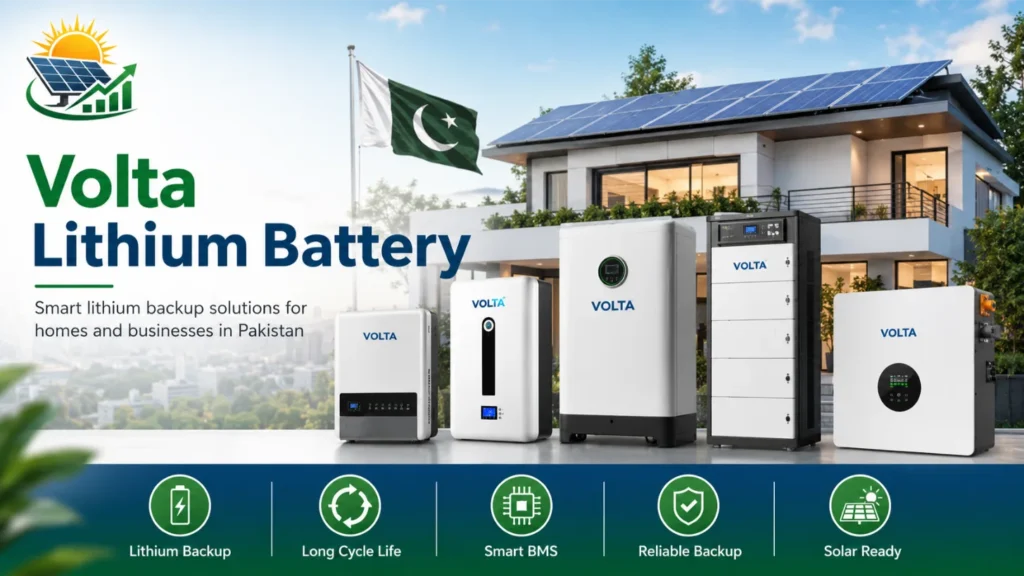
Volta has been a trusted Pakistani battery brand for decades — and in 2026, they have expanded into lithium ion technology to meet the growing demand for solar storage. Volta Lithium batteries combine the brand’s established local presence and widespread service network with modern LiFePO4 chemistry, making them an attractive option for Pakistani homeowners who value local support above all else.
Volta: A Well-Known Pakistani Brand
Volta is one of Pakistan’s most recognised local solar and power brands, and its lithium (LFP) batteries are a popular home-storage choice. The main advantage is local: a nationwide dealer and service network, locally-honoured warranties, and readier availability of replacements than with imported-only labels. Volta’s LFP packs target mainstream residential systems, offering the long cycle life and safety benefits of lithium over older lead-acid options, usually with a built-in BMS and app or display monitoring on higher models. Positioning is budget-to-mid: competitively priced for buyers who want lithium storage with dependable local after-sales rather than premium imported cells. Before purchase, confirm the exact usable capacity (kWh) and continuous/peak power, the battery voltage (low- vs high-voltage) and that it matches your inverter, the BMS communication compatibility, and the written warranty length and cycle rating.
Volta Lithium Battery Price in Pakistan (2026)
| Model | Capacity | Voltage | Price (PKR) |
|---|---|---|---|
| Volta Lithium 24V 100Ah | 2.56 kWh | 24V (25.6V) | Rs. 110,000 – Rs. 135,000 |
| Volta Lithium 48V 100Ah | 5.12 kWh | 48V (51.2V) | Rs. 195,000 – Rs. 225,000 |
| Volta Lithium 48V 200Ah | 10.24 kWh | 48V (51.2V) | Rs. 390,000 – Rs. 440,000 |
Prices updated June 2026. Available through Volta’s nationwide dealer network.
Volta Lithium Battery Specifications
| Specification | Details |
|---|---|
| Chemistry | LiFePO4 (Lithium Iron Phosphate) |
| Cycle Life | 4,000–5,000 cycles at 80% DoD |
| DoD | 80% |
| Round-trip Efficiency | 93–95% |
| Built-in BMS | Yes — with overcharge, over-discharge, and temperature protection |
| Communication | RS485 / CAN |
| Operating Temperature | 0°C to 45°C |
| Warranty | 3 years (local warranty, Pakistan) |
Volta Lithium’s Key Advantage – Local Service Network
Volta has service centers across Pakistan — including smaller cities and towns where imported brands have no presence. For solar buyers in Faisalabad, Gujranwala, Sialkot, Hyderabad, Sukkur, or Quetta, Volta Lithium may be the only brand where warranty service is genuinely accessible within driving distance.
This local support advantage is a meaningful differentiator in Pakistan’s solar market, where warranty claims on imported batteries often involve weeks of back-and-forth with distributors in Karachi or Lahore.
Volta Lithium vs Imported Brands
Volta Lithium has a shorter cycle life rating (4,000–5,000 vs 6,000 for Pylontech) and a shorter warranty (3 years vs 10 years). However, what Volta offers in return is unmatched local accessibility and a brand name that Pakistani consumers have trusted for decades. For buyers outside major cities, or those who prioritize having a dealer nearby, Volta Lithium is a strong choice.
Compatible Inverters for Volta Lithium
Volta Lithium batteries use standard 48V architecture and RS485/CAN communication, making them compatible with all major hybrid inverters in Pakistan: Growatt SPF series, Inverex Nitrox, Deye hybrid, Solis hybrid, Ziewnic Atlas, and Voltronic-based inverters. Your installer will need to configure the inverter battery parameters using Volta’s spec sheet.
Compare Volta with other lithium battery brands on our solar batteries page, or estimate your total system cost using our free price calculator.
Sources & references
Tariff, net-metering, and policy details on this page draw on the following official sources. Rates change often, so confirm current figures with the relevant authority or a licensed installer before you decide.
- NEPRA — National Electric Power Regulatory Authority: electricity tariffs and the 2026 shift from net metering to net billing.
- AEDB — Alternative Energy Development Board: solar policy, installer standards, and net-metering guidance.
- Your local distribution company (DISCO) — for example LESCO, K-Electric, IESCO, MEPCO, PESCO or QESCO — for area-specific tariffs and the net-metering application process.

Abubaker Jalil
Abubaker Jalil is an electrical engineer and a graduate of the University of Engineering and Technology (UET) Peshawar. He tracks panel, inverter and battery prices across Pakistan's wholesale solar markets and writes the buying guides on this site. If a dealer has quoted you a figure that does not match what you see here, write to info@solarpricepakistan.com.pk and it gets checked.