
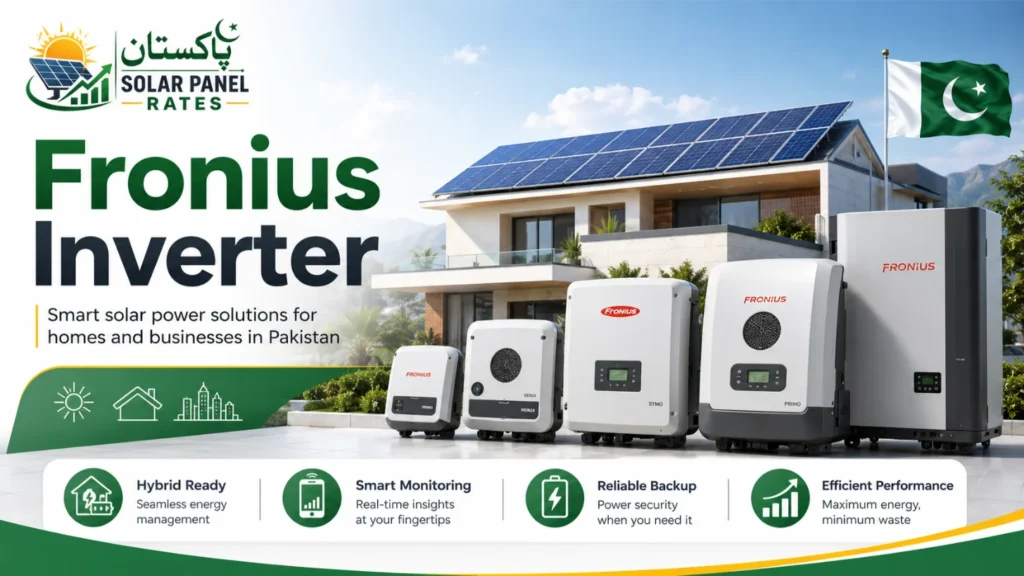
Fronius is an Austrian inverter manufacturer widely regarded as the gold standard for build quality and reliability in the solar industry. Fronius inverters command a premium price in Pakistan, but they deliver industry-leading efficiency, the best monitoring platform available, and consistently outlast cheaper alternatives. Here’s the current Fronius inverter price in Pakistan by model.
Fronius: Austrian Premium Inverters
Fronius is an Austrian manufacturer and one of the most respected premium inverter brands worldwide. In Pakistan its Primo (single-phase) and Symo (three-phase) on-grid inverters, and the newer GEN24 Plus hybrid range, are chosen by buyers who prioritise reliability and efficiency over lowest price. Fronius units are known for excellent build quality, high efficiency, flexible string sizing, active cooling for hot climates, and strong monitoring through Solar.web. They sit firmly at the top of the market on price, and because they are European-made, replacement parts and service can take longer than for mass-market Chinese brands. Fronius suits homeowners and businesses making a long-term investment who want proven durability and do not mind paying a premium. Confirm the specific model’s warranty (typically 5 to 10 years, extendable), and that your installer is Fronius-trained for warranty support.
Fronius Inverter Prices in Pakistan 2026
Fronius Primo (Single Phase – Residential)
| Model | Capacity | Price (PKR) |
|---|---|---|
| Fronius Primo 3.0-1 | 3kW | Rs. 200,000 – Rs. 250,000 |
| Fronius Primo 4.0-1 | 4kW | Rs. 240,000 – Rs. 290,000 |
| Fronius Primo 5.0-1 | 5kW | Rs. 280,000 – Rs. 340,000 |
| Fronius Primo 6.0-1 | 6kW | Rs. 320,000 – Rs. 380,000 |
| Fronius Primo 8.2-1 | 8.2kW | Rs. 380,000 – Rs. 440,000 |
Fronius Symo (Three Phase – Commercial)
| Model | Capacity | Price (PKR) |
|---|---|---|
| Fronius Symo 10.0-3 | 10kW | Rs. 350,000 – Rs. 420,000 |
| Fronius Symo 15.0-3 | 15kW | Rs. 490,000 – Rs. 570,000 |
| Fronius Symo 20.0-3 | 20kW | Rs. 620,000 – Rs. 720,000 |
Fronius Primo 5kW – Key Specs
| Spec | Value |
|---|---|
| Rated Output | 5,000W |
| Max Efficiency | 98.1% |
| MPPT Channels | 2 |
| Max PV Voltage | 1,000V |
| Monitoring | Fronius Solar.web (excellent) |
| Display | Color touchscreen |
| Warranty | 5 years standard (10 year option) |
| IP Rating | IP65 |
| Made in | Austria |
Fronius Pros & Cons
Pros
- Best build quality of any inverter available in Pakistan — Austrian engineering
- Highest efficiency ratings in its class (up to 98.1%)
- Fronius Solar.web is the most advanced monitoring platform available
- Extremely reliable — very low failure rates globally
- 10-year warranty option available
Cons
- Most expensive inverter brand in Pakistan — 2x the price of Growatt
- Fronius is primarily on-grid only — no standard hybrid model for battery backup
- Overkill for most budget residential installs
- Service centers only in Karachi and Lahore
Who Should Buy Fronius?
Fronius is best suited for commercial projects, high-budget residences, and export-quality installations where maximum efficiency and 10+ year reliability are required. If load-shedding backup is your main concern, note that Fronius does not offer a standard hybrid model — you’d need a separate battery solution.
See our inverter comparison page for how Fronius stacks up against all brands.
Sources & references
Tariff, net-metering, and policy details on this page draw on the following official sources. Rates change often, so confirm current figures with the relevant authority or a licensed installer before you decide.
- NEPRA — National Electric Power Regulatory Authority: electricity tariffs and the 2026 shift from net metering to net billing.
- AEDB — Alternative Energy Development Board: solar policy, installer standards, and net-metering guidance.
- Your local distribution company (DISCO) — for example LESCO, K-Electric, IESCO, MEPCO, PESCO or QESCO — for area-specific tariffs and the net-metering application process.

Abubaker Jalil
Abubaker Jalil is an electrical engineer and a graduate of the University of Engineering and Technology (UET) Peshawar. He tracks panel, inverter and battery prices across Pakistan's wholesale solar markets and writes the buying guides on this site. If a dealer has quoted you a figure that does not match what you see here, write to info@solarpricepakistan.com.pk and it gets checked.