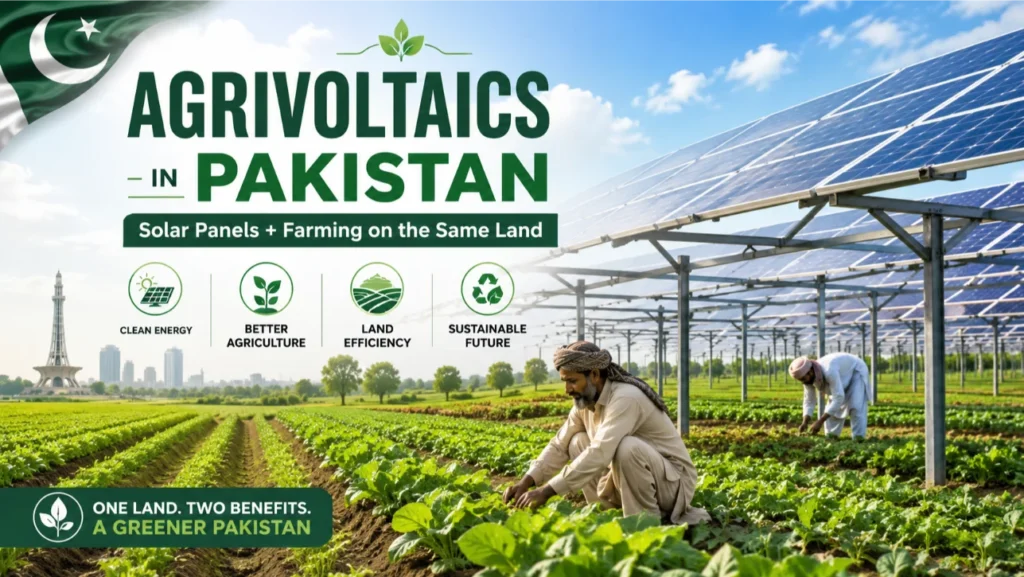
Agrivoltaics in Pakistan — Solar Panels + Farming on the Same Land
What Is Agrivoltaics?
In a standard ground-mounted solar installation, the land under and around panels is wasted — typically covered with gravel or grass. Agrivoltaics changes this by elevating panels 2–4 meters above ground on taller mounting structures, allowing crops, livestock, or greenhouses to operate beneath. The panels provide partial shade, and the crops provide a cooling effect that actually improves panel efficiency (solar panels perform better in cooler conditions).
Why Agrivoltaics Is Particularly Relevant for Pakistan
| Pakistan Challenge | How Agrivoltaics Helps |
|---|---|
| Water scarcity in agriculture | Panel shade reduces crop evapotranspiration by 20–50% — same yield with less water |
| Extreme summer heat damaging crops | Partial shade protects heat-sensitive crops during 45°C+ days |
| High electricity cost for tube wells | On-site solar powers irrigation pumps directly — eliminates WAPDA electricity for farming |
| Land competition (food vs energy) | Same land produces both food and energy — no trade-off required |
| Rural energy poverty | Agrivoltaic systems power rural homes and farm operations off-grid |
Crops That Benefit Most From Agrivoltaic Shade in Pakistan
- Vegetables: Tomatoes, chilies, spinach, and leafy greens — all benefit from partial shade in Pakistan’s heat. Studies show 10–20% yield increase under panels in hot climates
- Herbs and spices: Coriander, mint, and fenugreek are shade-tolerant and can thrive under agrivoltaic panels
- Fodder crops: Alfalfa and other fodder plants maintain yield under partial shade while benefiting from reduced water consumption
- Fruit orchards: Mango, guava, and citrus trees can coexist with raised panels — the trees provide additional cooling for panels
- Livestock grazing: Goats and sheep can graze under panels — their presence helps with weed control and provides panel cooling through humidity
Pakistan Agrivoltaics — Current Status (2026)
Pakistan’s agrivoltaics sector is at very early stages. The concept is understood in academic and policy circles but large-scale commercial deployment hasn’t happened yet. Key early movers:
- Several pilot projects in Bahawalpur and Multan regions combining solar tube well power with crop cultivation under elevated panels
- AEDB and PSDP discussions on agrivoltaic policy framework as part of 2030 renewable energy planning
- Private farm owners in Khanewal and Faisalabad experimenting with solar-shaded greenhouse cultivation
Challenges for Pakistan Agrivoltaics
- Higher installation cost: Elevated mounting structures cost 30–50% more than standard ground-mount racking — a barrier for small farmers
- Financing gap: Pakistan’s agricultural finance sector lacks specific agrivoltaic loan products
- Technical knowledge: Farmers and installers lack training on combined agrivoltaic systems
- Land tenure: Much Pakistani farmland is leased — tenants can’t install permanent infrastructure
Frequently Asked Questions
☀️ Solar for agriculture — see system prices
Sources & references
Tariff, net-metering, and policy details on this page draw on the following official sources. Rates change often, so confirm current figures with the relevant authority or a licensed installer before you decide.
- NEPRA — National Electric Power Regulatory Authority: electricity tariffs and the 2026 shift from net metering to net billing.
- AEDB — Alternative Energy Development Board: solar policy, installer standards, and net-metering guidance.
- Your local distribution company (DISCO) — for example LESCO, K-Electric, IESCO, MEPCO, PESCO or QESCO — for area-specific tariffs and the net-metering application process.