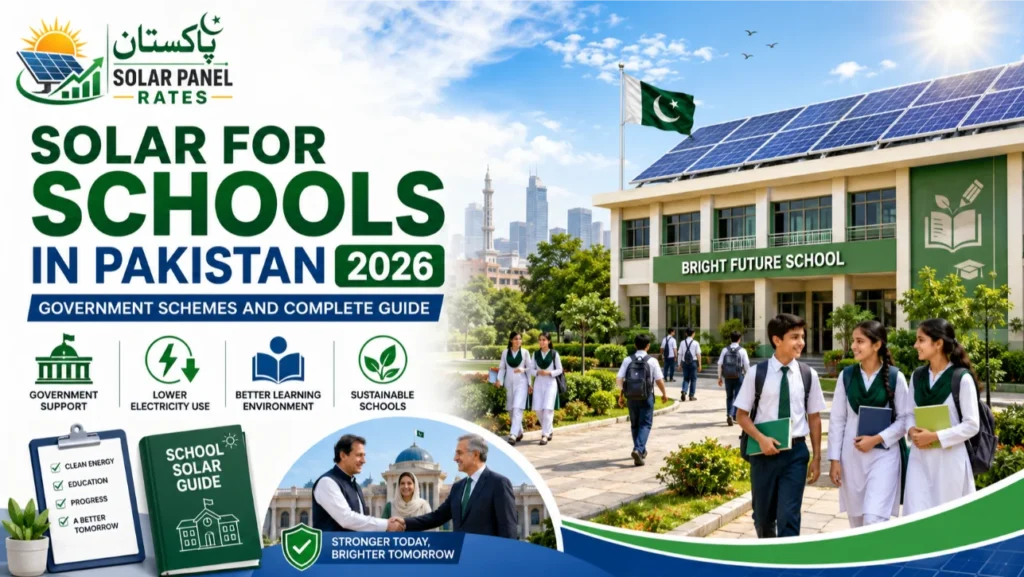
Solar for Schools in Pakistan 2026 — Government Schemes and Complete Guide
Why Schools Are Perfect Solar Candidates
- Daytime operation: Schools operate 7am–3pm — perfectly aligned with peak solar generation hours. Almost no battery storage needed for daytime classes
- Large flat rooftops: School buildings typically have extensive flat or low-pitch rooftops with no shading — ideal solar real estate
- Critical loads during outages: Fans, projectors, computers, and lights — all easily handled by a modest solar+battery system
- High electricity bills: Schools with multiple classrooms, computers, ACs (where available), and lab equipment can pay Rs. 30,000–150,000/month in electricity
- Educational value: A solar installation is a live learning resource for science, physics, and environmental studies
Government Schemes for School Solar in Pakistan
USAID / KfW-funded School Solar Programs
Several donor-funded programs have installed solar at government schools across Punjab, KPK, and Sindh. These programs prioritise rural off-grid schools and are typically implemented through AEDB and provincial education departments. Applications go through DEOs (District Education Officers).
Punjab Education Endowment Fund (PEEF) / PESRP
Punjab’s education support programs have included solar components in school improvement grants. Schools can apply through their district education offices.
Self-Funded with Bank Financing
Private schools and well-resourced government schools can finance solar systems independently through SBP’s Renewable Energy Financing Scheme or commercial bank green loans at concessional rates (9–12% per annum in 2026).
Sizing a Solar System for a Pakistani School
| School Size | Estimated Daily Load | Recommended System | Approx. Cost |
|---|---|---|---|
| Small primary (5 classrooms) | 8–12 kWh/day | 3–5 kW hybrid | Rs. 500,000–750,000 |
| Medium school (15 rooms) | 20–35 kWh/day | 8–10 kW hybrid | Rs. 1,100,000–1,500,000 |
| Large school / college (30+ rooms, labs, ACs) | 60–120 kWh/day | 20–30 kW 3-phase | Rs. 2,500,000–4,000,000 |
| Off-grid rural school (no grid) | 5–8 kWh/day | 3 kW off-grid + battery | Rs. 600,000–900,000 |
Frequently Asked Questions
☀️ Power your school with solar
Sources & references
Tariff, net-metering, and policy details on this page draw on the following official sources. Rates change often, so confirm current figures with the relevant authority or a licensed installer before you decide.
- NEPRA — National Electric Power Regulatory Authority: electricity tariffs and the 2026 shift from net metering to net billing.
- AEDB — Alternative Energy Development Board: solar policy, installer standards, and net-metering guidance.
- Your local distribution company (DISCO) — for example LESCO, K-Electric, IESCO, MEPCO, PESCO or QESCO — for area-specific tariffs and the net-metering application process.