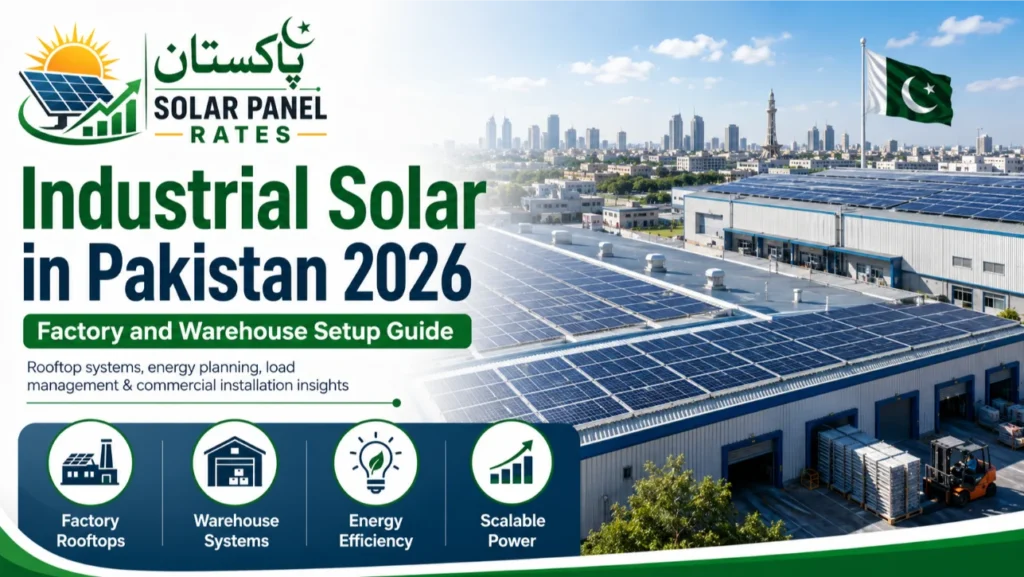
Industrial Solar in Pakistan 2026 — Factory and Warehouse Setup Guide
Why Industrial Solar Is Different
Industrial solar systems (50kW–10MW) operate at a fundamentally different scale and complexity than residential systems. They require 3-phase power, specialised string or central inverters, more complex safety and protection systems, NEPRA licensing for larger installations, and professional O&M contracts. The economics, however, are even more compelling than residential.
| Scale | System Size | Typical Application | Approx. Cost |
|---|---|---|---|
| Small commercial | 25–100 kW | Small factory, cold store, hotel | Rs. 5M–20M |
| Medium industrial | 100–500 kW | Mid-size factory, textile unit | Rs. 20M–100M |
| Large industrial | 500kW–2MW | Large factory, industrial estate | Rs. 100M–400M |
| Utility-scale | 2MW+ | Industrial park, major enterprise | Rs. 400M+ |
Key Design Considerations for Industrial Solar
Rooftop vs Ground-Mount
Factories and warehouses with large flat rooftops (10,000+ sq ft) are ideal for rooftop industrial solar. Ground-mount systems are used where roof space is insufficient or roof structural capacity is a concern. Large rooftop systems in Pakistan generate 80–150 kWh per kW installed annually — a 500kW rooftop system generates 40,000–75,000 kWh/month.
String Inverters vs Central Inverters
Systems up to 100kW typically use multiple string inverters (Growatt, Sungrow, Huawei 60–100kW units). Larger systems may use central inverters (250–630kW) which reduce component count and O&M complexity at the cost of single point of failure risk. Medium installations often use a distributed string architecture for better fault tolerance.
Grid Connection and NEPRA Licensing
Industrial net metering above 1MW requires NEPRA generation licensing (separate from DISCO net metering). Systems up to 1MW apply for net metering through the local DISCO. For systems exporting to the grid, a Grid Impact Study may be required by the DISCO. Engage an AEDB-certified EPC contractor who handles regulatory compliance as part of their scope.
Industrial Solar ROI in Pakistan
Industrial tariffs in Pakistan (2026) for medium-large consumers run Rs. 35–55/kWh. Solar generation cost (LCOE) for well-designed Pakistani industrial systems is Rs. 6–10/kWh over the system lifetime. The Rs. 25–45/kWh spread makes industrial solar the most financially compelling renewable investment in the country.
EPC Contractor Selection
- AEDB certification: Ensure the contractor is listed on AEDB’s approved vendor/installer list for commercial/industrial scale
- Proven industrial track record: Ask for case studies of completed industrial projects at similar scale with documented generation data
- Performance guarantees: Professional EPC contracts include performance ratio guarantees (typically PR ≥ 0.80) and generation warranties
- O&M scope: Industrial systems require professional O&M contracts — cleaning, inverter monitoring, thermal imaging, annual string testing
- Bankability: For bank-financed systems, the EPC contractor must provide performance bonds and equipment warranties acceptable to the financing bank
Frequently Asked Questions
⚡ Scale your industrial solar project
Sources & references
Tariff, net-metering, and policy details on this page draw on the following official sources. Rates change often, so confirm current figures with the relevant authority or a licensed installer before you decide.
- NEPRA — National Electric Power Regulatory Authority: electricity tariffs and the 2026 shift from net metering to net billing.
- AEDB — Alternative Energy Development Board: solar policy, installer standards, and net-metering guidance.
- Your local distribution company (DISCO) — for example LESCO, K-Electric, IESCO, MEPCO, PESCO or QESCO — for area-specific tariffs and the net-metering application process.