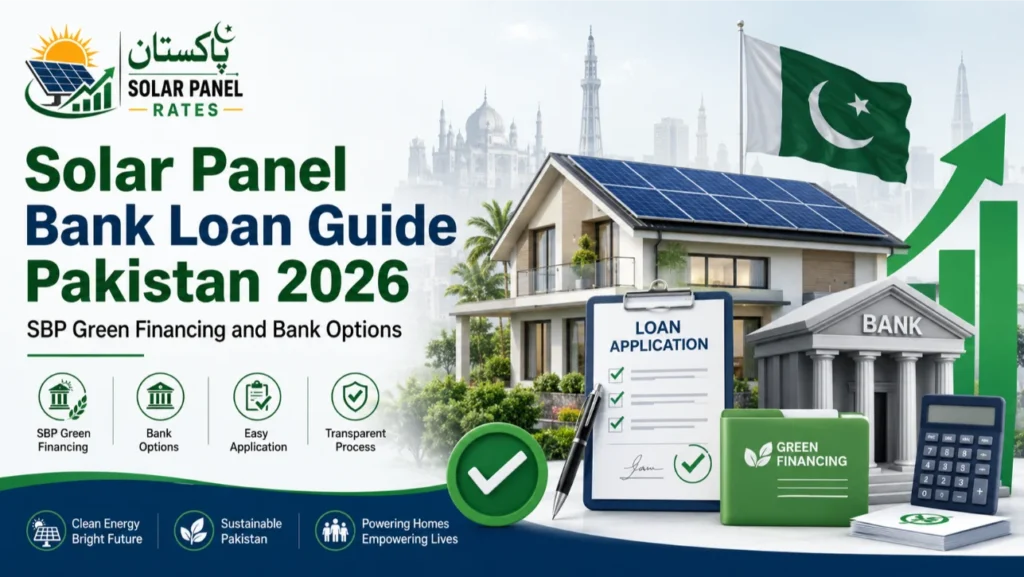
Solar Panel Bank Loan Guide Pakistan 2026 — SBP Green Financing and Bank Options
SBP Renewable Energy Financing Scheme (REFS)
The State Bank of Pakistan’s REFS is the flagship green financing program — offering concessional (below-market) loans to individuals, SMEs, and corporates for renewable energy including solar. Banks participating in REFS access SBP refinancing at subsidised rates and pass the benefit to end borrowers.
| Feature | Details (2026) |
|---|---|
| Maximum loan amount | Rs. 30 million (individual); Rs. 6 billion (corporate) |
| Indicative rate (REFS) | 5–9% per annum (varies by SBP policy rate adjustments) |
| Maximum tenure | 12 years |
| Eligible systems | Grid-tied, hybrid, off-grid — residential, commercial, industrial |
| Collateral | Property mortgage or documented income typically required |
| Participating banks | HBL, MCB, UBL, Bank Alfalah, NBP, Meezan, Bank of Punjab, Allied Bank |
Meezan Bank Solar Financing (Islamic)
Meezan Bank offers Diminishing Musharakah-based solar financing — Shariah-compliant, no riba (interest). The bank co-owns the solar system and the customer gradually buys out the bank’s share over the financing tenure. Effective rental cost is comparable to conventional financing rates. Popular with customers who prefer Islamic banking.
Monthly Payment vs Electricity Bill Saving
| System Size | Total Cost | Loan (80%, 7yr, 8%) | Monthly EMI | Monthly Saving | Net Cash Flow |
|---|---|---|---|---|---|
| 3kW | Rs. 430,000 | Rs. 344,000 | Rs. 5,200 | Rs. 10,000–15,000 | +Rs. 4,800–9,800 |
| 5kW | Rs. 700,000 | Rs. 560,000 | Rs. 8,500 | Rs. 18,000–25,000 | +Rs. 9,500–16,500 |
| 8kW | Rs. 1,050,000 | Rs. 840,000 | Rs. 12,700 | Rs. 28,000–38,000 | +Rs. 15,300–25,300 |
| 10kW | Rs. 1,300,000 | Rs. 1,040,000 | Rs. 15,700 | Rs. 35,000–50,000 | +Rs. 19,300–34,300 |
How to Apply for Solar Bank Financing in Pakistan
- Choose a PPIB-certified solar installer and get a detailed quotation with equipment specifications and total project cost
- Approach a participating REFS bank (HBL, MCB, Meezan, Bank Alfalah) with the solar quotation
- Submit loan application with income documentation (salary slips, bank statements, property documents)
- Bank conducts credit assessment and property valuation (if mortgage-backed)
- Loan approval and disbursement directly to the solar installer (many banks pay installer directly)
- Installation proceeds; system commissioned; net metering application filed
- Monthly EMI begins — immediately offset by electricity savings
Frequently Asked Questions
🏦 Finance your solar and save from day one
Sources & references
Where this page states a rule, a tariff or a registration requirement, it comes from the documents below. Links go to the document itself, not a homepage. Prices on this page come from our own daily rate feed, not from these sources.
- NEPRA (Prosumer) Regulations, 2026 — notified 6 August 2026. Sets the framework that replaced straight net metering with net billing. Under it, a prosumer facility of 25 kW or below does not need concurrence from the Authority.
- NEPRA net-metering licences — the register of issued distributed-generation and net-metering licences.
- Checklist for enlistment of installers under the AEDB (Certification) Regulations, 2021 — the actual requirements an installer must meet. Note that AEDB was dissolved and merged into PPIB in July 2023, so enlistment is handled by PPIB, even though the regulations still carry the AEDB name.
- Your distribution company — LESCO, MEPCO, FESCO, GEPCO, IESCO, PESCO, QESCO, HESCO, SEPCO or K-Electric — for the tariff that applies to your area and the net-metering application itself. K-Electric runs its own process, separate from the DISCOs.
Regulatory links last checked 4 October 2026. Rules change; confirm current figures with the authority or a licensed installer before you commit money.

Abubaker Jalil
Abubaker Jalil is an electrical engineer and a graduate of the University of Engineering and Technology (UET) Peshawar. He tracks panel, inverter and battery prices across Pakistan's wholesale solar markets and writes the buying guides on this site. If a dealer has quoted you a figure that does not match what you see here, write to info@solarpricepakistan.com.pk and it gets checked.