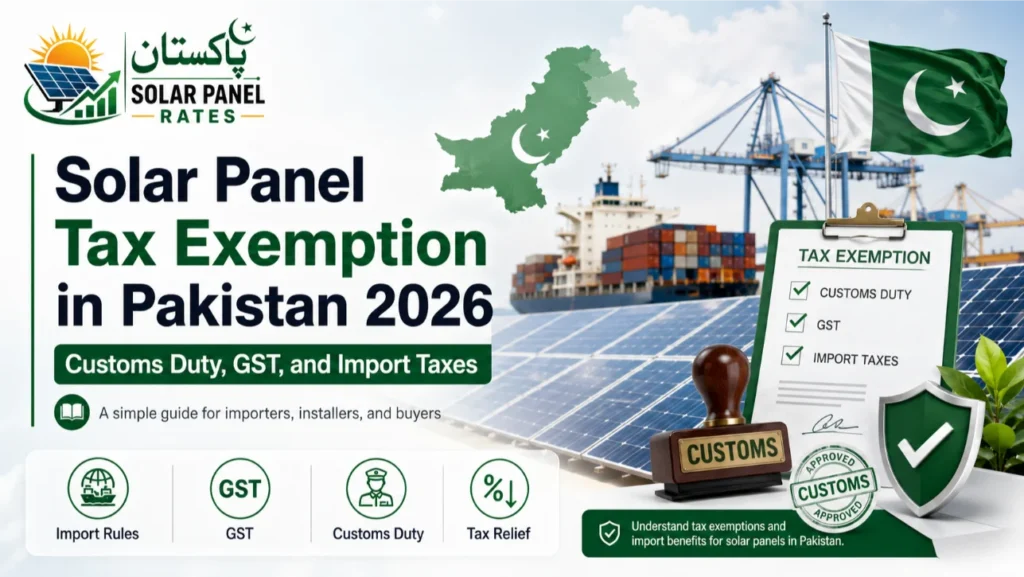
Solar Panel Tax Exemption in Pakistan 2026 — Customs Duty, GST, and Import Taxes
Current Solar Tax Exemptions in Pakistan (2026)
| Equipment | Customs Duty | GST/Sales Tax | Additional Taxes |
|---|---|---|---|
| Solar PV panels | 0% | 0% (exempt) | Exempt |
| Solar inverters (all types) | 0% | 0% (exempt) | Exempt |
| Solar charge controllers | 0% | 0% (exempt) | Exempt |
| Solar batteries (lithium / lead-acid for solar) | 11% (standard) | 17% (standard) | Partially exempt — check SRO |
| Mounting structures (specific solar) | Varies | 0% if solar-specific | — |
| Solar DC cables | Standard rate | Standard rate | Not specifically exempt |
The SRO Framework for Solar Exemptions
Pakistan’s solar tax exemptions are implemented through FBR (Federal Board of Revenue) Statutory Regulatory Orders (SROs). The key SROs for solar equipment provide customs duty exemption under PCT Code 8541.40 (solar cells, panels) and associated equipment. Importers must correctly classify goods under these PCT codes to benefit from exemptions. Mis-classification (accidentally or deliberately by customs) can result in incorrect duty assessment — solar buyers can challenge incorrect duty assessments through FBR’s customs adjudication process.
GST on Solar — The Nuances
Pakistan’s Sales Tax Act provides specific exemptions for solar equipment including panels and inverters (Schedule 6 items). However, GST exemption has been subject to annual budget adjustments — verify the current status at FBR.gov.pk or with your importing solar company. In 2025–26, solar panels and inverters remain GST-exempt, but batteries are subject to standard 17% GST (with some exceptions for specifically rated solar batteries).
Income Tax — Solar Investment Depreciation
For businesses, solar system investments are depreciable assets eligible for accelerated depreciation allowance under Pakistan’s Income Tax Ordinance. Solar assets qualify for 50% first-year depreciation — meaning a business investing Rs. 2,000,000 in solar can claim Rs. 1,000,000 depreciation deduction in year 1, reducing taxable income significantly. This accelerated depreciation further improves the after-tax ROI for corporate solar investments.
Frequently Asked Questions
💰 Maximise your solar investment with correct tax treatment
Sources & references
Tariff, net-metering, and policy details on this page draw on the following official sources. Rates change often, so confirm current figures with the relevant authority or a licensed installer before you decide.
- NEPRA — National Electric Power Regulatory Authority: electricity tariffs and the 2026 shift from net metering to net billing.
- AEDB — Alternative Energy Development Board: solar policy, installer standards, and net-metering guidance.
- Your local distribution company (DISCO) — for example LESCO, K-Electric, IESCO, MEPCO, PESCO or QESCO — for area-specific tariffs and the net-metering application process.