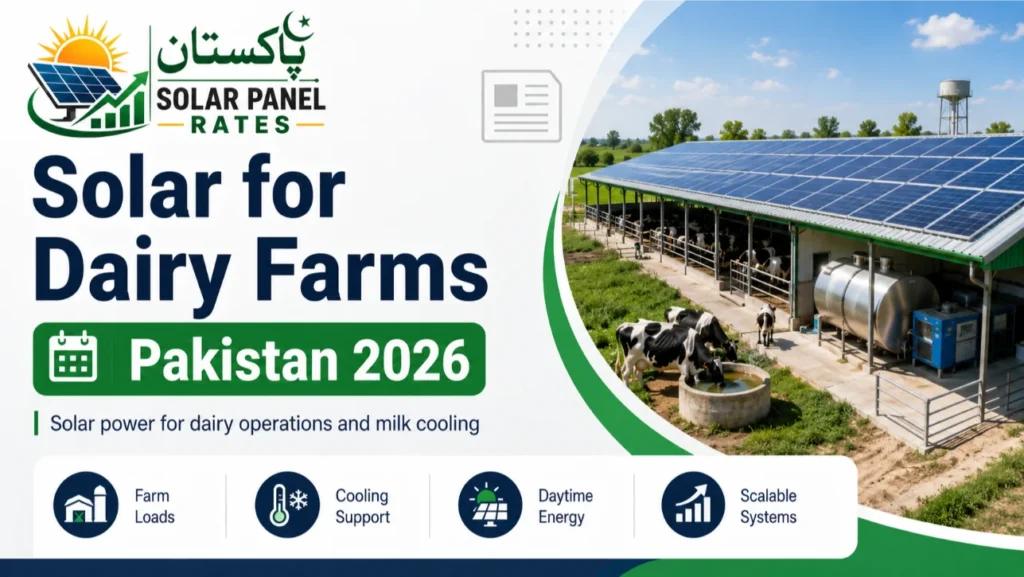
Solar for Dairy Farms Pakistan 2026 — Cost, Savings & System Guide
Pakistan has over 80 million cattle and buffalo — one of the world’s largest dairy sectors. Most dairy farms struggle with high electricity costs and load shedding that damages milk quality. Solar energy is a game-changing solution for dairy operations in 2026.
Why Dairy Farms Need Solar
- Milk cooling (bulk milk coolers) is the single largest electrical load on a dairy farm — must run continuously to maintain milk quality
- Milking machines run 2–4 hours twice daily — predictable daytime loads perfect for solar
- Water pumping for cattle (drinking, washing) is a major load — easily offset by solar
- Load shedding causes milk spoilage — a single outage on a 200-cow farm can mean Rs 100,000+ in lost milk
- Diesel generators are common but cost Rs 80,000–150,000/month on medium farms
- Pakistan Dairy Development Company and provincial livestock departments support solar adoption
Key Electrical Loads on a Dairy Farm
| Load | Power Draw | Hours/Day |
|---|---|---|
| Bulk milk cooler (200L) | 3–5 kW | 20–22 hrs |
| Bulk milk cooler (1,000L) | 8–12 kW | 20–22 hrs |
| Milking machine (2-unit) | 2–4 kW | 4–6 hrs |
| Water pump (cattle drinking) | 3–7 kW | 6–10 hrs |
| Feed mixer / conveyor | 3–10 kW | 2–4 hrs |
| Lighting (barn + office) | 2–5 kW | 8–14 hrs |
| Cooling fan (cattle comfort) | 5–15 kW | 8–14 hrs (summer) |
Recommended System Sizes
| Farm Size | Cattle Count | System Size | Monthly Saving |
|---|---|---|---|
| Small farm | 10–30 cows | 5–10kW hybrid | Rs 25,000–60,000 |
| Medium farm | 50–100 cows | 15–25kW hybrid | Rs 75,000–150,000 |
| Large farm | 200–500 cows | 40–80kW + battery | Rs 200,000–500,000 |
| Commercial dairy | 1,000+ cows | 150kW–500kW+ | Rs 750,000–3,000,000 |
Bulk Milk Cooler — The Priority Load
Dairy farm solar must prioritise the bulk milk cooler. Fresh milk stored above 4°C for more than 2 hours begins to spoil. Your solar system must have sufficient battery or generator backup to run the cooler through all grid outages, day or night. This is non-negotiable for milk quality and dairy licensing compliance.
Sample System — Medium Dairy Farm (100 cows)
| Component | Specification | Cost |
|---|---|---|
| Solar Panels | 20kW (34 × 600W TOPCon) | Rs 550,000–700,000 |
| Hybrid Inverter | 20kW single/three-phase | Rs 220,000–300,000 |
| Battery Bank | 40kWh LiFePO4 | Rs 800,000–1,000,000 |
| Mounting + Wiring | Farm roof / ground mount | Rs 150,000–220,000 |
| Labour | AEDB-licensed installer | Rs 120,000–180,000 |
| Total | Rs 1,840,000–2,400,000 |
A 20kW hybrid system with 40kWh battery covers the bulk milk cooler (8kW), milking machine, and water pump simultaneously. Monthly electricity + diesel saving: Rs 100,000–130,000. Payback: 15–22 months.
Agricultural Net Metering for Dairy Farms
- Dairy farms on agricultural electricity connections (A-1/A-2) can apply for net metering
- Agricultural tariffs are lower than commercial, but savings still strong due to high consumption
- Net metering exports surplus midday solar to grid — earning credit for night cooler use
- AEDB-licensed contractor required for net metering application
- Processing time: 4–8 weeks through provincial DISCO
Get Dairy Farm Solar Quotes in Pakistan
Free site assessment from AEDB-licensed solar installers with agricultural experience.
Sources & references
Tariff, net-metering, and policy details on this page draw on the following official sources. Rates change often, so confirm current figures with the relevant authority or a licensed installer before you decide.
- NEPRA — National Electric Power Regulatory Authority: electricity tariffs and the 2026 shift from net metering to net billing.
- AEDB — Alternative Energy Development Board: solar policy, installer standards, and net-metering guidance.
- Your local distribution company (DISCO) — for example LESCO, K-Electric, IESCO, MEPCO, PESCO or QESCO — for area-specific tariffs and the net-metering application process.