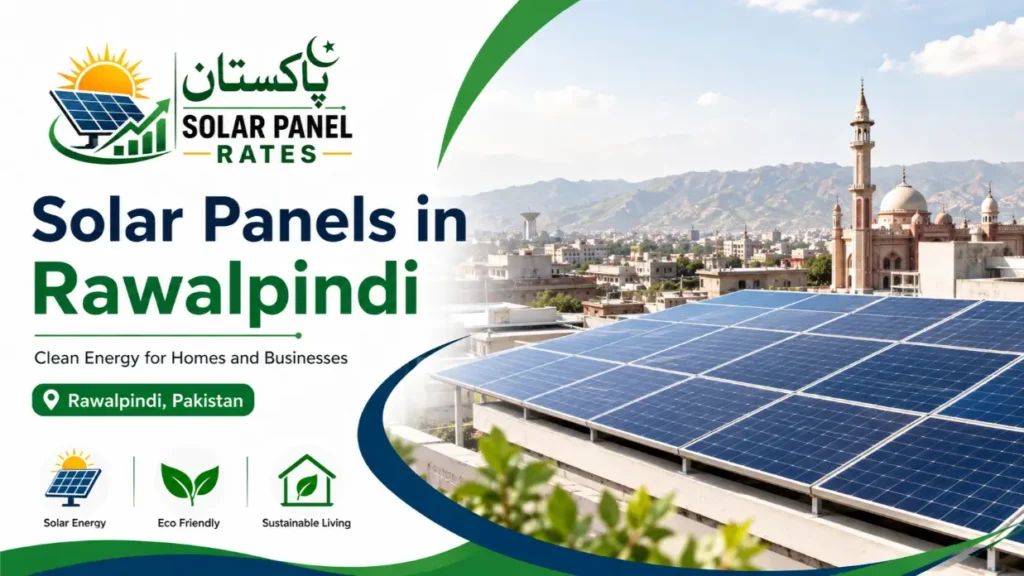
Rawalpindi — the twin city of Islamabad — is one of Pakistan’s fastest-growing solar markets. With load shedding affecting older neighborhoods for 6–10 hours daily in summer, and easy access to Raja Bazaar’s wholesale solar equipment market, Rawalpindi homeowners are going solar at record rates in 2026. This page shows today’s live solar panel price in Rawalpindi, complete system costs, and guidance from installation to net metering.
Solar Panel Prices in Rawalpindi – Live Rates (October 2026)
The rates below are sourced daily from Pakistan’s main wholesale solar markets — Hall Road Lahore, Saddar Karachi, and Raja Bazaar Islamabad. Rawalpindi dealer prices are typically 3–7% above wholesale due to transport and local overhead. Use these rates to verify any quote you receive from a Rawalpindi solar installer.
Tier-1 Panels (Most Popular in Rawalpindi)
| Brand | Rate (Rs/W) |
|---|---|
| Longi | 44.75 Rs/W |
| JA Solar | 44.75 Rs/W |
| Jinko | 44.25 Rs/W |
| Canadian | 39.75 Rs/W |
| Trina | 41.75 Rs/W |
| Astronergy | 47.75 Rs/W |
| Inverex | 41.75 Rs/W |
| Crown | 39.75 Rs/W |
| AIKO | 42.75 Rs/W |
Wholesale market rates as of 1 October 2026 (updated today). Dealer quotes vary by stock, grade and installation — confirm before you pay.
What makes Rawalpindi different for solar
Rawalpindi shares a border, a grid company, and a climate with Islamabad, but on the ground it is a different solar market. Where Islamabad is planned sectors and open plots, much of Rawalpindi is dense old-city housing with small, crowded rooftops, shared walls, and limited clear space for panels. That single difference drives most local solar decisions: roof space and shading are the constraints here, not budget appetite.
The city gets around 4.9 to 5.1 peak sun hours a day averaged over the year, close to Islamabad’s numbers. It tends to run a touch hotter and dustier than its twin, especially in the older commercial quarters, so panels here need cleaning a bit more often. The same monsoon that clouds Islamabad’s July and August skies covers Rawalpindi too.
Electricity comes from IESCO, the same utility that serves Islamabad, so the net metering process and office are shared. What differs is the roof you are working with, and that is where a good local installer earns their fee.
Where solar is sold in Rawalpindi
Rawalpindi’s trade is centred on its historic bazaars, which remain the hardware and electrical heart of the twin cities:
- Raja Bazaar: the oldest and largest trading area, with electrical, hardware, and solar dealers packed together.
- College Road and Bank Road: established electronics and electrical strips with panel and inverter shops.
- Commercial Market, Satellite Town: a retail-facing market where many homeowners shop for solar and appliances.
- Bohar Bazaar and Moti Bazaar: dense wholesale hardware areas useful for structure steel, wiring, and accessories.
Rawalpindi buyers are generally more price-conscious than Islamabad’s, and the bazaars reward comparison shopping. Whatever quote you get, measure the equipment cost against our daily rate tracker to be sure you are not overpaying.
Solar dealers in Rawalpindi
The dealers below serve Rawalpindi buyers. Confirm current pricing and stock directly, ask for an itemised written quote, and check AEDB registration before paying any advance.
| Company | Google rating | Area | Phone |
|---|---|---|---|
| SunGrid Solar Pakistan | 4.9 ★ | Main Boulevard, Gulberg Greens / Islamabad Expressway, Rawalpindi | 0300 5013000 |
| Apex Solar Solutions | 4.8 ★ | Commercial Market, Satellite Town, Rawalpindi | 0333 5101032 |
| Zipper Solar | 4.7 ★ | Midway Musik Plaza, Sixth Road, Rawalpindi | 0333 5511211 |
| Bright Solar Energy | 4.6 ★ | Saddar Bazar, Cantt, Rawalpindi | 0334 5092003 |
| Inverex Solar Energy (branch) | 4.5 ★ | Murree Road, near Chandni Chowk, Rawalpindi | 0311 1333150 |
| Solar Max Rawalpindi | 4.4 ★ | Peshawar Road, near Westridge, Rawalpindi | 0321 5171120 |
Ratings and contact details as verified on Google. Listed for buyer convenience — we are not affiliated with these companies and take no commission. Confirm AEDB registration and get a written, itemised quote directly with each before you buy.
Installation cost in Rawalpindi
Rawalpindi’s labour rates are usually a little lower than Islamabad’s, though tight old-city rooftops can add cost where access is difficult. The balance-of-system and labour on top of your panels and inverter look roughly like this:
| Item | Typical Rawalpindi cost | Notes |
|---|---|---|
| Installation labour | Rs. 8,000 – 13,000 per kW | Higher on cramped or hard-to-access old-city roofs |
| Mounting structure | Rs. 11,000 – 20,000 per kW | Small roofs often need taller or elevated structures to fit panels and clear shade |
| DC/AC wiring, DB, breakers, earthing | Rs. 25,000 – 55,000 | Older wiring may need upgrading before a system is connected |
| Net metering (meter + application + processing) | Rs. 60,000 – 85,000 | IESCO bi-directional meter and connection charges |
| Surge protection | Rs. 6,000 – 15,000 | Recommended for monsoon storm protection |
Budget roughly Rs. 42,000 to Rs. 68,000 per kW for labour and balance-of-system above the panel and inverter cost. A fully installed 5kW hybrid system with a battery and net metering in Rawalpindi generally falls between Rs. 820,000 and Rs. 1,020,000, with plain on-grid systems costing less. Use our calculator for a figure matched to your roof and system size.
IESCO net metering in Rawalpindi
Rawalpindi is served by IESCO, the same utility as Islamabad, so the application route is identical. The 2026 change applies here too: NEPRA has replaced net metering with net billing for new connections. Systems approved after 9 February 2026 export surplus units at around Rs. 11 per unit under a five-year contract, instead of the old one-for-one exchange, while agreements dated before that keep their earlier terms until they expire.
Because many Rawalpindi roofs are small to begin with, most systems here are already sized close to household consumption rather than for large export, so the shift to net billing hurts less than it does for owners of big export-focused arrays. Even so, a battery to shift daytime generation into the evening is now the better use of budget than extra panels aimed at the grid.
How to apply in Rawalpindi
- Install an AEDB-standard system through a licensed installer.
- Submit the application to IESCO, usually via your installer.
- IESCO inspects and approves the connection.
- A bi-directional meter is fitted.
- Your monthly bill nets imported units against exported units.
IESCO processing generally runs two to four months across the twin cities.
Recommendations for Rawalpindi homes
On a typical Rawalpindi roof, space and shade decide almost everything:
- Choose high-efficiency panels to fit more power on a small roof. When roof area is the limit, higher-wattage N-type modules let you install more capacity in the space you have. This is where paying up for efficiency genuinely pays back.
- Survey shade carefully in dense neighbourhoods. Neighbouring buildings, water tanks, and parapet walls throw shadows that can cripple a string. A good installer will map the shade before fixing panel positions.
- Check your existing wiring. Older Rawalpindi homes sometimes need the DB and cabling upgraded before a solar system can be safely connected. Budget for it rather than being surprised.
- Clean a little more often than Islamabad. The older quarters carry more dust, so a wash every few weeks in dry season protects output.
- Right-size by bill: a Rs. 20,000–35,000 monthly IESCO bill typically suits a 4–6kW system; if roof space allows and bills are higher, 8kW and up makes sense.
Seasonal output and payback in Rawalpindi
Rawalpindi tracks Islamabad closely through the year, with the same monsoon dip and a little more dust to manage. The numbers below are rough planning figures for a 5kW system in local conditions, and depend on your roof angle, shading, and cleaning habits.
| Season | Conditions | Approx. 5kW daily output |
|---|---|---|
| Spring (Mar–May) | Clear, warming, long days | 23–26 units |
| Summer (Jun–Aug) | Hot, then monsoon cloud | 19–25 units (July–Aug dip) |
| Autumn (Sep–Nov) | Clear and stable | 22–25 units |
| Winter (Dec–Feb) | Cool, short days, some haze | 15–19 units |
Because Rawalpindi systems are often sized to fit smaller roofs, they tend to match household use closely, which suits the 2026 net-billing rules well. For a home with a Rs. 25,000-plus monthly IESCO bill, a right-sized system usually pays back in roughly two to three years, and a battery to carry the evening load is now a better spend than extra panels aimed at grid export.
Rawalpindi solar FAQs
My rooftop is small. Can I still go solar in Rawalpindi?
Usually yes. High-wattage N-type panels let you fit meaningful capacity on a small roof, and a good installer will use the space and clear the shade to make it work. A shade survey before you buy is the key step.
Is Rawalpindi’s net metering the same as Islamabad’s?
Yes. Both cities are served by IESCO, so the application and office are the same. New connections after 9 February 2026 fall under net billing at around Rs. 11 per exported unit on a five-year contract; older agreements keep their earlier terms.
Do older Rawalpindi homes need electrical upgrades before solar?
Sometimes. Aging wiring and distribution boards may need upgrading so the system connects safely. A proper site survey will flag this, so ask about it before you finalise a quote.
How much more should I clean panels here than in Islamabad?
A little more. The older commercial quarters carry more dust, so a wash every few weeks in dry season keeps output up. The monsoon rain does part of the job for you in summer.
What does a 5kW system cost installed in Rawalpindi?
Around Rs. 820,000 to Rs. 1,020,000 for a hybrid system with a battery and net metering, and less for a plain on-grid setup. Compare the equipment portion with our daily rates before you commit.
Is installation cheaper in Rawalpindi than Islamabad?
Usually a little, since Rawalpindi labour rates run slightly below Islamabad’s. The saving can disappear on cramped old-city roofs where access is hard and the structure has to be raised to clear shade, so judge each site on its own rather than on the city average.
Sources & references
Tariff, net-metering, and policy details on this page draw on the following official sources. Rates change often, so confirm current figures with the relevant authority or a licensed installer before you decide.
- NEPRA — National Electric Power Regulatory Authority: electricity tariffs and the 2026 shift from net metering to net billing.
- AEDB — Alternative Energy Development Board: solar policy, installer standards, and net-metering guidance.
- Your local distribution company (DISCO) — for example LESCO, K-Electric, IESCO, MEPCO, PESCO or QESCO — for area-specific tariffs and the net-metering application process.

Abubaker Jalil
Abubaker Jalil is an electrical engineer and a graduate of the University of Engineering and Technology (UET) Peshawar. He tracks panel, inverter and battery prices across Pakistan's wholesale solar markets and writes the buying guides on this site. If a dealer has quoted you a figure that does not match what you see here, write to info@solarpricepakistan.com.pk and it gets checked.