
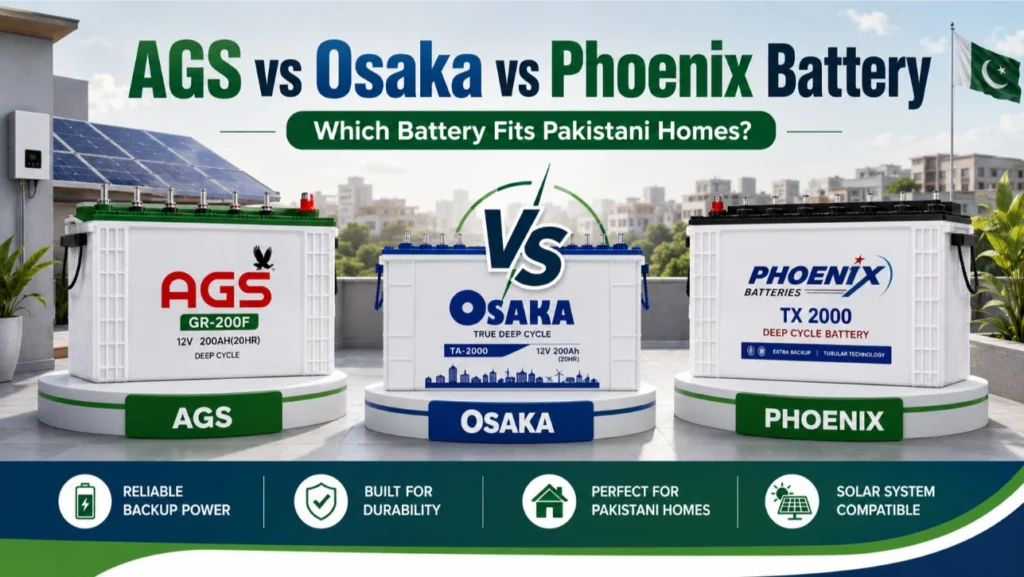
AGS vs Osaka vs Phoenix Battery Pakistan — Which Wet Battery Is Best?
AGS, Osaka, and Phoenix are Pakistan’s three most popular locally-manufactured tubular/wet lead-acid batteries. They power millions of UPS and solar systems across the country. Despite the rise of lithium batteries, these brands remain the dominant choice for budget-conscious buyers — typically costing Rs. 20,000–55,000 per unit vs Rs. 150,000+ for lithium. This guide compares all three brands so you can pick the right one for your home or business.
AGS vs Osaka vs Phoenix — Overview Comparison
| Factor | AGS | Osaka | Phoenix |
|---|---|---|---|
| Parent Company | Exide Pakistan Ltd. | Osaka Battery Pvt. Ltd. | Phoenix (Pvt) Ltd. |
| Manufacturing | 100% local | 100% local | 100% local |
| Battery Types | Tubular, AGM, SMF | Tubular, AGM, Gel | Tubular, SMF, AGM |
| Popular Solar Model | AGS UP200 (200AH) | Osaka TP200 (200AH) | Phoenix P200 (200AH) |
| 200AH Price Range | Rs. 45,000–55,000 | Rs. 38,000–48,000 | Rs. 40,000–50,000 |
| Warranty | 12–18 months | 12–18 months | 12–18 months |
| Expected Life (solar) | 3–5 years | 3–4 years | 3–5 years |
| Dealer Network | Widest in Pakistan | Strong nationwide | Strong nationwide |
AGS Batteries — Strengths & Weaknesses
Strengths
- Widest dealer network — AGS (made by Exide Pakistan) has the most extensive distribution of any battery brand in Pakistan — available in virtually every town
- Strong brand reputation — AGS has been in Pakistan’s market for decades with high consumer trust
- Tubular technology quality — AGS UP series tubular batteries are widely regarded as among the most durable locally-made options
- Service infrastructure — AGS/Exide has authorized service centers in major cities for warranty claims
Weaknesses
- Highest price — AGS UP200 typically costs Rs. 5,000–10,000 more than Osaka or Phoenix equivalents
- Heavy maintenance — Like all tubular batteries, requires monthly water top-ups
Osaka Batteries — Strengths & Weaknesses
Strengths
- Best value for money — Osaka TP200 offers the lowest price in the Rs. 38,000–48,000 range for comparable capacity
- Good solar performance — Osaka batteries perform well with solar charge controllers at C10 discharge rates typical of home solar setups
- Wide availability — Strong dealer presence nationwide, particularly strong in Punjab
Weaknesses
- Perception of lower build quality — Some installers report slightly lower plate quality vs AGS UP series
- Service network — Warranty claim experience varies more by region vs AGS
Phoenix Batteries — Strengths & Weaknesses
Strengths
- Competitive pricing — Phoenix P200 sits between Osaka and AGS in price — a mid-market value option
- Long track record — Phoenix has been manufacturing batteries in Pakistan for decades
- Phoenix SMF range — Phoenix’s sealed maintenance-free (SMF) range is popular for UPS systems that don’t allow wet batteries
Weaknesses
- Less differentiated vs competition — Doesn’t clearly lead AGS or Osaka on any specific metric
- Inconsistent quality reports — More variance in user reports vs AGS’s consistently strong tubular reputation
Which Battery Should You Buy?
| Your Priority | Recommendation |
|---|---|
| Best value / lowest price | ✅ Osaka TP200 |
| Best long-term reliability | ✅ AGS UP200 |
| Mid-range price with good availability | ✅ Phoenix P200 |
| Buying in a small city / town | ✅ AGS (widest dealer reach) |
| Sealed maintenance-free battery | ✅ Phoenix SMF or Osaka AGM |
⚠️ Lithium vs Wet Battery reminder: All three wet batteries require monthly water maintenance, last 3–5 years in solar applications, and are sensitive to deep discharge. If you can stretch to Rs. 150,000–200,000 per unit, a LiFePO4 lithium battery (Pylontech, Dyness, Knox) will last 10+ years maintenance-free and deliver significantly better ROI over a 10-year horizon.
Frequently Asked Questions
❓ Which battery is best for a 5kW solar system — AGS, Osaka, or Phoenix?
For a 5kW solar system, most buyers use 2 × 200AH tubular batteries in a 24V or 48V configuration. AGS UP200 is the most trusted choice for solar due to its deep cycle tubular design. Osaka TP200 is a solid budget alternative. Phoenix P200 is a reasonable middle ground. All three work — the bigger factor is the quality of your charge controller and inverter settings.
❓ How long do AGS, Osaka, and Phoenix batteries last with solar?
With proper charge controller settings and regular maintenance (monthly water top-ups, keeping at least 50% charge), tubular batteries from all three brands typically last 3–5 years in a solar application. The main causes of premature failure are overcharging (incorrect charge controller settings), deep discharge below 20%, and neglecting water maintenance in heat.
❓ Is AGS battery better than Osaka?
AGS UP series tubular batteries have a slight edge in build quality — specifically the thickness and quality of the tubular plates. This translates to marginally better deep cycle performance and longevity. However, Osaka costs Rs. 5,000–10,000 less per unit. For budget buyers who maintain batteries properly, Osaka offers competitive value. For buyers who want the most reliable option without thinking about it, AGS is the safer pick.
❓ Should I buy wet lead-acid or lithium for solar in Pakistan in 2026?
If budget allows lithium (Rs. 150,000+ per unit), it’s the better 10-year investment — zero maintenance, 3× the cycle life, no water top-ups, no damage from deep discharge. If your budget is under Rs. 100,000 for batteries, wet tubular (AGS, Osaka, or Phoenix) is the only practical option. Most Pakistani homeowners currently use wet batteries for cost reasons, with lithium adoption growing fast.
🔋 See battery prices in Pakistan
AGS battery prices → | Osaka battery prices → | Phoenix battery prices →
Sources & references
Tariff, net-metering, and policy details on this page draw on the following official sources. Rates change often, so confirm current figures with the relevant authority or a licensed installer before you decide.
- NEPRA — National Electric Power Regulatory Authority: electricity tariffs and the 2026 shift from net metering to net billing.
- AEDB — Alternative Energy Development Board: solar policy, installer standards, and net-metering guidance.
- Your local distribution company (DISCO) — for example LESCO, K-Electric, IESCO, MEPCO, PESCO or QESCO — for area-specific tariffs and the net-metering application process.