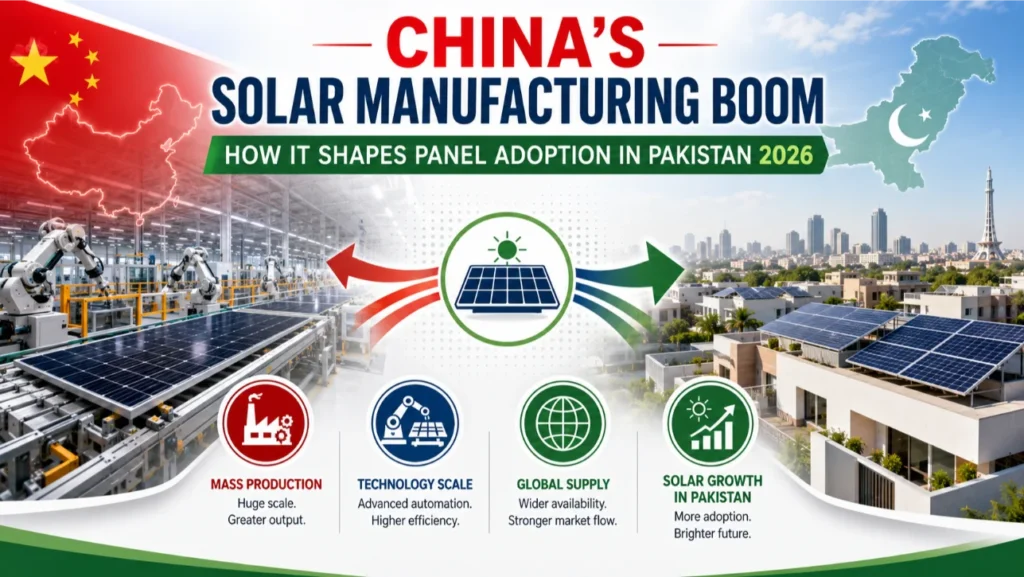
Why China’s Solar Manufacturing Boom Is Making Panels Cheaper in Pakistan 2026
How Much Have Solar Prices Fallen in Pakistan?
| Year | Mono PERC 550W Panel (Rs.) | 6kW Complete System (Rs.) |
|---|---|---|
| 2021 | Rs. 25,000–30,000 | Rs. 1,500,000–1,800,000 |
| 2022 | Rs. 22,000–26,000 | Rs. 1,300,000–1,600,000 |
| 2023 | Rs. 16,000–20,000 | Rs. 1,050,000–1,300,000 |
| 2024 | Rs. 11,000–15,000 | Rs. 900,000–1,100,000 |
| 2026 | Rs. 9,000–13,000 | Rs. 750,000–1,000,000 |
Why Did China Build So Much Solar Manufacturing?
China’s solar manufacturing dominance is the result of deliberate industrial policy executed over 15 years:
- Government subsidies: Chinese provincial and national governments provided massive subsidies — cheap land, discounted energy, low-interest loans — to solar manufacturers throughout the 2010s
- Domestic demand: China itself became the world’s largest solar market, giving manufacturers a huge home market to scale against
- Vertical integration: Chinese manufacturers control the entire supply chain — from polysilicon production to wafer slicing to cell manufacturing to module assembly — squeezing costs at every step
- Technology investment: LONGi, Jinko, JA Solar, and Trina Solar invested billions in R&D, achieving efficiency gains that further reduced cost-per-watt
The result: China now produces approximately 85% of the world’s solar panels. This scale has driven panel costs below $0.10/watt in some Chinese factory-gate prices — the lowest in history.
The Overcapacity Problem
China has built more solar manufacturing capacity than the world currently demands. In 2025–2026, global solar panel production capacity exceeded installed demand by approximately 2–3×. This surplus is the primary reason prices keep falling — manufacturers are competing aggressively on price for market share.
What This Means for Pakistani Buyers
- Prices are near their floor: The dramatic 50–65% falls of 2021–2025 are unlikely to repeat. Expect 5–15% more gradual declines over 2026–2028, then stabilization
- Now is a good time to buy: Prices are near historic lows. Waiting for further falls means years of missed electricity savings for marginal additional discounts
- Quality risk: When manufacturers compete on price, quality sometimes suffers. Buy from established brands (LONGi, Jinko, Canadian Solar, JA Solar) with verifiable factory-direct warranties rather than unknown brands selling ultra-cheap panels
- Pakistan benefits disproportionately: Pakistan imports virtually all panels from China — there are no import duties on solar panels. Pakistan gets the full benefit of Chinese manufacturing price reductions
Frequently Asked Questions
☀️ See today’s solar panel prices in Pakistan
Sources & references
Tariff, net-metering, and policy details on this page draw on the following official sources. Rates change often, so confirm current figures with the relevant authority or a licensed installer before you decide.
- NEPRA — National Electric Power Regulatory Authority: electricity tariffs and the 2026 shift from net metering to net billing.
- AEDB — Alternative Energy Development Board: solar policy, installer standards, and net-metering guidance.
- Your local distribution company (DISCO) — for example LESCO, K-Electric, IESCO, MEPCO, PESCO or QESCO — for area-specific tariffs and the net-metering application process.