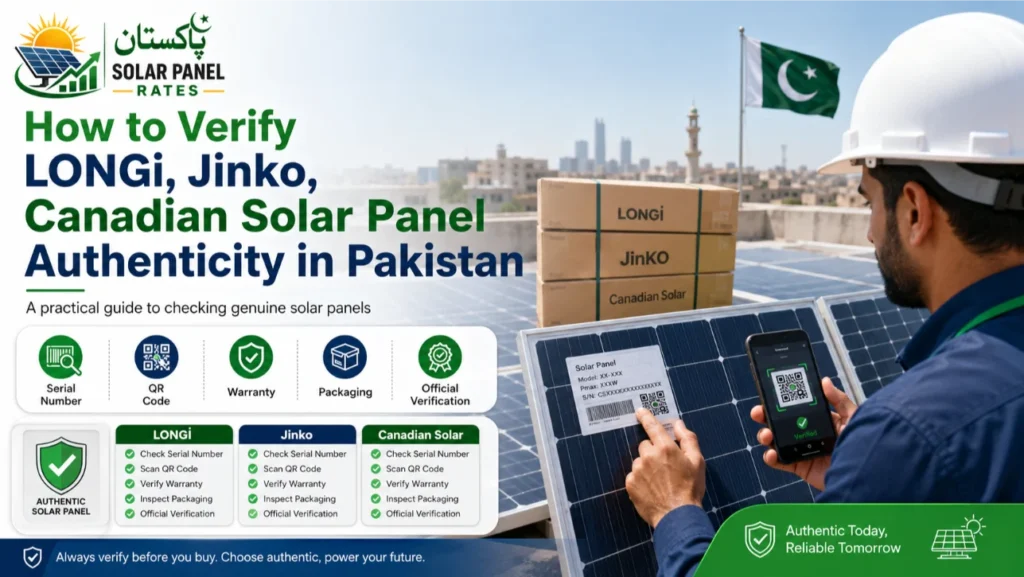
How to Verify LONGi, Jinko, Canadian Solar Panel Authenticity in Pakistan
Counterfeit and mislabelled solar panels are a real problem in Pakistan’s market. With hundreds of dealers selling panels and no universal verification system, some buyers unknowingly receive lower-wattage panels, rebranded generics, or outright fakes labelled as premium brands. This guide gives you the exact steps to verify authenticity before you pay.
Why Fake Solar Panels Exist in Pakistan
Chinese Tier-1 panel brands (LONGi, Jinko, JA Solar, Canadian Solar) carry premium prices because of their efficiency, warranty, and global certifications. A 550W LONGi Hi-MO 6 panel might cost Rs. 12,000–14,000, while a generic panel of the same physical size might cost Rs. 7,000–8,000. The price gap creates a strong incentive for unscrupulous dealers to relabel generic panels or sell lower-wattage panels as higher-wattage models.
Step-by-Step Verification Process
- Check the serial number on the panel itself — Every genuine LONGi, Jinko, Canadian Solar, and JA Solar panel has a serial number printed on a label on the back. The serial number should match the one on your purchase invoice and delivery documents.
- Verify on the manufacturer’s website — LONGi, Jinko, and Canadian Solar all have online serial number verification tools. Visit the brand’s official website, find the product verification section, and enter the serial number. A genuine panel will return its model, specs, and manufacturing date.
- Check the QR code — Most 2024–2026 generation panels have a QR code on the back label. Scan it with your phone. It should link to the manufacturer’s official verification page or return structured product data. A broken link, generic website, or no QR code is a red flag.
- Request the certificate of origin — Ask your dealer for the Certificate of Origin and customs clearance documentation. Genuine bulk imports come with COO documents from the country of manufacture. Legitimate dealers can provide these — fake panel sellers typically cannot.
- Match specifications on the datasheet — Download the official datasheet for the exact model number from the manufacturer’s website. Verify: wattage, Voc, Isc, dimensions, and weight. Physical measurements and the spec sheet should match precisely — a 550W panel won’t weigh 5kg less than a 550W datasheet states.
- Check for IEC and other certifications — Genuine panels from major brands carry IEC 61215, IEC 61730 certifications (listed on the back label). Check that certification numbers are real by cross-referencing with the certifying body if in doubt.
Brand-Specific Verification
| Brand | Verification Method | URL |
|---|---|---|
| LONGi | Serial number + QR on panel back | longi.com/en/product-verification |
| Jinko Solar | Serial number lookup + QR code | jinkosolar.com/verification |
| Canadian Solar | Product authentication portal | canadiansolar.com/authentication |
| JA Solar | QR code scan + serial lookup | jasolar.com/verification |
| Trina Solar | SN verification + QR | trinasolar.com/verification |
Red Flags to Watch For
- Dealer refuses to provide serial numbers before payment
- Serial number returns no result on manufacturer website
- Panel weight is significantly lower than datasheet specification
- No QR code or QR code links to a non-manufacturer website
- Price is 30%+ below market rate for that brand and model
- Dealer cannot provide Certificate of Origin or customs documentation
- Panel label printed on paper sticker rather than embedded label
⚠️ Important: Always verify at least 2–3 panel serial numbers from a batch — not just one. Fraudulent shipments sometimes mix genuine and fake panels. Spot-check multiple units from a delivery before signing off.
Frequently Asked Questions
❓ Is buying from an authorized distributor enough to guarantee authenticity?
Buying from manufacturers’ official authorized distributors is the safest approach — all major brands publish their official Pakistan distributor lists on their websites. However, even this isn’t 100% foolproof if a dealer purchases through unofficial channels and misrepresents themselves. Always do serial number verification regardless of who you buy from.
❓ Can I test a solar panel’s actual wattage output before buying?
Yes — a solar irradiance meter (pyranometer) combined with a clamp meter measuring actual output current allows you to verify approximate wattage under known sunlight conditions. Professional installers carry this equipment. Ask your installer to measure at least 2 panels from the batch on a clear midday day. Output within ±5% of rated power is acceptable (panels carry ±3% factory tolerance).
❓ What should I do if I received fake panels?
Document everything: photograph the panels, serial numbers, packaging, and delivery documents. Contact the brand’s Pakistan distributor and report the counterfeit. File a complaint with the Pakistan Standards and Quality Control Authority (PSQCA) and the Pakistan Electronic Media Regulatory Authority if applicable. Pursue legal action through consumer courts — Pakistan’s consumer protection laws cover counterfeit goods. Do not pay the remaining balance if any is outstanding.
❓ Are lower-tier Chinese brands automatically fake?
No — there are legitimate Tier-2 and Tier-3 Chinese brands that sell genuine products at lower prices. The fraud risk is specifically panels labelled as premium brands (LONGi, Jinko, Canadian Solar, etc.) that are actually generic panels. A panel honestly sold as “Risen Energy” or “Seraphim” at a lower price is legitimate — it’s the mislabelling of generics as Tier-1 brands that constitutes fraud.
☀️ Buy from verified sources — compare panel prices
Sources & references
Tariff, net-metering, and policy details on this page draw on the following official sources. Rates change often, so confirm current figures with the relevant authority or a licensed installer before you decide.
- NEPRA — National Electric Power Regulatory Authority: electricity tariffs and the 2026 shift from net metering to net billing.
- AEDB — Alternative Energy Development Board: solar policy, installer standards, and net-metering guidance.
- Your local distribution company (DISCO) — for example LESCO, K-Electric, IESCO, MEPCO, PESCO or QESCO — for area-specific tariffs and the net-metering application process.