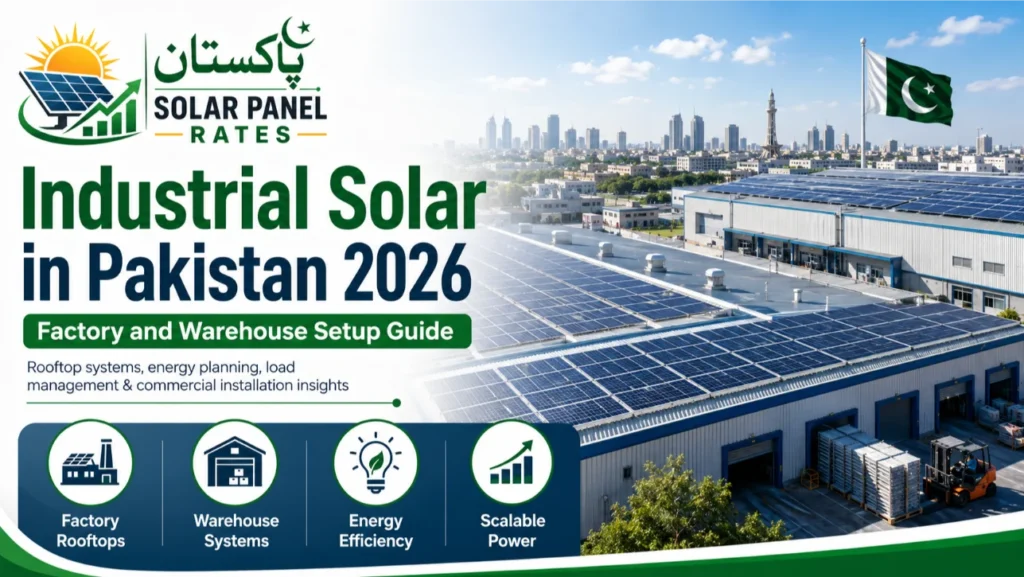
Industrial Solar in Pakistan 2026 — Factory and Warehouse Setup Guide
Why Industrial Solar Is Different
Industrial solar systems (50kW–10MW) operate at a fundamentally different scale and complexity than residential systems. They require 3-phase power, specialised string or central inverters, more complex safety and protection systems, NEPRA licensing for larger installations, and professional O&M contracts. The economics, however, are even more compelling than residential.
| Scale | System Size | Typical Application | Approx. Cost |
|---|---|---|---|
| Small commercial | 25–100 kW | Small factory, cold store, hotel | Rs. 5M–20M |
| Medium industrial | 100–500 kW | Mid-size factory, textile unit | Rs. 20M–100M |
| Large industrial | 500kW–2MW | Large factory, industrial estate | Rs. 100M–400M |
| Utility-scale | 2MW+ | Industrial park, major enterprise | Rs. 400M+ |
Key Design Considerations for Industrial Solar
Rooftop vs Ground-Mount
Factories and warehouses with large flat rooftops (10,000+ sq ft) are ideal for rooftop industrial solar. Ground-mount systems are used where roof space is insufficient or roof structural capacity is a concern. Large rooftop systems in Pakistan generate 80–150 kWh per kW installed annually — a 500kW rooftop system generates 40,000–75,000 kWh/month.
String Inverters vs Central Inverters
Systems up to 100kW typically use multiple string inverters (Growatt, Sungrow, Huawei 60–100kW units). Larger systems may use central inverters (250–630kW) which reduce component count and O&M complexity at the cost of single point of failure risk. Medium installations often use a distributed string architecture for better fault tolerance.
Grid Connection and NEPRA Licensing
Industrial net metering above 1MW requires NEPRA generation licensing (separate from DISCO net metering). Systems up to 1MW apply for net metering through the local DISCO. For systems exporting to the grid, a Grid Impact Study may be required by the DISCO. Engage a PPIB-enlisted EPC contractor who handles regulatory compliance as part of their scope.
Industrial Solar ROI in Pakistan
Industrial tariffs in Pakistan (2026) for medium-large consumers run Rs. 35–55/kWh. Solar generation cost (LCOE) for well-designed Pakistani industrial systems is Rs. 6–10/kWh over the system lifetime. The Rs. 25–45/kWh spread makes industrial solar the most financially compelling renewable investment in the country.
EPC Contractor Selection
- PPIB certification: Ensure the contractor is listed on PPIB’s approved vendor/installer list for commercial/industrial scale
- Proven industrial track record: Ask for case studies of completed industrial projects at similar scale with documented generation data
- Performance guarantees: Professional EPC contracts include performance ratio guarantees (typically PR ≥ 0.80) and generation warranties
- O&M scope: Industrial systems require professional O&M contracts — cleaning, inverter monitoring, thermal imaging, annual string testing
- Bankability: For bank-financed systems, the EPC contractor must provide performance bonds and equipment warranties acceptable to the financing bank
Frequently Asked Questions
⚡ Scale your industrial solar project
Sources & references
Where this page states a rule, a tariff or a registration requirement, it comes from the documents below. Links go to the document itself, not a homepage. Prices on this page come from our own daily rate feed, not from these sources.
- NEPRA (Prosumer) Regulations, 2026 — notified 6 August 2026. Sets the framework that replaced straight net metering with net billing. Under it, a prosumer facility of 25 kW or below does not need concurrence from the Authority.
- NEPRA net-metering licences — the register of issued distributed-generation and net-metering licences.
- Checklist for enlistment of installers under the AEDB (Certification) Regulations, 2021 — the actual requirements an installer must meet. Note that AEDB was dissolved and merged into PPIB in July 2023, so enlistment is handled by PPIB, even though the regulations still carry the AEDB name.
- Your distribution company — LESCO, MEPCO, FESCO, GEPCO, IESCO, PESCO, QESCO, HESCO, SEPCO or K-Electric — for the tariff that applies to your area and the net-metering application itself. K-Electric runs its own process, separate from the DISCOs.
Regulatory links last checked 4 October 2026. Rules change; confirm current figures with the authority or a licensed installer before you commit money.

Abubaker Jalil
Abubaker Jalil is an electrical engineer and a graduate of the University of Engineering and Technology (UET) Peshawar. He tracks panel, inverter and battery prices across Pakistan's wholesale solar markets and writes the buying guides on this site. If a dealer has quoted you a figure that does not match what you see here, write to info@solarpricepakistan.com.pk and it gets checked.