How to Apply for Net Metering in Pakistan 2026 — Step-by-Step Guide
What is Net Metering in Pakistan?
Net metering is a billing arrangement where your electricity meter runs backwards when your solar system generates more power than you use. The surplus units are exported to your DISCO’s grid and credited to your account at the retail tariff rate. At the end of each billing cycle, you pay only for your net consumption (imported units minus exported units).
Eligibility for Net Metering in Pakistan
- System capacity: 1kW to 1,000kW (1MW)
- System type: Grid-tied (on-grid) or hybrid solar systems
- Consumer categories: Residential, Commercial, Industrial, Agricultural
- Installer must be AEDB-licensed
- Equipment must meet NEPRA-approved standards
Step-by-Step Application Process
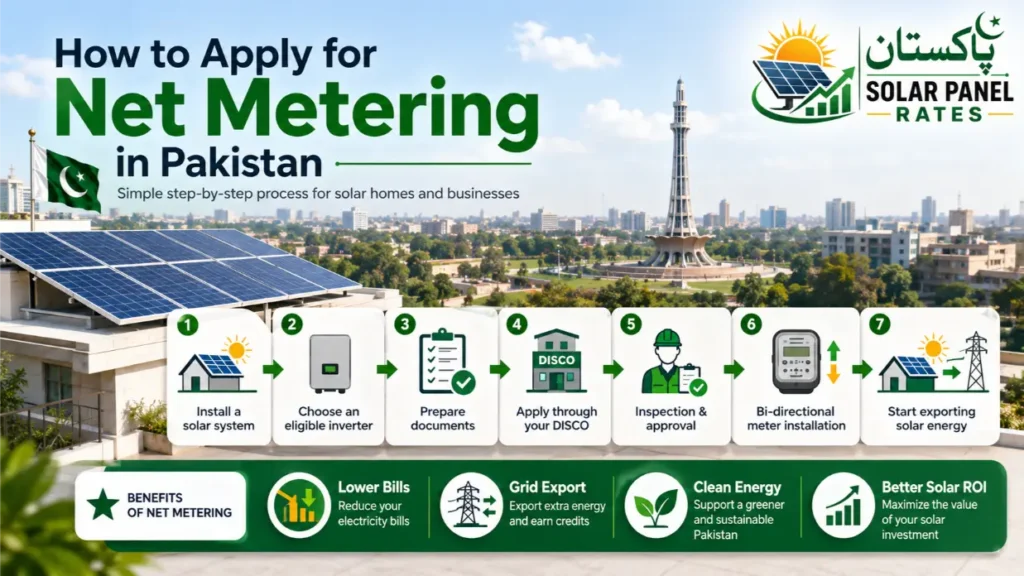
- Install your solar system — Hire an AEDB-licensed installer. Installation takes 1–3 days.
- Obtain AEDB Generation License — Your installer applies for an AEDB generation license (systems under 25kW are exempt). Takes 2–4 weeks.
- Submit application to your DISCO — File the net metering application at your local DISCO office (LESCO, HESCO, FESCO, MEPCO, IESCO, PESCO, QESCO, GEPCO, or SEPCO) with all required documents.
- Technical inspection — DISCO engineers visit your site to inspect the installation. Typically within 7–21 days of application.
- Bidirectional meter installation — After approval, DISCO replaces your standard meter with a bidirectional meter. Cost: Rs 15,000–25,000 (borne by consumer).
- Net metering agreement signed — Sign the Net Metering Connection Agreement with the DISCO. Your system is now officially live.
Documents Required for Net Metering Application
| Document | Details |
|---|---|
| CNIC copy | Applicant’s national identity card |
| Electricity bill copy | Latest 3 months’ bills from your DISCO |
| AEDB license / NOC | Your installer’s AEDB license number |
| Single-line diagram (SLD) | Electrical diagram of your solar system — prepared by installer |
| Equipment specifications | Datasheet of panels and inverter with model numbers |
| Site photographs | Photos of installed panels, inverter, and metering location |
| Net metering application form | Available from DISCO office or their website |
Net Metering Costs (2026)
| Cost Item | Amount |
|---|---|
| Bidirectional meter | Rs 15,000–25,000 |
| AEDB license fee (if required) | Rs 5,000–15,000 |
| Application processing fee | Rs 1,000–3,000 (varies by DISCO) |
| Total extra cost | Rs 20,000–40,000 |
How Long Does Net Metering Take in Pakistan?
From application submission to live net metering, the typical timeline is 4–8 weeks for residential consumers. LESCO (Lahore) and IESCO (Islamabad) tend to be faster (3–5 weeks). HESCO and QESCO may take up to 10–12 weeks.
Net Metering Tariff Rates in Pakistan 2026
Under NEPRA regulations, exported solar units are credited at the applicable retail tariff rate for your consumer category — approximately Rs 45–58/unit for domestic consumers. Units exported beyond your monthly consumption roll over as a monetary credit on your next bill.
Frequently Asked Questions
Check our Solar Panel Prices and System Size Guides to plan your system before installation.
Sources & references
Tariff, net-metering, and policy details on this page draw on the following official sources. Rates change often, so confirm current figures with the relevant authority or a licensed installer before you decide.
- NEPRA — National Electric Power Regulatory Authority: electricity tariffs and the 2026 shift from net metering to net billing.
- AEDB — Alternative Energy Development Board: solar policy, installer standards, and net-metering guidance.
- Your local distribution company (DISCO) — for example LESCO, K-Electric, IESCO, MEPCO, PESCO or QESCO — for area-specific tariffs and the net-metering application process.