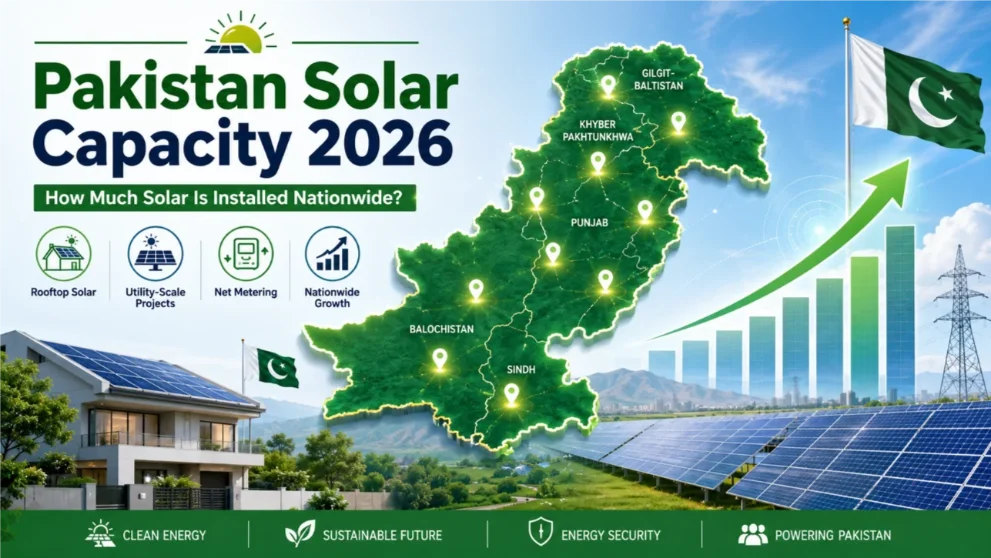
Pakistan Solar Capacity 2026 — How Much Solar Is Installed Nationwide?
Pakistan has undergone one of the world’s fastest solar adoption surges between 2022 and 2026, driven by soaring electricity tariffs, widespread load shedding, and dramatic falls in panel prices. This data-driven guide covers how much solar capacity Pakistan has installed, how it’s distributed, and where the country is heading on its renewable energy journey.
Pakistan’s Total Solar Capacity — Key Figures (2026)
| Category | Installed Capacity (Est.) | Notes |
|---|---|---|
| Utility-scale solar (grid-connected) | ~3,500 MW | Quaid-e-Azam Solar Park and other IPPs |
| Rooftop / distributed solar (net metered) | ~2,800 MW | Residential + commercial, as of early 2026 |
| Off-grid solar (rural, non-metered) | ~1,200 MW (est.) | Unregistered — actual figure likely higher |
| Total estimated solar | ~7,500 MW+ | Pakistan’s largest renewable source |
📊 Context: Just 3 years ago in 2022, Pakistan’s total solar capacity was estimated at under 1,500 MW. The 5x growth in 3 years is primarily driven by the rooftop solar boom — Pakistan’s tariff crisis made solar economically irresistible for middle-class households.
Solar Panel Imports — Volume Data
Pakistan has become one of the world’s largest importers of solar panels by volume. Customs and trade data shows:
- Pakistan imported an estimated 10–12 GW worth of solar panels in 2023 alone — among the top 5 globally
- The vast majority came from Chinese manufacturers (Longi, Jinko, JA Solar, Trina, Canadian Solar)
- Import volumes in 2024–2025 moderated slightly as domestic installation pace was digested
- Most imported panels are 550W–600W mono PERC and TOPCon modules
Net Metering Connections — DISCO Data
| DISCO | Net Metered Connections (Est. 2026) | Growth (2023–2026) |
|---|---|---|
| LESCO (Lahore) | ~180,000+ | +400% |
| IESCO (Islamabad) | ~95,000+ | +350% |
| MEPCO (Multan) | ~120,000+ | +300% |
| FESCO (Faisalabad) | ~110,000+ | +320% |
| GESCO (Gujranwala) | ~85,000+ | +280% |
| HESCO (Hyderabad) | ~45,000+ | +250% |
| PESCO (Peshawar) | ~65,000+ | +380% |
| All DISCOs combined | ~750,000+ | +330% avg. |
Figures are estimates based on publicly available NEPRA and AEDB data — actual figures may vary.
💡 Pakistan’s solar boom is remarkable: Pakistan now has more rooftop solar connections than most developed European countries — driven not by climate policy but by tariff economics and load shedding. The payback period of 3.5–5 years at current rates makes solar essentially mandatory for any middle-class household.
Quaid-e-Azam Solar Park — Pakistan’s Largest Project
Located in Bahawalpur, Punjab, the Quaid-e-Azam Solar Park is one of the largest solar installations in Asia. Key facts:
- Total target capacity: 1,000 MW (currently ~600 MW operational)
- Located in the Cholistan desert — exceptional solar irradiance year-round
- Panels supplied by Chinese manufacturers; operations managed by QASP
- Feeds directly into the national grid under NTDC’s transmission system
- Has significantly reduced Pakistan’s dependence on expensive HFO-based generation during peak daylight hours
Pakistan’s Solar Energy Targets
| Target | Goal | Status |
|---|---|---|
| ARE Policy 2019 target | 30% renewable energy by 2030 | On track (solar + wind) |
| AEDB rooftop solar target | 10 GW rooftop by 2030 | ~2.8 GW achieved — on track |
| Total renewable capacity 2030 | 60% of electricity from renewables | Ambitious — requires policy continuity |
Frequently Asked Questions
❓ How much solar capacity does Pakistan have in 2026?
Pakistan’s total solar capacity across utility-scale, rooftop net-metered, and off-grid systems is estimated at 7,000–8,000 MW (7–8 GW) in 2026. This makes solar Pakistan’s largest renewable energy source, surpassing hydro on an installed capacity basis (though hydro still generates more annual kWh due to higher capacity factors).
❓ Where is Pakistan’s largest solar farm?
The Quaid-e-Azam Solar Park in Bahawalpur, Punjab, is Pakistan’s largest solar installation at ~600 MW currently operational, with a 1,000 MW target. Pakistan is also developing additional large-scale solar projects in Sindh and Balochistan under CPEC and independent power producer frameworks.
❓ Is Pakistan’s solar growth helping reduce electricity prices?
At the household level, yes — rooftop solar users have dramatically reduced their bills. However, at the grid level, Pakistan faces a “capacity payment paradox” — it pays fixed capacity charges to thermal IPPs regardless of whether their power is used, meaning solar cannot reduce capacity payments in the short term. Grid-level tariff relief requires power purchase agreement renegotiation.
❓ Which province has the most solar installations in Pakistan?
Punjab leads in total rooftop solar installations due to its population size and LESCO/MEPCO/FESCO coverage. However, Balochistan and Khyber Pakhtunkhwa have the highest solar irradiance and are growing fastest in per-capita adoption. The Quaid-e-Azam Solar Park also makes Punjab the leader in utility-scale solar.
🌞 Join Pakistan’s solar revolution
Check current prices and see what a solar system costs for your home.
Today’s panel prices → | 5kW system guide → | All inverter brands →
Sources & references
Tariff, net-metering, and policy details on this page draw on the following official sources. Rates change often, so confirm current figures with the relevant authority or a licensed installer before you decide.
- NEPRA — National Electric Power Regulatory Authority: electricity tariffs and the 2026 shift from net metering to net billing.
- AEDB — Alternative Energy Development Board: solar policy, installer standards, and net-metering guidance.
- Your local distribution company (DISCO) — for example LESCO, K-Electric, IESCO, MEPCO, PESCO or QESCO — for area-specific tariffs and the net-metering application process.