Solar Panel Payback Period Pakistan 2026 — Real ROI Calculations
How long does it actually take for a solar system to pay for itself in Pakistan? With electricity prices rising to Rs 45–70/unit in 2026 and solar costs dropping, the payback period has never been shorter. This guide gives you real numbers — not estimates — based on current Pakistan electricity rates and solar system costs.
What is Solar Payback Period?
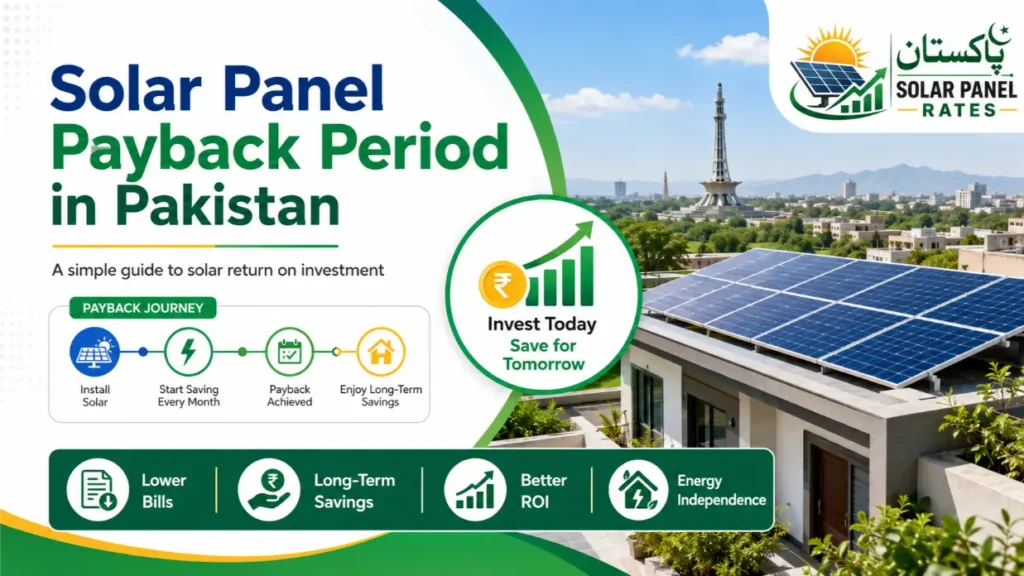
The payback period is the time it takes for your cumulative electricity savings to equal your initial solar investment. After payback, all savings are pure profit for the remaining 20–25 years of the system’s life.
Formula: Payback Period = Total System Cost ÷ Annual Electricity Savings
Real Payback Calculations — Pakistan 2026
Scenario 1: 3kW On-Grid System (Small Home — Lahore)
| Item | Value |
|---|---|
| System cost | Rs 4,20,000 |
| Monthly generation | 350 units |
| Monthly saving (@ Rs 50/unit avg) | Rs 17,500 |
| Annual saving | Rs 2,10,000 |
| Payback period | 2.0 years |
Scenario 2: 5kW Hybrid System (Medium Home — Lahore)
| Item | Value |
|---|---|
| System cost (with 10kWh battery) | Rs 8,50,000 |
| Monthly generation | 580 units |
| Monthly saving (@ Rs 52/unit avg) | Rs 30,160 |
| Saved generator/UPS cost | Rs 5,000/month |
| Total monthly benefit | Rs 35,160 |
| Annual benefit | Rs 4,21,920 |
| Payback period | 2.0 years |
Scenario 3: 10kW On-Grid Commercial System
| Item | Value |
|---|---|
| System cost | Rs 12,00,000 |
| Monthly generation | 1,150 units |
| Monthly saving (@ Rs 65/unit commercial) | Rs 74,750 |
| Annual saving | Rs 8,97,000 |
| Payback period | 1.3 years |
25-Year Return on Investment (5kW Hybrid)
| Period | Savings |
|---|---|
| Year 1–2 (payback) | Rs 7,00,000 (recovers investment) |
| Year 3–10 (8 years profit) | Rs 28,00,000+ (accounting for 5% annual tariff increase) |
| Year 11–25 (15 years profit) | Rs 65,00,000+ (after inverter replacement ~Rs 1,20,000) |
| 25-year net profit | Rs 85–95 lakh on an Rs 8.5 lakh investment |
📊 Key factor: Pakistan’s electricity tariffs have increased 15–25% per year since 2022. Each tariff hike increases the value of your solar savings, shortening the effective payback period and boosting long-term ROI.
What Affects Your Payback Period?
- Electricity tariff — higher tariff = faster payback
- Solar generation — more sun hours (Karachi, Multan) = faster payback
- Net metering — maximizes savings vs self-consumption only
- System quality — better panels degrade less (0.4%/year vs 0.7%/year for cheap panels)
- Load shedding cost savings — hybrid systems eliminate generator/UPS costs
Frequently Asked Questions
❓ What is the payback period for solar in Pakistan in 2026?
The payback period for solar systems in Pakistan in 2026 ranges from 1.5–3 years for on-grid systems and 2–4 years for hybrid systems with batteries. Commercial users on higher tariffs can achieve payback in under 18 months.
❓ Is solar investment worth it in Pakistan?
Absolutely. With payback periods under 2–3 years and system lifespans of 25+ years, solar is one of the best returns on investment available in Pakistan. Rising electricity tariffs make the investment more valuable every year.
❓ Does a hybrid solar system have a longer payback period?
Yes — a hybrid system costs Rs 1.5–3 lakh more than on-grid due to batteries, adding 6–12 months to the payback period. However, eliminating generator and UPS costs (Rs 3,000–8,000/month) often offsets the battery cost, keeping the total payback under 3 years.
See full system costs to calculate your exact payback.Check our 5kW, 8kW, and 10kW system price guides for accurate 2026 cost figures.
Sources & references
Tariff, net-metering, and policy details on this page draw on the following official sources. Rates change often, so confirm current figures with the relevant authority or a licensed installer before you decide.
- NEPRA — National Electric Power Regulatory Authority: electricity tariffs and the 2026 shift from net metering to net billing.
- AEDB — Alternative Energy Development Board: solar policy, installer standards, and net-metering guidance.
- Your local distribution company (DISCO) — for example LESCO, K-Electric, IESCO, MEPCO, PESCO or QESCO — for area-specific tariffs and the net-metering application process.