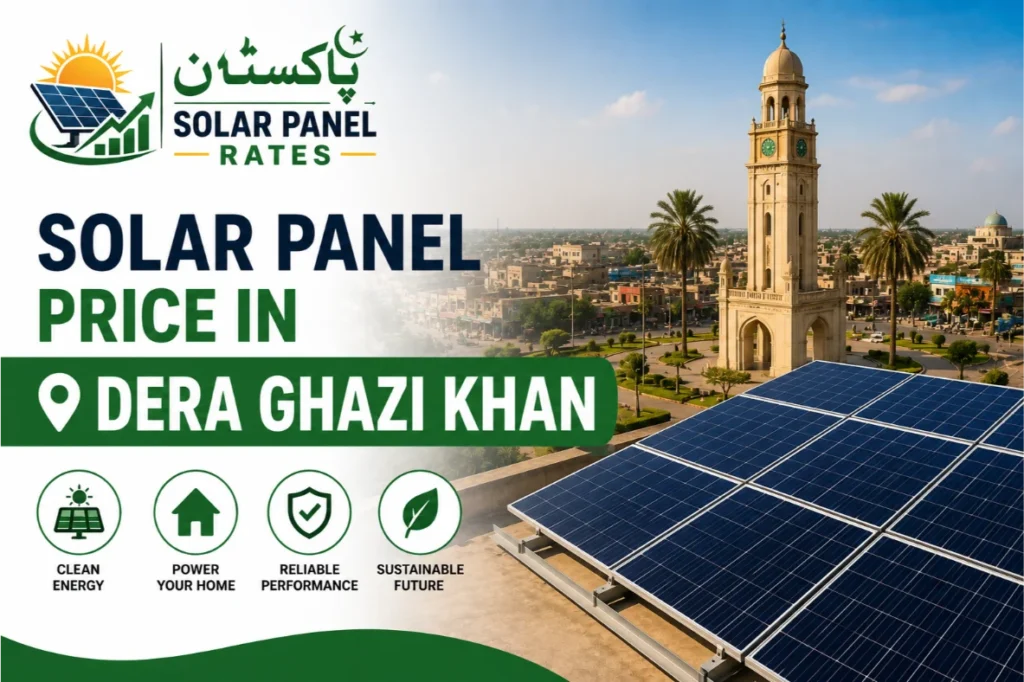
Solar Panel Price in Dera Ghazi Khan 2026 — South Punjab Market Rates
Dera Ghazi Khan regularly records Pakistan’s highest temperatures (48–52°C in summer). With MEPCO load shedding running 8–14 hours daily and a vast farming community dependent on tube well irrigation, solar has become essential rather than optional. DG Khan is one of Pakistan’s most important agricultural solar markets.
Solar Panel Prices in DG Khan — July 2026
What makes Dera Ghazi Khan different for solar
Dera Ghazi Khan sits where the south Punjab plain meets the Sulaiman mountains and the tribal belt, and it is one of the hotter, drier districts in the country. Summers are severe, regularly in the mid-40s, so air conditioning runs hard and consumption climbs just as the heat trims panel efficiency. The district is heavily agricultural — cotton, wheat, and dates — with a cement plant and other industry nearby, so solar demand ranges from home rooftops to tube wells to commercial loads.
The sun is a real strength. D.G. Khan gets roughly 5.3 to 5.6 peak sun hours a day averaged over the year, among the highest in Punjab, on a dry plain with clear skies for most months. Dust off the surrounding land and the occasional dust storm settle on panels quickly, so cleaning discipline matters. Electricity comes from MEPCO, whose supply here carries real load shedding, which is part of why solar has spread fast.
Because heat and outages are both significant, many D.G. Khan systems are hybrids with battery storage, built to keep cooling running through the cuts as well as to cut the bill.
Where solar is sold in Dera Ghazi Khan
D.G. Khan’s electrical and solar trade sits around the central commercial area and main roads:
- Block 20 and the central commercial area: the main trading hub, with electrical, hardware, and solar dealers.
- Jampur Road and Multan Road: retail solar showrooms and full-service companies serving nearby homes.
- Railway Road and the old bazaars: wholesale electrical goods, wiring, and accessories at trade rates.
- Agricultural supply markets on the outskirts: dealers who handle solar tube-well and farm systems.
Many buyers also source from Multan for wider choice on larger orders. Whatever the quote, check the equipment cost against our daily rate tracker.
Solar dealers in Dera Ghazi Khan
The dealers below serve Dera Ghazi Khan buyers. Confirm current pricing and stock directly, ask for an itemised written quote, and check AEDB registration before paying any advance.
| Company | Google rating | Area | Phone |
|---|---|---|---|
| DGK Solar & Renewable Energy | 4.8 ★ | Block 15, near Company Bagh Gate, Dera Ghazi Khan | 0300 6789012 |
| Hadron Solar DG Khan | 4.8 ★ | Main Jampur Road, Dera Ghazi Khan | 0311 1100500 |
| Ziewnic Solar (DG Khan outlet) | 4.7 ★ | Manka Canal Road, near Pull Phtay Wali, Dera Ghazi Khan | 0311 1000666 |
| Solar Max DG Khan | 4.6 ★ | Block A, Main Market, Dera Ghazi Khan | 0300 8661661 |
| Inverex Solar Sales Center DG Khan | 4.5 ★ | Hospital Road, Dera Ghazi Khan | 0311 1333150 |
| SkyElectric Dera Ghazi Khan | 4.3 ★ | Main Multan Road, near College Chowk, Dera Ghazi Khan | 0800 77759 |
Ratings and contact details as verified on Google. Listed for buyer convenience — we are not affiliated with these companies and take no commission. Confirm AEDB registration and get a written, itemised quote directly with each before you buy.
Installation cost in Dera Ghazi Khan
Because many D.G. Khan systems are hybrids with battery storage, the total cost here often runs a little higher than a plain on-grid system elsewhere. The balance-of-system and labour on top of panels, inverter, and battery run roughly:
| Item | Typical D.G. Khan cost | Notes |
|---|---|---|
| Installation labour | Rs. 8,000 – 13,000 per kW | Hybrid and battery wiring adds a little to the job |
| Mounting structure | Rs. 10,000 – 18,000 per kW | Standard galvanised structure suits the dry climate; leave airflow under panels to fight heat |
| DC/AC wiring, DB, breakers, earthing | Rs. 25,000 – 55,000 | Battery and changeover wiring included on hybrid systems |
| Net metering (meter + application + processing) | Rs. 60,000 – 85,000 | MEPCO bi-directional meter and connection charges |
| Surge protection | Rs. 6,000 – 15,000 | Recommended, particularly on rural feeders |
For a home system, budget around Rs. 42,000 to Rs. 68,000 per kW for labour and balance-of-system above the panel, inverter, and battery cost. A fully installed 5kW hybrid system with a lithium battery and net metering in Dera Ghazi Khan generally lands between Rs. 820,000 and Rs. 1,050,000. Use our calculator for a figure matched to your cooling load and backup needs.
MEPCO net metering in Dera Ghazi Khan
D.G. Khan’s grid is run by MEPCO, so net metering files go to your local MEPCO office. The 2026 rule change applies here in full: NEPRA has replaced net metering with net billing for new connections. Systems approved after 9 February 2026 export surplus units at a buyback rate of about Rs. 11 per unit on a five-year contract, rather than the old one-for-one exchange. Anyone who already held a valid net metering agreement before that date keeps the earlier terms until it expires.
With such heavy cooling demand and load shedding, most systems here are built to power the home directly rather than to sell a big surplus to MEPCO. A battery that keeps the ACs running through the cuts, and shifts daytime generation into the evening, is worth more than extra panels aimed at grid export.
How to apply in Dera Ghazi Khan
- Install an AEDB-standard system through a licensed installer.
- Submit the application to MEPCO, usually through your installer.
- MEPCO inspects and approves the connection.
- A bi-directional meter is installed.
- Your monthly bill nets imported units against exported units.
MEPCO processing generally takes two to four months. Ask your installer to handle the file and put the timeline in writing.
Recommendations for Dera Ghazi Khan homes and farms
D.G. Khan’s extreme heat, strong sun, and dust point to a clear setup:
- Buy heat-tolerant N-type panels and give them airflow. In mid-40s summers a low temperature coefficient plus an airflow gap under the array holds output up. LONGi, Jinko Tiger Neo, and JA N-type all suit the heat.
- Go hybrid with a battery. Between the heat and the load shedding, a hybrid inverter and battery are what keep your cooling running through the cuts.
- Clean regularly. Dust settles fast on this dry plain, so a wash every one to two weeks in the dry season protects output.
- For tube wells, size to the pump and the sun. The strong midday sun suits solar pumping; use an installer with real farm-system experience.
- Right-size by bill: a home with a Rs. 30,000–50,000 monthly MEPCO bill running several ACs is usually well served by a 6–10kW hybrid system.
Seasonal output and payback in Dera Ghazi Khan
D.G. Khan’s strong sun gives it high output most of the year, with heat and dust the main things that trim it. The figures below are rough planning numbers for a 5kW system locally, and assume the panels are kept clean.
| Season | Conditions | Approx. 5kW daily output |
|---|---|---|
| Spring (Mar–May) | Clear, hot, long days | 25–28 units |
| Summer (Jun–Aug) | Extreme heat, dust, brief monsoon | 22–26 units (heat trims efficiency) |
| Autumn (Sep–Nov) | Clear and stable | 24–27 units |
| Winter (Dec–Feb) | Mild days, some fog, short days | 16–20 units |
Kept clean, a D.G. Khan system holds output well across the year, helped by a fairly mild winter. For a home with a Rs. 35,000-plus monthly MEPCO bill, a well-sized hybrid system generally pays back in roughly two to three years, before counting the comfort of keeping the ACs on through load shedding. Under the 2026 net-billing rules, the best returns come from powering your own home and carrying the evening on a battery.
Before you buy solar in Dera Ghazi Khan — quick checklist
- Check today’s panel rates on our live tracker before accepting any dealer quote.
- Buy heat-tolerant N-type panels and ask for an airflow gap under the array.
- Plan a hybrid inverter and battery to keep cooling running through MEPCO load shedding.
- Plan frequent cleaning — dust cuts output fast on this dry plain.
- Get a fully itemised written quote, and do not pay a large advance before work begins.
- Confirm your installer is AEDB registered and will handle the MEPCO net metering file.
Dera Ghazi Khan solar FAQs
Do I need a battery for solar in Dera Ghazi Khan?
For most homes, yes. Between the heat and MEPCO load shedding, a hybrid inverter and battery are what keep your cooling running through the cuts. Size the battery to the evening AC load you most want to keep.
Which panels handle D.G. Khan’s heat best?
N-type modules with a low temperature coefficient, such as LONGi, Jinko Tiger Neo, and JA N-type, lose less output in the heat than older PERC panels and are widely stocked in the region.
How often should I clean panels in D.G. Khan?
Every one to two weeks in the dry season, and more after a dust storm. Dust settles fast on this dry plain and cuts output if left.
How did MEPCO net metering change in 2026?
New connections now use net billing, buying surplus back at around Rs. 11 per unit on a five-year contract instead of the old unit exchange. Older agreements keep their earlier terms. Powering your own home now beats exporting.
What does a 5kW hybrid system cost installed in D.G. Khan?
Roughly Rs. 820,000 to Rs. 1,050,000 with a lithium battery and net metering. Larger systems are common given the cooling load; check the panel and battery portions against our daily rates.
Sources & references
Tariff, net-metering, and policy details on this page draw on the following official sources. Rates change often, so confirm current figures with the relevant authority or a licensed installer before you decide.
- NEPRA — National Electric Power Regulatory Authority: electricity tariffs and the 2026 shift from net metering to net billing.
- AEDB — Alternative Energy Development Board: solar policy, installer standards, and net-metering guidance.
- Your local distribution company (DISCO) — for example LESCO, K-Electric, IESCO, MEPCO, PESCO or QESCO — for area-specific tariffs and the net-metering application process.