
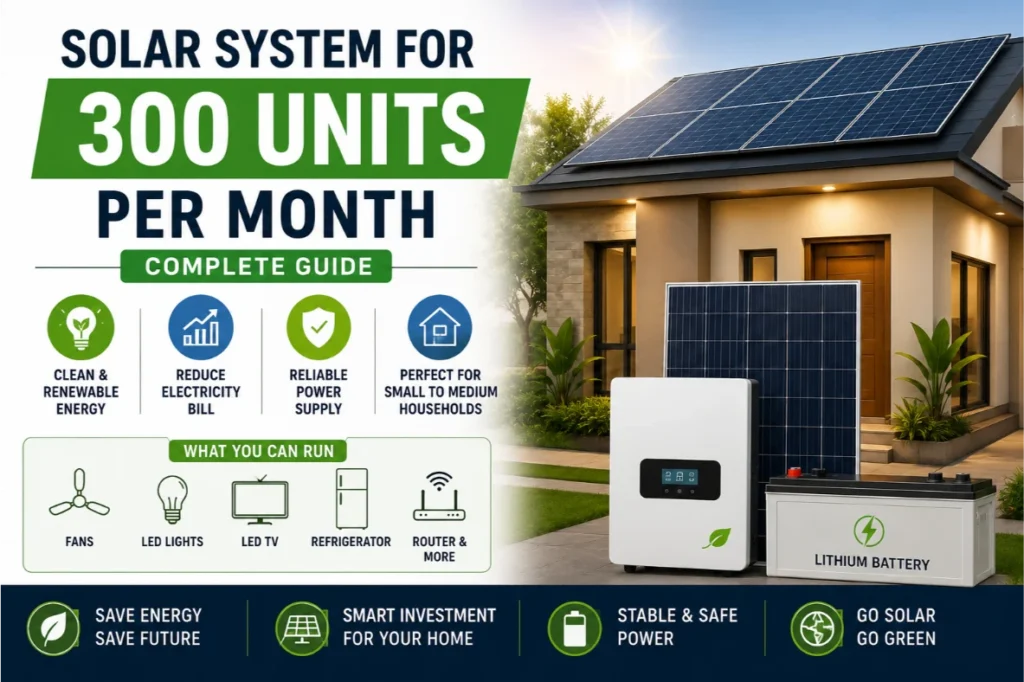
Solar System for 300 Units Per Month in Pakistan 2026
If your electricity meter shows 300 units consumed per month, here is exactly what size solar system you need, what it costs, and how quickly it pays back. Updated July 2026 with current market prices.
What System Size Covers 300 Units/Month?
| Monthly Units | System Size | On-Grid Price (PKR) | Monthly Savings (est.) |
|---|---|---|---|
| 300 units | 3kW | Rs 240,000–270,000 | Rs 12,000–16,000 |
How System Size Is Calculated from Monthly Units
Solar system size (kW) = Monthly units ÷ (30 days × peak sun hours × 0.8 efficiency). In Pakistan with 5 peak sun hours:
| Monthly Units | Formula | System Size Needed |
|---|---|---|
| 200 units | 200 ÷ (30 × 5 × 0.8) | 1.67 kW → 2 kW |
| 300 units | 300 ÷ (30 × 5 × 0.8) | 2.5 kW → 3 kW |
| 500 units | 500 ÷ (30 × 5 × 0.8) | 4.17 kW → 5 kW |
| 700 units | 700 ÷ (30 × 5 × 0.8) | 5.83 kW → 6–7 kW |
| 1,000 units | 1000 ÷ (30 × 5 × 0.8) | 8.33 kW → 10 kW |
Add 15–20% extra to account for dust losses, cable losses, and peak summer demand variations. Pakistan’s summer peak can push consumption 30–40% higher than winter months.
What’s Included in a 3kW Solar System?
- Solar panels: sufficient wattage to produce 300+ units/month
- On-grid string inverter or hybrid inverter
- Hot-dip galvanised mounting structure
- AC/DC wiring, circuit breakers, SPDs
- DISCO net meter (bidirectional)
- 5-year installation warranty, 25-year panel performance warranty
Net Metering: How Your Bill Works After Solar
With NEPRA net metering, surplus units exported to the grid are credited at the same rate you pay. During winter or low-consumption months, your export credits roll over to the next billing cycle.
Frequently Asked Questions
Get a Free Quote for 300 Units/Month Solar System
Use our calculator or speak to an AEDB-licensed installer in your city.
Who Needs a 300-Unit Solar System?
A household using around 300 units (kWh) a month is typically a small family in a 1–2 bedroom home running the everyday essentials: fans, lights, a refrigerator, a TV, phone charging and a water pump, with little or no air-conditioning. If you run an inverter AC for a few hours in summer, your usage is likely closer to the 500 units per month or 700 units per month range instead, so check a few recent bills before sizing your system.
What a 3kW System for 300 Units Actually Contains
To offset roughly 300 units a month you need about a 3kW solar array. In practice that means:
- Panels: 5–6 panels of 550–585W (N-Type is now the value sweet spot), totalling ~3–3.3kW.
- Inverter: a 3kW hybrid or on-grid inverter.
- Mounting & wiring: structure, DC/AC cabling, breakers and earthing.
- Battery (optional): only if you want backup during load-shedding — a single 3–5kWh lithium unit is enough for a home this size.
With Battery vs Without — for a 300-Unit Home
On a grid-tied 3kW system with net metering (no battery), you export surplus daytime power and draw from the grid at night, keeping the upfront cost lowest. Adding one lithium battery raises the price by roughly Rs 115,000–160,000 but keeps your fans, lights and fridge running through outages. For a modest 300-unit home, most buyers start without a battery and add one later if load-shedding is a problem.
Payback for a 300-Unit System
At an installed cost of about Rs 240,000–270,000 and monthly savings of roughly Rs 12,000–16,000, a 3kW system for a 300-unit home typically pays for itself in around 16–22 months — after which the electricity is effectively free for the 20–25 year life of the panels. Payback is fastest if you use most of your power during daylight hours.
Related Sizing Guides
- Solar system for 500 units per month
- Solar system for 700 units per month
- What size system a 5 marla house needs
- Solar price calculator
Is 300 units a month a small or large household?
It’s on the smaller side. A 300-unit home usually runs essentials without heavy air-conditioning. Homes with one or more inverter ACs running daily typically use 500–1,000+ units a month and need a larger system.
How many solar panels do I need for 300 units per month?
About 5–6 modern panels (550–585W each) make up the ~3kW needed to offset 300 units per month, depending on your roof’s sunlight and the exact panel wattage.
Sources & references
Tariff, net-metering, and policy details on this page draw on the following official sources. Rates change often, so confirm current figures with the relevant authority or a licensed installer before you decide.
- NEPRA — National Electric Power Regulatory Authority: electricity tariffs and the 2026 shift from net metering to net billing.
- AEDB — Alternative Energy Development Board: solar policy, installer standards, and net-metering guidance.
- Your local distribution company (DISCO) — for example LESCO, K-Electric, IESCO, MEPCO, PESCO or QESCO — for area-specific tariffs and the net-metering application process.