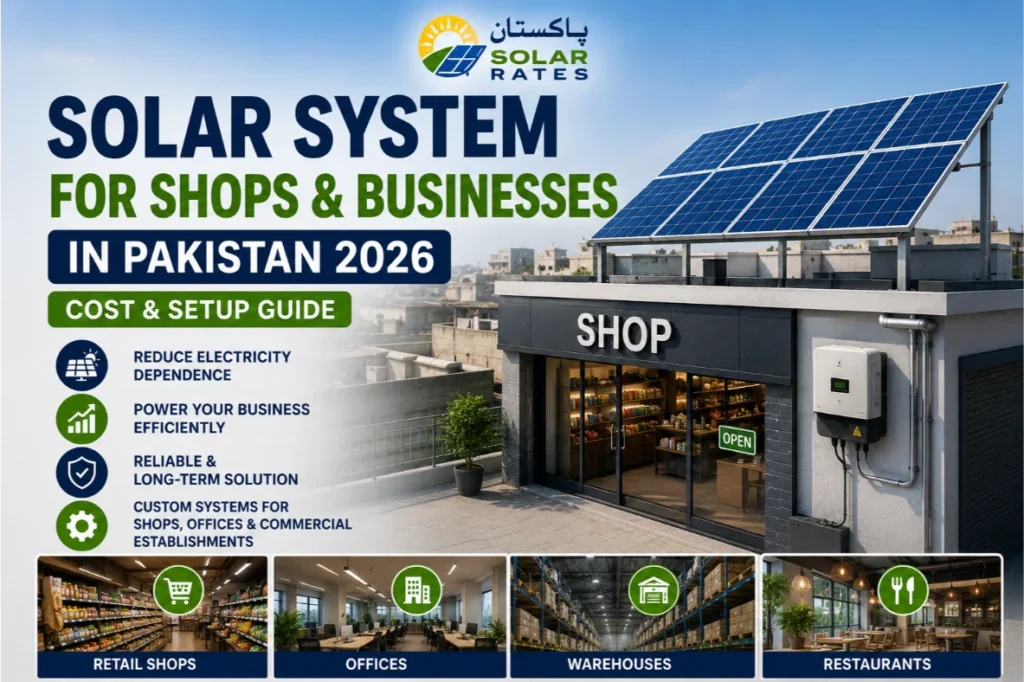
Solar System for Shops and Businesses in Pakistan 2026 — Cost & Setup Guide
Solar Makes Strong Business Sense in 2026
Commercial electricity tariffs in Pakistan are higher than domestic rates, making solar even more financially attractive for businesses. A commercial consumer paying Rs. 35–45 per kWh saves more per solar kWh generated than a domestic consumer paying Rs. 20–30/kWh.
| Business Type | Typical Monthly Bill | Recommended System | Est. Monthly Saving |
|---|---|---|---|
| Small shop / kiryana store | Rs. 8,000–20,000 | 3–5 kW | Rs. 6,000–16,000 |
| Medical clinic / pharmacy | Rs. 20,000–45,000 | 5–8 kW | Rs. 15,000–35,000 |
| Restaurant / dhaba | Rs. 25,000–60,000 | 6–10 kW | Rs. 20,000–50,000 |
| Garment / textile shop | Rs. 15,000–35,000 | 5–8 kW | Rs. 12,000–28,000 |
| Auto workshop / mechanic | Rs. 12,000–30,000 | 5–6 kW | Rs. 10,000–24,000 |
Key Considerations for Commercial Solar
Daytime Usage — Solar’s Sweet Spot
Businesses operating during daylight hours (9am–6pm) are ideal solar candidates. Solar generates maximum power exactly when businesses are open and consuming electricity. Unlike homes where evening consumption is significant (requiring battery storage), shops can run almost entirely on direct solar power during business hours with minimal battery requirement.
Three-Phase vs Single-Phase
Many commercial premises have 3-phase connections for heavier equipment. Three-phase solar systems (requiring 3-phase inverters) are slightly more complex and expensive but essential for businesses with 3-phase machinery. Confirm your connection type before system sizing.
Load Shedding Protection
A hybrid inverter with battery keeps critical loads running during load shedding — lighting, fans, POS systems, refrigeration. For shops where load shedding means zero revenue, even 2kWh of battery storage (Rs. 100,000–130,000) covers critical loads for 3–5 hours of outage.
Recommended Setup for Common Shop Types
| Shop Type | System Size | Battery Needed? | Approx. Cost |
|---|---|---|---|
| Kiryana / general store | 3–5 kW hybrid | 1 × 100Ah (basic) | Rs. 500,000–750,000 |
| Pharmacy / clinic | 5–8 kW hybrid | 1–2 × 200Ah lithium | Rs. 750,000–1,200,000 |
| Restaurant with AC | 8–10 kW hybrid | 2 × lithium | Rs. 1,100,000–1,500,000 |
| Garment shop (showroom) | 5–6 kW | Optional | Rs. 700,000–950,000 |
Frequently Asked Questions
⚡ Get your business off load shedding today
Sources & references
Tariff, net-metering, and policy details on this page draw on the following official sources. Rates change often, so confirm current figures with the relevant authority or a licensed installer before you decide.
- NEPRA — National Electric Power Regulatory Authority: electricity tariffs and the 2026 shift from net metering to net billing.
- AEDB — Alternative Energy Development Board: solar policy, installer standards, and net-metering guidance.
- Your local distribution company (DISCO) — for example LESCO, K-Electric, IESCO, MEPCO, PESCO or QESCO — for area-specific tariffs and the net-metering application process.