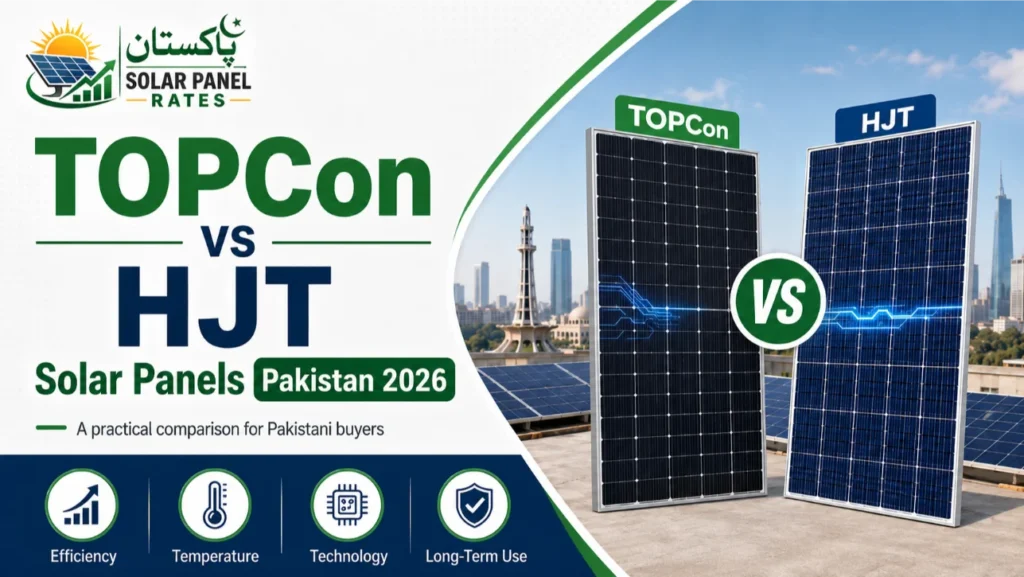
TOPCon vs HJT Solar Panels Pakistan 2026 — Technology Comparison
TOPCon and HJT (Heterojunction) are the two leading next-generation solar panel technologies replacing PERC. Both are available in Pakistan in 2026. This guide explains what each technology means, how they compare in Pakistan’s climate, and which you should buy.
TOPCon vs HJT — Technology Explained
| Factor | TOPCon | HJT (Heterojunction) |
|---|---|---|
| Full Name | Tunnel Oxide Passivated Contact | Heterojunction Technology |
| Cell Type | N-type silicon with tunnel oxide | Amorphous + crystalline silicon stack |
| Efficiency Range (module) | 22.0%–24.0% | 22.5%–25.0% |
| Temperature Coefficient | −0.28% to −0.32%/°C | −0.23% to −0.26%/°C |
| Low-Light Performance | Excellent | Superior |
| Bifacial Gain | 7–12% | 10–15% |
| Manufacturing Compatibility | Uses existing PERC lines (lower cost) | Requires new dedicated lines (higher cost) |
| Price in Pakistan (600W) | Rs 16,000–24,000 | Rs 24,000–35,000 |
| Key Brands in Pakistan | LONGi, JA, Jinko, Trina | REC, Huasun, some Jinko models |
| Availability in Pakistan | Very high | Low to moderate |
TOPCon Technology — Why It Dominates Pakistan
- TOPCon is the current mainstream N-type technology — 80%+ of new panels sold in Pakistan in 2026 are TOPCon
- Efficiency up to 24.0% — significantly better than PERC’s 21.5% ceiling
- Temperature coefficient of −0.30%/°C means better output in Pakistan’s 40–50°C summers than PERC
- Wide availability from all major brands (LONGi, JA, Jinko, Trina) in Pakistan
- Price-competitive — Rs 16,000–24,000 per 600W panel across brands and grades
- Long track record since 2022 — reliability data exists from real-world installations
HJT Technology — Why It’s Superior but Rarer
- HJT achieves the lowest temperature coefficient (−0.24%/°C) — best performance in Pakistan’s heat
- Superior low-light output — generates meaningfully more at dawn, dusk, and overcast days
- Higher bifacial gain (10–15%) — ideal for flat white-membrane Pakistani rooftops
- Module efficiency up to 25.0% — best available anywhere in 2026
- Price premium: HJT costs Rs 8,000–12,000 more per 600W panel than equivalent TOPCon
- Limited Pakistan availability — imported on order, not stocked widely
- Fewer local installers familiar with HJT system design requirements
Performance in Pakistan’s Climate
| Condition | TOPCon Output | HJT Output | HJT Advantage |
|---|---|---|---|
| STC (25°C, lab) | 600W | 600W | — |
| Pakistan summer (50°C) | ~94% = ~564W | ~96% = ~576W | +12W (+2%) |
| Early morning (8 AM) | Good | Excellent | +3–5% |
| Overcast / hazy day | Good | Excellent | +4–6% |
| Bifacial gain (flat roof) | 8–10% | 12–15% | +3–5% |
In Pakistan’s climate — hot summers, dust haze, and flat rooftops — HJT has a measurable performance advantage. However, the Rs 8,000–12,000/panel price premium means the payback period for choosing HJT over TOPCon is 4–6 extra years. Most Pakistani homeowners get better ROI from TOPCon.
Which Should You Buy?
- Buy TOPCon if: you want the best combination of price, performance, and availability. Correct for 95% of Pakistani buyers in 2026.
- Buy HJT if: you have a premium budget, need to maximise output on a constrained roof, or are doing a large commercial project with a long horizon where peak efficiency compounds over 25 years.
- Avoid old PERC panels: any installer offering PERC in 2026 is selling outdated stock. Insist on TOPCon or better.
Frequently Asked Questions
Get TOPCon Panel Quotes in Pakistan
Compare current prices from AEDB-licensed installers across Pakistan.
Sources & references
Tariff, net-metering, and policy details on this page draw on the following official sources. Rates change often, so confirm current figures with the relevant authority or a licensed installer before you decide.
- NEPRA — National Electric Power Regulatory Authority: electricity tariffs and the 2026 shift from net metering to net billing.
- AEDB — Alternative Energy Development Board: solar policy, installer standards, and net-metering guidance.
- Your local distribution company (DISCO) — for example LESCO, K-Electric, IESCO, MEPCO, PESCO or QESCO — for area-specific tariffs and the net-metering application process.