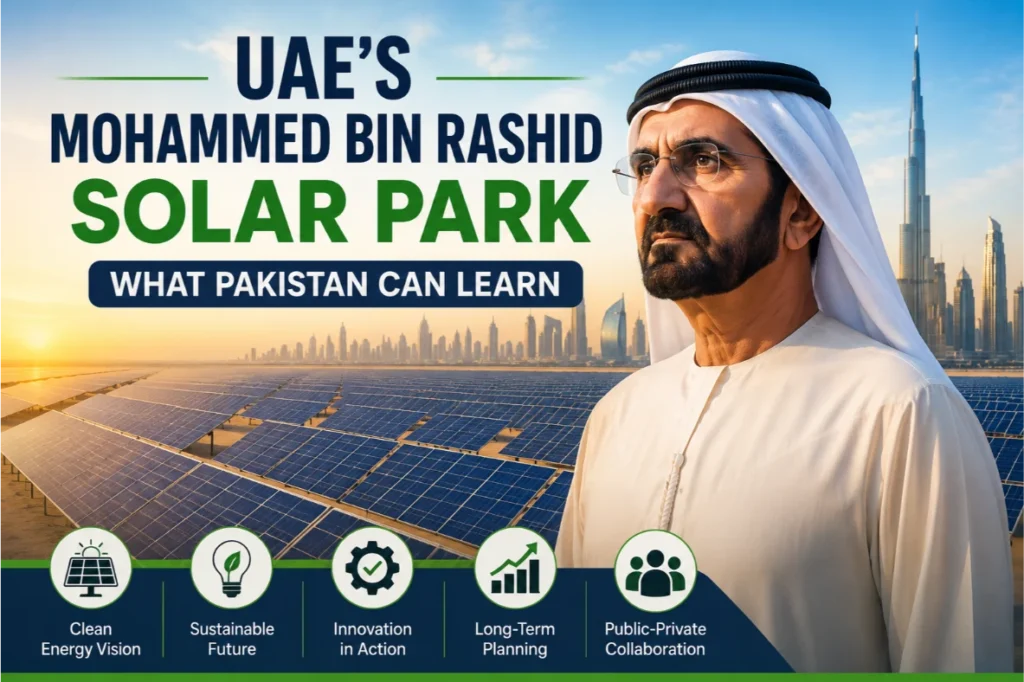
UAE’s Mohammed bin Rashid Solar Park — What Pakistan Can Learn
The Mohammed bin Rashid Al Maktoum Solar Park in Dubai is the world’s largest single-site solar project — a 5GW installation that will eventually generate enough electricity to power 1.3 million homes. Built in a desert environment with similar solar irradiance to Pakistan’s Balochistan and southern Punjab, it’s one of the most relevant global examples for Pakistan’s renewable energy ambitions. Here’s what Pakistan’s energy planners and investors can learn from Dubai’s solar flagship.
The Mohammed bin Rashid Solar Park — Key Facts
| Metric | Detail |
|---|---|
| Location | Saih Al-Dahal, Dubai — 50km south of city center |
| Total Target Capacity | 5,000 MW (5 GW) — completion by 2030 |
| Installed Capacity (2026) | ~2,850 MW operational |
| Technologies Used | Mono PERC / TOPCon PV, concentrated solar power (CSP), thermal storage |
| Lowest Solar Tariff Achieved | $0.0169/kWh (Phase 5, 2020) — world record at time |
| Developer Model | DEWA (government utility) + competitive IPP tenders |
| Investment | AED 50 billion (~$14 billion USD) |
| Land Area | 214 km² total planned area |
How Dubai Got Solar to $0.017/kWh
The most remarkable achievement of the MBRS Solar Park is its electricity tariff. Phase 5 (900MW) received bids as low as $0.0169/kWh from a consortium led by ACWA Power and LONGi — making it the cheapest electricity ever produced in the Middle East at the time. How?
- Competitive tender process: DEWA ran transparent international competitive auctions attracting global developers — driving prices down through genuine competition
- Creditworthy off-taker: DEWA is a AAA-rated utility backed by the Dubai government. Developers accepted razor-thin margins because payment risk was zero
- Long-term PPAs: 25-year power purchase agreements allowed developers to finance at extremely low interest rates — debt cost is the biggest factor in solar tariff
- Massive scale: 900MW in a single phase allowed procurement at maximum economies of scale for panels, inverters, and balance-of-system
- Desert site with high irradiance: Dubai’s 5.5–6.0 kWh/m²/day solar resource (similar to Pakistan’s Balochistan) maximizes generation per installed MW
Comparison: Pakistan’s Solar Resource vs Dubai
| Location | Solar Irradiance (kWh/m²/day) | vs Dubai |
|---|---|---|
| Dubai (MBRS Solar Park) | 5.5–6.0 | Baseline |
| Balochistan (Quetta/Turbat) | 6.0–7.0 | Better |
| Bahawalpur / Cholistan | 5.8–6.5 | Similar to better |
| Karachi coast | 5.5–6.0 | Similar |
| Lahore / Multan | 5.0–5.5 | Slightly lower |
Pakistan’s Balochistan has better solar irradiance than Dubai. The fundamental resource for achieving Dubai-level solar tariffs exists in Pakistan. The gap is in project execution, financing, and policy — not physics.
5 Lessons Pakistan Must Apply
- Creditworthy off-taker is everything: Pakistan’s circular debt and DISCO payment record deters low-cost financing. Until off-taker credit risk is resolved, Pakistan cannot achieve Dubai-level tariffs regardless of solar resource quality
- Transparent competitive tenders get the best prices: DEWA’s international competitive auctions were open, transparent, and attracted global competition. Pakistan’s procurement history has been less transparent, limiting competition
- Scale matters: Pakistan should tender 500MW–1GW+ projects, not 50–100MW — scale drives down per-unit costs dramatically
- CSP + thermal storage for 24-hour power: MBRS Solar Park includes concentrated solar power (CSP) with molten salt thermal storage — providing solar electricity at night. Pakistan’s baseload reliability problem could be addressed similarly at large desert sites
- Land bank early: Dubai identified and cleared land years before projects broke ground. Pakistan needs a designated solar land bank in Balochistan and Cholistan with clear titles, grid connection plans, and environmental clearances ready for developers
Frequently Asked Questions
❓ Can Pakistan achieve Dubai-level solar tariffs?
Theoretically yes — Pakistan’s solar resource is equal to or better than Dubai’s. But tariff depends primarily on financing cost, and financing cost depends on off-taker credit risk. Pakistan’s power sector circular debt means lenders demand higher risk premiums, raising financing costs and thus tariffs. Resolving circular debt and establishing a creditworthy special-purpose off-taker entity is the single most important step toward achieving competitive solar tariffs in Pakistan.
❓ What is concentrated solar power (CSP) and does Pakistan need it?
CSP uses mirrors to concentrate sunlight and generate heat, which drives a steam turbine to produce electricity — similar to thermal power but with free solar fuel. CSP with molten salt thermal storage can store heat for 8–16 hours, providing electricity generation after sunset. Pakistan’s baseload reliability requirement makes CSP + storage conceptually attractive, particularly for Balochistan’s high-irradiance desert areas. However, CSP costs remain high ($0.08–0.15/kWh) compared to PV ($0.02–0.04/kWh). PV + battery storage is currently more cost-competitive for most applications.
❓ Is there a Pakistan equivalent of the Mohammed bin Rashid Solar Park?
The closest equivalent is the Quaid-e-Azam Solar Park in Bahawalpur, Punjab — a 400MW project commissioned in 2015 under CPEC. At $0.12–0.15/kWh tariff, it’s far more expensive than Dubai’s MBRS Solar Park equivalent phases. Pakistan has not yet held the kind of large-scale competitive international tender that drove Dubai’s record-low tariffs. This remains a significant untapped policy opportunity.
❓ What role does China play in Pakistan’s and UAE’s large solar projects?
In both cases, Chinese companies are central. LONGi, Jinko, and other Chinese manufacturers supply the panels. Chinese EPC contractors (SEPCO3, CMEC, PowerChina) build projects. In Pakistan’s case, CPEC provides both financing and Chinese contractor involvement. In the UAE, Chinese companies competed as part of international consortia — ACWA Power + LONGi won Phase 5. China’s solar manufacturing dominance means both countries benefit from Chinese technology regardless of project financing source.
⚡ Pakistan’s rooftop solar revolution starts now
Sources & references
Tariff, net-metering, and policy details on this page draw on the following official sources. Rates change often, so confirm current figures with the relevant authority or a licensed installer before you decide.
- NEPRA — National Electric Power Regulatory Authority: electricity tariffs and the 2026 shift from net metering to net billing.
- AEDB — Alternative Energy Development Board: solar policy, installer standards, and net-metering guidance.
- Your local distribution company (DISCO) — for example LESCO, K-Electric, IESCO, MEPCO, PESCO or QESCO — for area-specific tariffs and the net-metering application process.