Why Solar Panel Prices Are Falling in Pakistan 2026 — Analysis
The Global Manufacturing Overcapacity Factor
The primary driver of global solar panel price decline is Chinese manufacturing overcapacity. China’s solar panel manufacturing capacity (900+ GW/year as of 2025) vastly exceeds global installation demand (~600 GW/year). This structural oversupply drives intense price competition among Chinese manufacturers, pushing panel prices to historic lows.
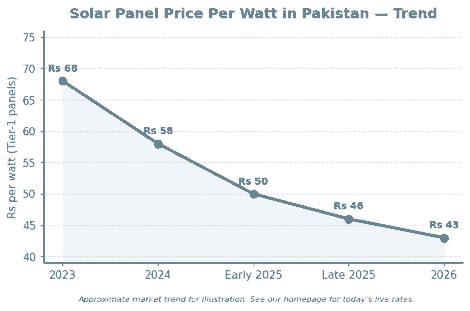
Price Timeline — Pakistan (per Watt, 550W Mono PERC/TOPCon panels)
| Year | Price per Watt (Rs.) | 550W Panel Price | Key Factor |
|---|---|---|---|
| 2020 | Rs. 55–65 | Rs. 30,000–36,000 | Pre-boom, limited competition |
| 2022 | Rs. 38–45 | Rs. 21,000–25,000 | Post-COVID supply chain normalising |
| 2023 | Rs. 28–35 | Rs. 15,000–19,000 | Chinese oversupply begins |
| 2024 | Rs. 20–26 | Rs. 11,000–14,000 | Massive Chinese capacity addition |
| 2025 | Rs. 18–23 | Rs. 10,000–12,500 | Oversupply deepens |
| 2026 (mid) | Rs. 17–22 | Rs. 9,500–12,000 | Continued pressure, TOPCon now standard |
Why Pakistani Prices Track Global Prices
Pakistan imports the vast majority of solar panels from China. As Chinese manufacturer gate prices fall, Pakistani import prices follow — though with a lag of 1–3 months and adjustment for shipping, duties (currently 0% on solar panels under SRO), and importer margins. The Pakistani rupee’s value also affects final prices: rupee depreciation partially offsets global price falls for local buyers.
Anti-Dumping Risk
Several countries (EU, US, India) have imposed anti-dumping duties on Chinese solar panels. If Pakistan follows suit in response to pressure from nascent local panel assembly industry, prices could stop falling or reverse. Currently (mid-2026) Pakistan has no anti-dumping duties on solar panels — the government’s pro-solar policy maintains free import. This could change; monitor NEPRA and FBR announcements.
Frequently Asked Questions
📉 Lowest prices ever — act now
Sources & references
Tariff, net-metering, and policy details on this page draw on the following official sources. Rates change often, so confirm current figures with the relevant authority or a licensed installer before you decide.
- NEPRA — National Electric Power Regulatory Authority: electricity tariffs and the 2026 shift from net metering to net billing.
- AEDB — Alternative Energy Development Board: solar policy, installer standards, and net-metering guidance.
- Your local distribution company (DISCO) — for example LESCO, K-Electric, IESCO, MEPCO, PESCO or QESCO — for area-specific tariffs and the net-metering application process.