
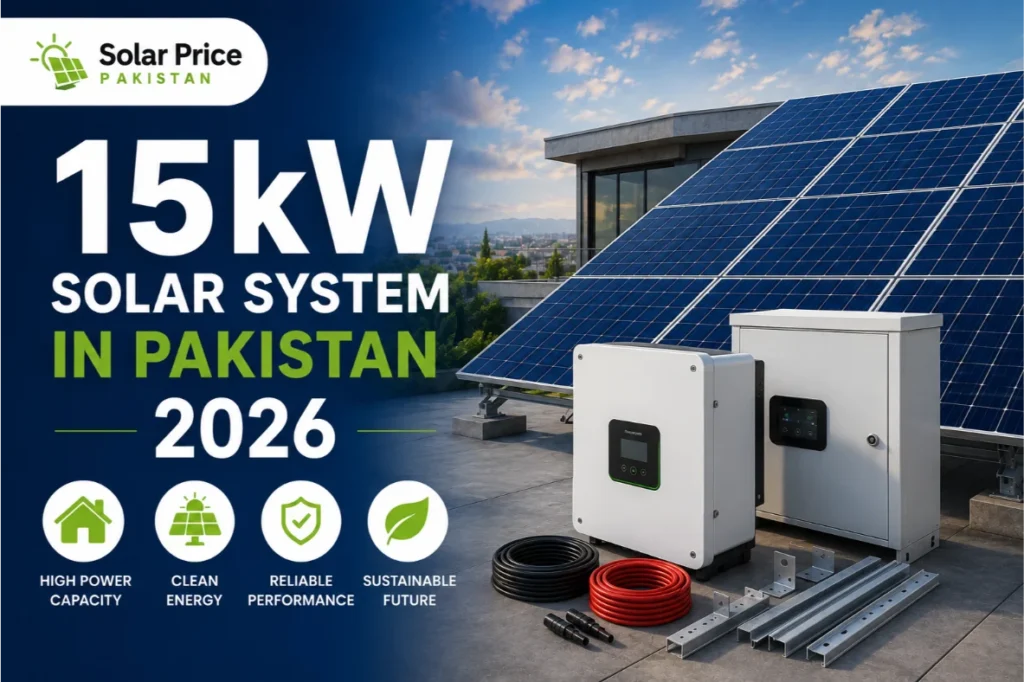
15kW: Small-Commercial and Large-Villa Scale
A 15 kW system is a small-commercial-scale array – roughly twenty-eight 550W panels generating 60-68 units a day – suited to large villas, shops, clinics or small offices. It runs on a three-phase inverter and needs about 72 square metres of roof or ground space. At this level the economics shift slightly: commercial tariffs, load profiles that peak during daylight (ideal for solar), and net-metering sanction limits all matter more than on a home system. If you are a business, match the array to your daytime consumption pattern rather than just your total bill, since solar offsets daytime use most efficiently and export is credited at the DISCO’s buy-back rate.
15kW Solar System Price in Pakistan 2026 – Commercial & Large Villa Guide
15kW Solar System Price Breakdown 2026
| Component | Specification | Estimated Cost (PKR) |
|---|---|---|
| Solar Panels | 24–28 × 550W–580W | Rs. 880,000 – Rs. 1,120,000 |
| Hybrid Inverter | 15kW 3-phase hybrid | Rs. 480,000 – Rs. 680,000 |
| Lithium Batteries (optional) | 25–40kWh LiFePO4 | Rs. 750,000 – Rs. 1,600,000 |
| Mounting Structure | Galvanized steel | Rs. 100,000 – Rs. 175,000 |
| Wiring, Protection, Installation | Full professional install | Rs. 140,000 – Rs. 225,000 |
| Total (on-grid, no batteries) | Rs. 1,600,000 – Rs. 2,200,000 | |
| Total (hybrid, with batteries) | Rs. 2,350,000 – Rs. 3,800,000 |
Daily & Monthly Generation Estimates
| Season | Daily Generation | Monthly Units |
|---|---|---|
| Summer (May–Aug) | 80–105 units | 2,400–3,150 |
| Spring/Autumn | 68–88 units | 2,040–2,640 |
| Winter (Dec–Feb) | 55–70 units | 1,650–2,100 |
Is a 15kW System Right for You?
- Monthly electricity bill exceeds Rs. 80,000–150,000
- You have a 3-phase WAPDA connection (commercial or large residential)
- Running a clinic, school, small factory, restaurant, or large villa
- You have 200–250 sq ft of unshaded roof space
- You want to apply for net metering and sell excess power to WAPDA
Best 15kW Inverters in Pakistan
- Growatt MAC 15KTL3-X — Popular 3-phase string inverter for on-grid setups. Rs. 480,000–560,000. Excellent monitoring via ShinePhone.
- Sungrow SH15T — Premium 3-phase hybrid. Rs. 600,000–680,000. Best-in-class for commercial hybrid applications.
- Deye SUN-15K-SG01HP3 — Cost-effective 3-phase hybrid. Rs. 500,000–580,000. Popular choice for Pakistani commercial solar.
- Huawei SUN2000-15KTL-M2 — Premium string inverter with excellent app. Rs. 560,000–650,000.
Frequently Asked Questions
🌞 Sizing a 15kW commercial system?
Check today’s panel and inverter prices to build your estimate.
Sources & references
Tariff, net-metering, and policy details on this page draw on the following official sources. Rates change often, so confirm current figures with the relevant authority or a licensed installer before you decide.
- NEPRA — National Electric Power Regulatory Authority: electricity tariffs and the 2026 shift from net metering to net billing.
- AEDB — Alternative Energy Development Board: solar policy, installer standards, and net-metering guidance.
- Your local distribution company (DISCO) — for example LESCO, K-Electric, IESCO, MEPCO, PESCO or QESCO — for area-specific tariffs and the net-metering application process.