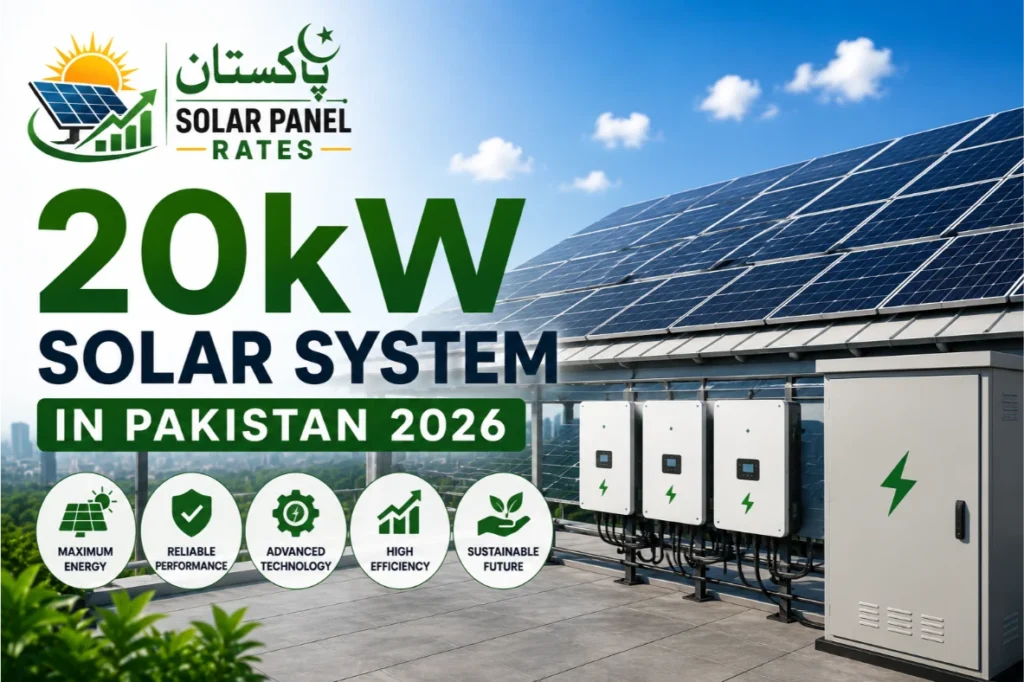
20kW Solar System Price in Pakistan 2026 – Industrial Solar Setup Guide
A 20kW solar system is designed for medium-sized factories, schools, hospitals, large commercial buildings, or luxury estates in Pakistan. Generating approximately 85–115 units per day, a 20kW system can eliminate electricity costs of Rs. 100,000–200,000/month for commercial users. Total installed cost ranges from Rs. 2,200,000 to Rs. 3,200,000 on-grid, up to Rs. 5,000,000+ with full hybrid battery backup.
20kW Solar System Price Breakdown 2026
| Component | Specification | Estimated Cost (PKR) |
|---|---|---|
| Solar Panels | 32–36 × 580W–600W | Rs. 1,150,000 – Rs. 1,450,000 |
| Inverter | 20kW 3-phase hybrid/string | Rs. 600,000 – Rs. 850,000 |
| Lithium Batteries (optional) | 30–50kWh LiFePO4 | Rs. 900,000 – Rs. 2,000,000 |
| Mounting & BOS | Structure, cables, protection | Rs. 200,000 – Rs. 320,000 |
| Installation | Professional licensed team | Rs. 150,000 – Rs. 250,000 |
| Total (on-grid) | Rs. 2,100,000 – Rs. 2,870,000 | |
| Total (hybrid with batteries) | Rs. 3,000,000 – Rs. 4,870,000 |
💡 Commercial WAPDA tariff advantage: Commercial electricity users in Pakistan pay Rs. 38–45/unit at peak tariff — significantly higher than residential. A 20kW system generating 95 units/day saves Rs. 3,610–4,275/day = Rs. 108,000–128,000/month for commercial users. Payback can be under 2 years.
Is a 20kW System Right for You?
- Monthly commercial electricity bill exceeds Rs. 100,000–200,000
- You have a 3-phase WAPDA commercial connection
- Running a factory, hospital wing, school, large restaurant, or hotel
- Available roof or land space of 280–340 sq ft unshaded
- You want to maximize net metering credit under NEPRA commercial net metering policy
⚠️ Net metering limit: Under NEPRA regulations, single commercial connections can net meter up to 1MW. However, approval process for large systems (above 25kW) involves additional technical assessments by your DISCO. Budget extra time (3–9 months) for the approval process.
Best 20kW Inverters Available in Pakistan
- Growatt MAC 20KTL3-X — Best-selling 3-phase string for on-grid commercial. Rs. 580,000–680,000.
- Sungrow SG20RT — Commercial-grade 3-phase string, excellent reliability. Rs. 650,000–780,000.
- Deye SUN-20K-SG01HP3 — 3-phase hybrid for backup + grid. Rs. 620,000–720,000.
- Huawei SUN2000-20KTL-M2 — Premium monitoring, AI optimization. Rs. 700,000–850,000.
📊 ROI summary: Commercial user saving Rs. 120,000/month on a Rs. 2,500,000 system = 20-month payback. Residential user saving Rs. 95,000/month on the same system = 26-month payback. Both are exceptional returns on investment given 25-year panel lifespan.
Frequently Asked Questions
❓ How much does a 20kW solar system cost in Pakistan?
A 20kW on-grid system costs Rs. 2,100,000–2,870,000 installed. Adding 30–50kWh lithium battery backup brings total to Rs. 3,000,000–4,870,000. Commercial users often skip batteries and use on-grid to maximize net metering revenue.
❓ How many units does a 20kW solar system generate per day in Pakistan?
A 20kW system generates 85–115 units per day in Pakistan’s climate — averaging around 95 units/day over the full year. Summer months produce significantly more (100–115 units/day) while winter drops to 72–88 units/day.
❓ How many panels does a 20kW system need?
A 20kW system requires 32–36 solar panels of 580W–600W each. This requires approximately 280–340 sq ft of unshaded south-facing roof or ground space. Ground-mounted systems offer more flexibility in panel orientation for optimal generation.
❓ Can a 20kW system qualify for net metering in Pakistan?
Yes. 20kW is within the net metering limit for commercial WAPDA connections. Your licensed installer applies through your local DISCO (LESCO, HESCO, MEPCO, etc.). Commercial net metering approval typically takes 3–6 months and requires AEDB-approved equipment.
🌞 Planning a 20kW commercial solar system?
See today’s component prices and build your cost estimate.
Sources & references
Tariff, net-metering, and policy details on this page draw on the following official sources. Rates change often, so confirm current figures with the relevant authority or a licensed installer before you decide.
- NEPRA — National Electric Power Regulatory Authority: electricity tariffs and the 2026 shift from net metering to net billing.
- AEDB — Alternative Energy Development Board: solar policy, installer standards, and net-metering guidance.
- Your local distribution company (DISCO) — for example LESCO, K-Electric, IESCO, MEPCO, PESCO or QESCO — for area-specific tariffs and the net-metering application process.