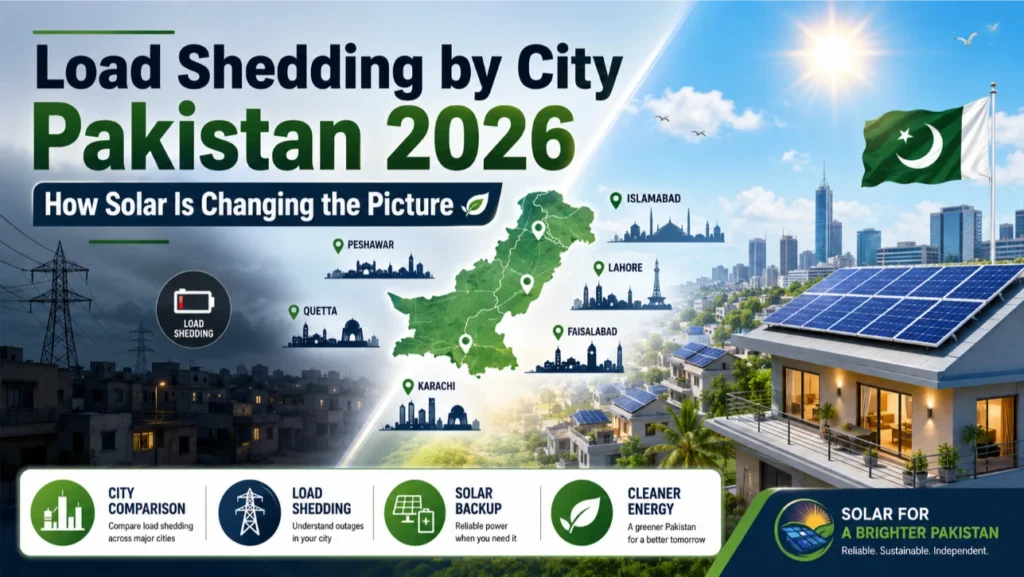
Load Shedding by City Pakistan 2026 — How Solar Is Changing the Picture
Load shedding remains one of Pakistan’s most persistent economic and quality-of-life challenges. In 2026, urban areas experience 4–10 hours of scheduled outages daily, while rural areas face 12–20 hours. Solar energy — particularly hybrid systems with battery backup — is now the most practical solution for most Pakistani households. This guide covers load shedding by city and how solar with storage eliminates the problem.
Load Shedding Hours by City — Pakistan 2026 (Estimated)
| City | DISCO | Urban Load Shedding | Rural Load Shedding |
|---|---|---|---|
| Karachi | KESC/KE | 2–6 hrs/day | 6–12 hrs/day |
| Lahore | LESCO | 4–8 hrs/day | 8–14 hrs/day |
| Islamabad | IESCO | 2–5 hrs/day | 6–10 hrs/day |
| Rawalpindi | IESCO | 4–8 hrs/day | 10–14 hrs/day |
| Faisalabad | FESCO | 6–10 hrs/day | 12–18 hrs/day |
| Multan | MEPCO | 6–12 hrs/day | 14–20 hrs/day |
| Peshawar | PESCO | 8–12 hrs/day | 16–20 hrs/day |
| Quetta | QESCO | 8–14 hrs/day | 16–22 hrs/day |
| Hyderabad | HESCO | 6–10 hrs/day | 14–18 hrs/day |
| Gujranwala | GESCO | 6–10 hrs/day | 12–16 hrs/day |
Note: Load shedding hours are indicative based on 2025–2026 patterns. Summer peaks (May–August) and winter peaks (December–January) often see higher than average outages.
⚠️ Unscheduled outages: In addition to scheduled load shedding, Pakistan experiences frequent unscheduled outages (faults, tripping, transformer failures). Rural areas especially face long restoration times. Solar + battery backup addresses both scheduled and unscheduled outages.
Why Hybrid Solar + Battery Is the Best Load Shedding Solution
- Automatic switchover — Hybrid inverters switch to battery power within milliseconds of a grid outage — no manual generator start, no UPS delay
- Silent operation — Unlike generators, solar+battery runs silently 24/7
- Zero fuel cost — No diesel or gas cost once installed
- Covers both day and night outages — Solar charges batteries during day; batteries cover nighttime load shedding
- Net metering during grid hours — When grid is up, export excess solar and earn credits on your bill
How Many Hours of Backup Does a Solar+Battery System Provide?
| Home Load | 1 Battery (5kWh) | 2 Batteries (10kWh) | 3 Batteries (15kWh) |
|---|---|---|---|
| Light (fans, lights, fridge only) ~500W | 8–10 hrs | 16–20 hrs | 24+ hrs |
| Medium (1 AC + basics) ~1,500W | 2–3 hrs | 5–6 hrs | 8–10 hrs |
| Heavy (2 AC + basics) ~3,000W | 1–1.5 hrs | 2.5–3 hrs | 4–5 hrs |
💡 Right-sizing tip: For cities with 8–12 hours of daily load shedding, most households need 2–3 batteries (10–15kWh). The solar panels recharge batteries during daylight — so the system is self-sustaining even through extended outages as long as there’s sun for recharging.
Solar Adoption Rate by City — Pakistan 2026
- 🥇 Lahore — Highest solar adoption nationally. LESCO area has most rooftop installations.
- 🥈 Islamabad/Rawalpindi — Highest average system sizes. High-income households, 10kW+ systems common.
- 🥉 Faisalabad — Industrial solar leader. Factory rooftop solar very common.
- 4️⃣ Karachi — Rapid growth despite KE (not WAPDA) grid. KE’s net metering is available.
- 5️⃣ Peshawar — Fastest growing market. High load shedding is a strong driver.
Frequently Asked Questions
❓ Can solar completely eliminate load shedding impact in Pakistan?
Yes — a properly sized hybrid solar system with adequate battery storage can provide uninterrupted power regardless of grid outages. For a typical 2-AC Pakistani home with 10–12 hours of daily load shedding, a 6kW–8kW system with 2–3 lithium batteries (10–15kWh) will eliminate the impact of outages for most of the day.
❓ What happens to a solar system during a grid outage?
A hybrid solar inverter automatically switches to battery + solar power within milliseconds of a grid outage. Your home continues running normally with no interruption. When the grid comes back, the inverter seamlessly reconnects and resumes exporting/importing as needed.
❓ Is solar better than a generator for load shedding in Pakistan?
For most households, solar+battery is significantly better than a generator. Solar has zero fuel cost (generators cost Rs. 3,000–8,000/month in diesel), silent operation, automatic switchover, and also saves on your electricity bill during grid hours. The only advantage generators have is unlimited runtime — solar batteries deplete if load shedding is very long and there’s been no sun. A combination of solar+battery as primary backup + small generator for emergencies is ideal for areas with 16+ hours of daily outages.
❓ Which Pakistani city has the worst load shedding in 2026?
Rural areas across Multan, Peshawar, Quetta, and interior Sindh and Balochistan consistently experience the longest outages — often 16–22 hours per day. Ironically, these high-irradiance areas are also where solar performs best, making the ROI case for solar extremely strong.
🔋 End load shedding with solar+battery backup
Check inverter and battery prices to build your backup system.
All inverter brands → | All battery brands → | Hybrid solar guide →
Sources & references
Tariff, net-metering, and policy details on this page draw on the following official sources. Rates change often, so confirm current figures with the relevant authority or a licensed installer before you decide.
- NEPRA — National Electric Power Regulatory Authority: electricity tariffs and the 2026 shift from net metering to net billing.
- AEDB — Alternative Energy Development Board: solar policy, installer standards, and net-metering guidance.
- Your local distribution company (DISCO) — for example LESCO, K-Electric, IESCO, MEPCO, PESCO or QESCO — for area-specific tariffs and the net-metering application process.