Pylontech vs Dyness Battery Pakistan 2026 — Which Lithium Battery Wins?
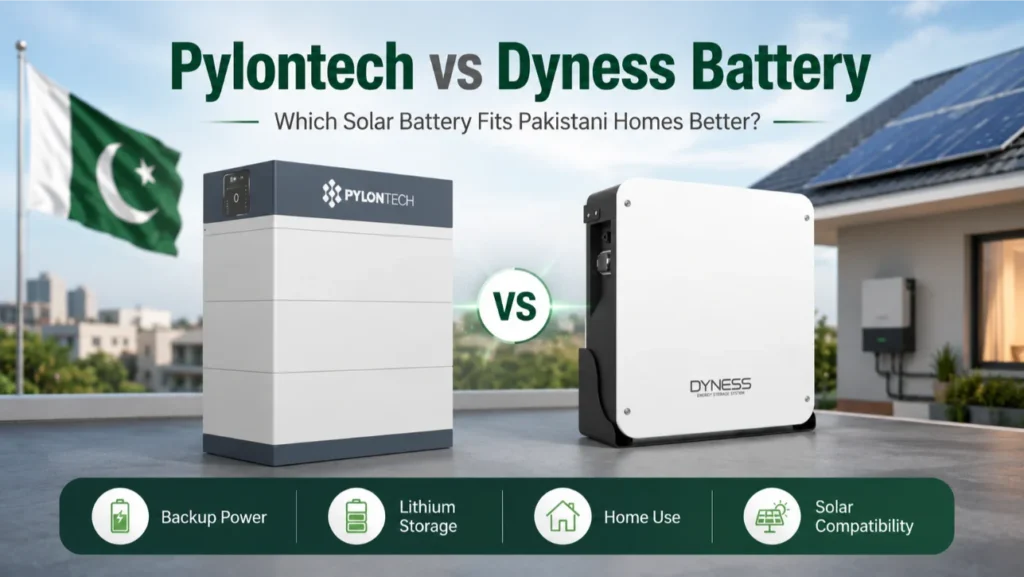
Pylontech and Dyness are two of the most popular imported lithium (LiFePO4) battery brands in Pakistan. Both use lithium iron phosphate chemistry for safety and longevity, both integrate with all major inverters via CAN/RS-485, and both are widely available from Pakistani solar dealers. But there are meaningful differences in warranty, capacity options, pricing, and form factor. Here’s the full comparison.
Pylontech vs Dyness — Specifications Comparison
| Specification | Pylontech US5000 (4.8kWh) | Dyness DL5.0C (5.12kWh) |
|---|---|---|
| Capacity | 4.8 kWh | 5.12 kWh |
| Chemistry | LiFePO4 | LiFePO4 |
| Nominal Voltage | 48V | 51.2V |
| Usable Capacity | 4.56 kWh (95%) | 4.86 kWh (95%) |
| Max Charge/Discharge | 74A / 74A | 50A / 50A |
| Cycle Life | 6,000+ cycles | 6,000+ cycles |
| IP Rating | IP20 | IP55 |
| Communication | CAN / RS-485 | CAN / RS-485 |
| Warranty | 10 years | 10 years |
| Mounting | Rack / floor | Wall-mounted |
| Price in Pakistan (2026) | Rs. 175,000–210,000 | Rs. 200,000–255,000 |
Where Pylontech Wins
- Higher charge/discharge rate — Pylontech US5000 supports 74A vs Dyness’s 50A — important for high-load homes that need rapid discharge during peak AC usage
- Lower price — Pylontech US5000 typically costs Rs. 25,000–50,000 less than Dyness DL5.0C for similar capacity
- Global market leader — Pylontech is the world’s #1 residential lithium battery brand by volume — the highest level of global field validation
- Modular stacking — Pylontech’s rack-mount design allows clean stacking of multiple units in battery cabinets
- Inverter compatibility — Pylontech is compatible with the widest range of inverters and has the most pre-tested compatibility matrices
Where Dyness Wins
- IP55 weatherproofing — Dyness is rated IP55 vs Pylontech US5000’s IP20. Dyness can handle more demanding installation environments
- Wall-mount form factor — Dyness DL5.0C mounts directly on a wall, saving floor space — ideal for utility rooms or covered outdoor areas
- Slightly more usable capacity — 5.12kWh vs 4.8kWh means approximately 6% more stored energy per unit
- Clean aesthetic — Dyness has a more premium, modern appearance — matters for exposed installations
Which Should You Choose?
| Your Situation | Recommendation |
|---|---|
| Budget priority, indoor installation | ✅ Pylontech US5000 |
| High-load home needing rapid discharge | ✅ Pylontech (74A vs 50A) |
| Wall-mount needed to save floor space | ✅ Dyness DL5.0C |
| Semi-outdoor or damp location | ✅ Dyness (IP55) |
| Maximum inverter compatibility | ✅ Pylontech |
💡 Bottom line: Pylontech US5000 is the safer choice for most buyers — better price, higher discharge rate, and maximum inverter compatibility. Choose Dyness if you need wall-mounting, IP55 weatherproofing, or prefer the aesthetics.
Frequently Asked Questions
❓ Which battery lasts longer — Pylontech or Dyness?
Both claim 6,000+ cycle life at standard conditions, which equates to 16+ years at one cycle per day. Both carry 10-year warranties. In real-world Pakistan conditions (heat, frequent cycling), both LiFePO4 chemistries perform similarly. Pylontech has more long-term field data globally to back its cycle life claims.
❓ Can I mix Pylontech and Dyness batteries in the same system?
No — you should never mix different battery brands in a single bank. Different voltages, BMS protocols, and charge/discharge rates will cause imbalanced charging and can damage batteries. Stick to one brand per battery bank. You can have separate battery banks for separate inverters, but not in parallel.
❓ How many Pylontech batteries do I need for a 2-AC home?
A typical 2-AC Pakistani home draws 2,000–3,000W. For 6–8 hours of backup: 2 × Pylontech US5000 (9.6kWh usable) covers 3–4 hours of heavy load or 6–8 hours of moderate load. For full-night backup through load shedding, consider 3 units (14.4kWh).
❓ Is Pylontech or Dyness better for a Growatt inverter?
Both are compatible with Growatt inverters. Pylontech has official CAN bus integration with Growatt’s SPF series and is listed on Growatt’s compatibility matrix. Dyness also integrates via CAN. Both work reliably — Pylontech’s official Growatt support is slightly more documented if using the ShinePhone app for battery monitoring.
🔋 Compare battery prices in Pakistan
Sources & references
Tariff, net-metering, and policy details on this page draw on the following official sources. Rates change often, so confirm current figures with the relevant authority or a licensed installer before you decide.
- NEPRA — National Electric Power Regulatory Authority: electricity tariffs and the 2026 shift from net metering to net billing.
- AEDB — Alternative Energy Development Board: solar policy, installer standards, and net-metering guidance.
- Your local distribution company (DISCO) — for example LESCO, K-Electric, IESCO, MEPCO, PESCO or QESCO — for area-specific tariffs and the net-metering application process.