Global LiFePO4 Battery Supply 2026 — Why Prices Dropped and What Happens Next
Why LiFePO4 Prices Fell So Dramatically
1. Chinese Manufacturing Dominance
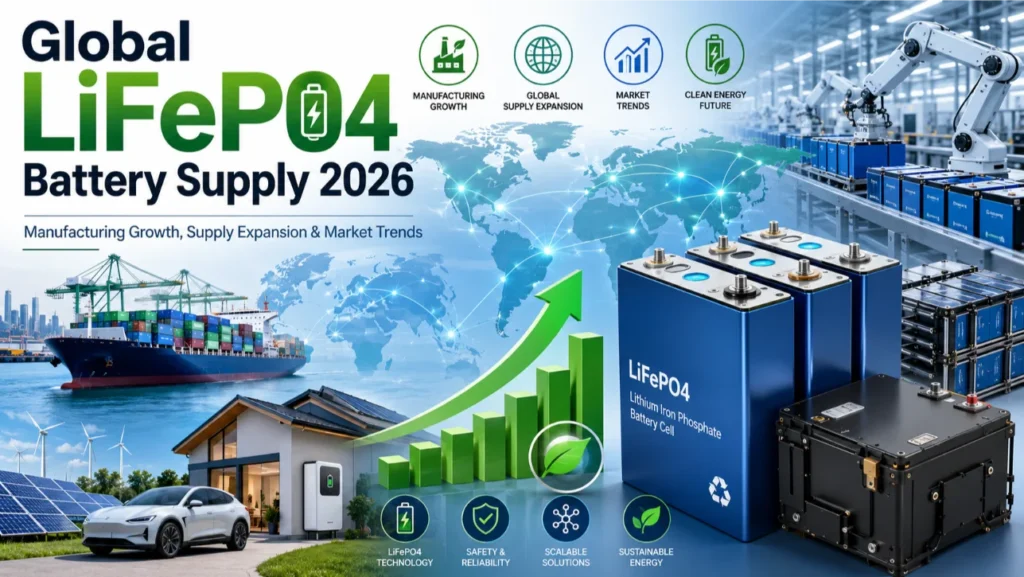
China produces approximately 75–80% of the world’s lithium battery cells, with CATL, BYD, CALB, and EVE Energy dominating global supply. These manufacturers have invested hundreds of billions of yuan in new gigafactories over 2020–2025, dramatically expanding production capacity beyond current global demand.
2. Lithium Carbonate Price Collapse
Lithium carbonate — the primary raw material for LiFePO4 batteries — peaked at approximately $80,000/tonne in late 2022, driven by EV demand hysteria and supply constraints. By 2024–2026, new lithium mining projects in Australia, Chile, and China came online, crashing lithium carbonate prices to $8,000–12,000/tonne — an 85% fall. Since lithium is ~5% of battery cell cost, this translated directly into lower battery prices.
3. EV Market Slower Than Forecast
EV adoption in the US and Europe grew slower than manufacturers projected in 2021–2022. This meant battery production capacity outpaced actual EV demand, creating surplus that manufacturers redirected to stationary storage (home and grid) — increasing competition and lowering prices.
LiFePO4 Price History in Pakistan
| Year | Pylontech US5000 (4.8kWh) — Pakistan Price |
|---|---|
| 2022 | Rs. 320,000–380,000 |
| 2023 | Rs. 250,000–290,000 |
| 2024 | Rs. 200,000–240,000 |
| 2026 | Rs. 175,000–210,000 |
What Happens to Battery Prices Next?
| Scenario | 2027–2028 Battery Price Direction |
|---|---|
| Baseline (most likely) | Gradual 5–10% annual decline |
| Sodium-ion breakthrough | Possible 15–25% additional fall if Na-ion scales |
| Lithium supply tightening | Prices stabilize or modestly rise |
| Trade war escalation | Possible 10–20% increase if China restricts exports |
Should You Buy Now or Wait?
For Pakistani buyers, the calculus is straightforward: every month without a solar+storage system means paying WAPDA rates and enduring load shedding. At current prices, a complete solar system with battery storage pays back in 4–6 years. Waiting 1 year for a potential 5–10% further price reduction saves Rs. 30,000–60,000 on a system — but costs Rs. 80,000–150,000 in electricity bills and lost comfort from continued load shedding.
Frequently Asked Questions
🔋 Compare battery storage prices in Pakistan

Abubaker Jalil
Abubaker Jalil is an electrical engineer and a graduate of the University of Engineering and Technology (UET) Peshawar. He tracks panel, inverter and battery prices across Pakistan's wholesale solar markets and writes the buying guides on this site. If a dealer has quoted you a figure that does not match what you see here, write to info@solarpricepakistan.com.pk and it gets checked.