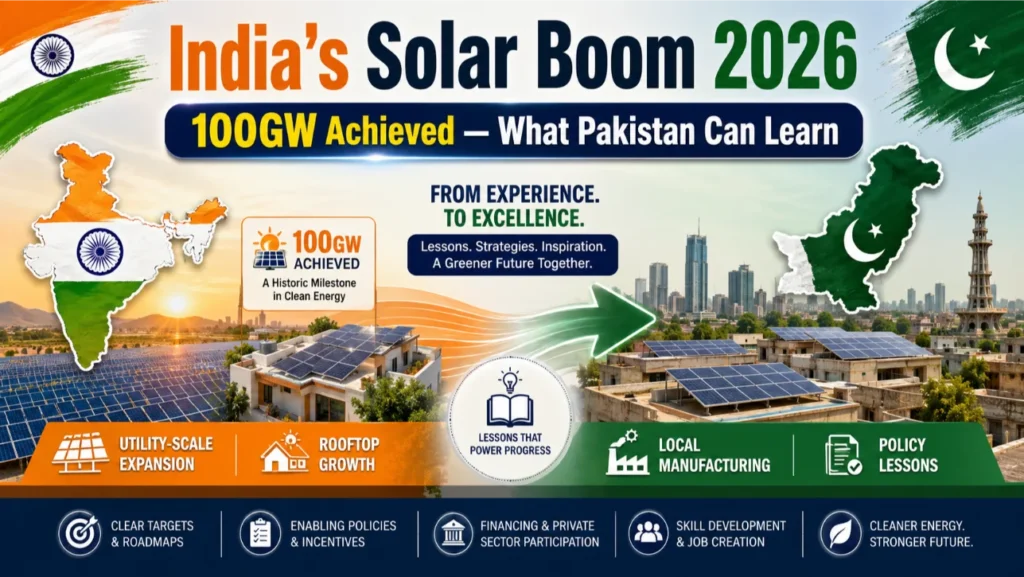
India’s Solar Boom 2026 — 100GW Achieved. What Pakistan Can Learn
India vs Pakistan Solar: Where Things Stand in 2026
| Metric | India | Pakistan |
|---|---|---|
| Installed Solar Capacity | ~120 GW (2026) | ~5–6 GW (2026) |
| Solar % of Electricity Mix | ~18% | ~4–6% |
| Net Metering Policy | Nationwide, mature | Exists but complex |
| Domestic Panel Manufacturing | Growing — PM Surya Ghar scheme | Minimal |
| Solar Target (2030) | 500 GW renewable | 60% renewable by 2030 |
| Government Solar Subsidies | PM Surya Ghar — 300W free for poor | PM Solar Scheme — limited rollout |
How India Did It — 5 Key Lessons
1. Massive Utility-Scale Solar Tenders
India’s government ran competitive reverse auctions for utility-scale solar parks — inviting private developers to bid on building large solar farms and selling power to state electricity boards at fixed tariffs. This drove solar tariffs down from Rs. 7–8/unit in 2015 to Rs. 2–2.5/unit by 2024 — cheaper than coal. Pakistan has attempted similar tenders (Quaid-e-Azam Solar Park, Bahawalpur) but at much smaller scale.
2. PM Surya Ghar — Rooftop Solar for 10 Million Homes
India’s PM Surya Ghar Muft Bijli Yojana (2024) subsidizes rooftop solar for residential consumers — free installation up to 300W for lower-income households, subsidized loans for larger systems. The scheme targets 10 million homes and has driven massive residential solar adoption. Pakistan’s PM Solar Scheme is a much smaller, less well-funded analog.
3. Domestic Manufacturing Push
India imposed tariffs on Chinese solar panels (40% Basic Customs Duty + 25% ALMM requirement) to protect and build domestic manufacturing. Indian companies like Adani Solar and Waaree now manufacture panels domestically. This created jobs and reduced import dependence. Pakistan has taken the opposite approach — zero tariffs to maximize affordability — both approaches have valid rationales.
4. Banking and Finance Ecosystem
Indian banks (SBI, PNB, NABARD) developed standard solar loan products with long tenors (10–15 years) and reasonable rates. Solar financing became accessible to middle-class homeowners without requiring large upfront capital. Pakistan’s solar financing ecosystem is far less developed — most buyers pay cash, limiting market size.
5. State-Level Competition and Federalism
India’s federal structure meant states competed to attract solar investment. Rajasthan, Gujarat, and Tamil Nadu developed solar-friendly policies to attract utility-scale projects, creating model frameworks others copied. Pakistan’s more centralized energy policy has moved more slowly.
What Pakistan Should Learn
- Scale up net metering: India’s mature net metering framework made rooftop solar economically compelling. Pakistan’s net metering process needs to be faster and cheaper for broader adoption
- Solar financing: Government-backed solar loan schemes through NRSP, microfinance banks, and commercial banks could unlock demand from the middle and lower-middle class who cannot afford upfront costs
- Utility-scale procurement: Pakistan needs far larger solar park tenders — 500MW to 1GW+ competitive auctions — to drive down wholesale electricity costs the way India did
- Data and transparency: India’s solar sector benefits from detailed publicly available data on installed capacity, tariffs, and net metering. Pakistan’s data quality needs improvement
Frequently Asked Questions
⚡ Join Pakistan’s solar revolution — compare prices today
Sources & references
Tariff, net-metering, and policy details on this page draw on the following official sources. Rates change often, so confirm current figures with the relevant authority or a licensed installer before you decide.
- NEPRA — National Electric Power Regulatory Authority: electricity tariffs and the 2026 shift from net metering to net billing.
- AEDB — Alternative Energy Development Board: solar policy, installer standards, and net-metering guidance.
- Your local distribution company (DISCO) — for example LESCO, K-Electric, IESCO, MEPCO, PESCO or QESCO — for area-specific tariffs and the net-metering application process.