
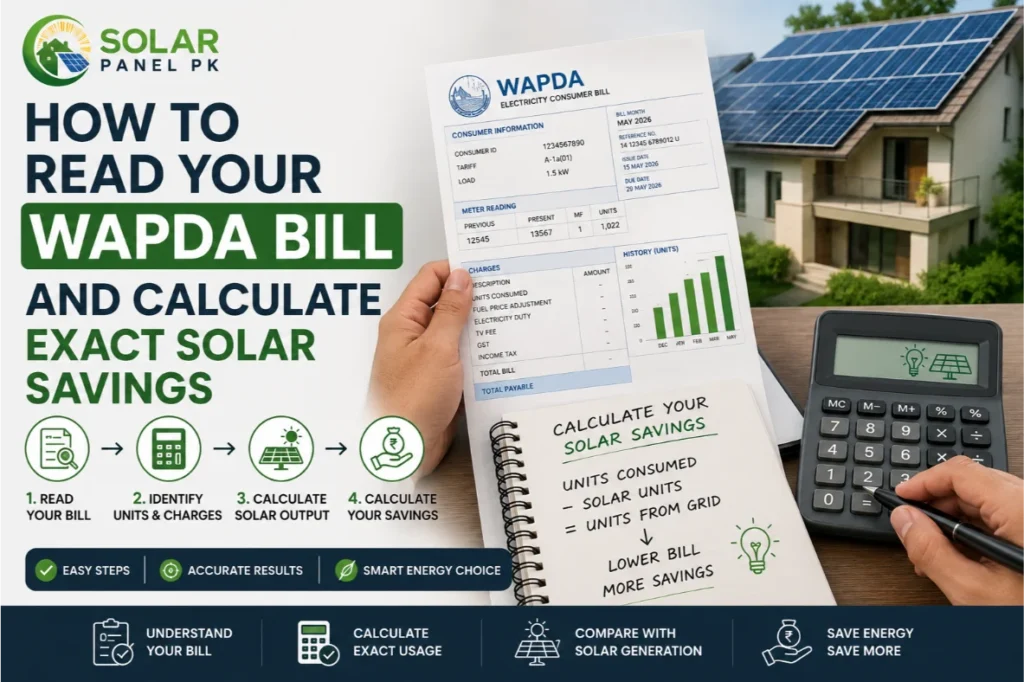
How to Read Your WAPDA Bill and Calculate Exact Solar Savings
Step 1 — Find Your Monthly Units Consumed
Look for the line labelled “Units Consumed” or “kWh” on your bill. This is the total electricity your home used during the billing period (usually 2 months for domestic WAPDA bills). Divide by 2 to get your monthly average.
Step 2 — Identify Your Per-Unit Rate
Pakistan uses a slab-based tariff — the per-unit rate increases as your consumption rises. As of 2026:
| Monthly Units | Rate (Rs./kWh) |
|---|---|
| 1–100 units | Rs. 22.44 |
| 101–200 units | Rs. 28.91 |
| 201–300 units | Rs. 33.10 |
| 301–400 units | Rs. 37.99 |
| 401–500 units | Rs. 40.22 |
| 501–600 units | Rs. 41.62 |
| 601–700 units | Rs. 42.76 |
| 700+ units | Rs. 47.69 |
High consumers (300+ units/month) pay the highest per-unit rates — which means they also get the highest solar savings per kWh generated.
Step 3 — Calculate Your Effective Per-Unit Cost
Don’t just look at the energy charges. Your bill also includes: fuel price adjustment (FPA), electricity duty, meter rent, and taxes. Divide your total bill amount by your units consumed to get the true effective rate you pay per kWh.
Example: Bill = Rs. 18,500 ÷ 550 units = Rs. 33.6 effective per kWh. This is the number to use for savings calculations — not the slab rate alone.
Step 4 — Estimate Your Solar System Generation
Pakistan averages 4.5–5 peak sun hours per day. Multiply your system size (kW) × 4.5 × 30 to get estimated monthly generation:
| System Size | Monthly Generation (est.) |
|---|---|
| 5 kW | 675 kWh/month |
| 6 kW | 810 kWh/month |
| 8 kW | 1,080 kWh/month |
| 10 kW | 1,350 kWh/month |
Step 5 — Calculate Monthly Solar Savings
Formula: Solar units generated × your effective per-kWh rate = monthly savings
Example: 6kW system generates 810 kWh × Rs. 33.6 effective rate = Rs. 27,216/month saved
Annual savings: Rs. 27,216 × 12 = Rs. 326,592/year
Step 6 — Calculate Payback Period
Formula: Total system cost ÷ annual savings = payback in years
Example: Rs. 900,000 system ÷ Rs. 326,592/year = 2.75 years payback
Frequently Asked Questions
⚡ Ready to go solar? Compare system prices in Pakistan

Abubaker Jalil
Abubaker Jalil is an electrical engineer and a graduate of the University of Engineering and Technology (UET) Peshawar. He tracks panel, inverter and battery prices across Pakistan's wholesale solar markets and writes the buying guides on this site. If a dealer has quoted you a figure that does not match what you see here, write to info@solarpricepakistan.com.pk and it gets checked.