Solar System for 1.5 Ton AC in Pakistan 2026 — Size & Cost Guide
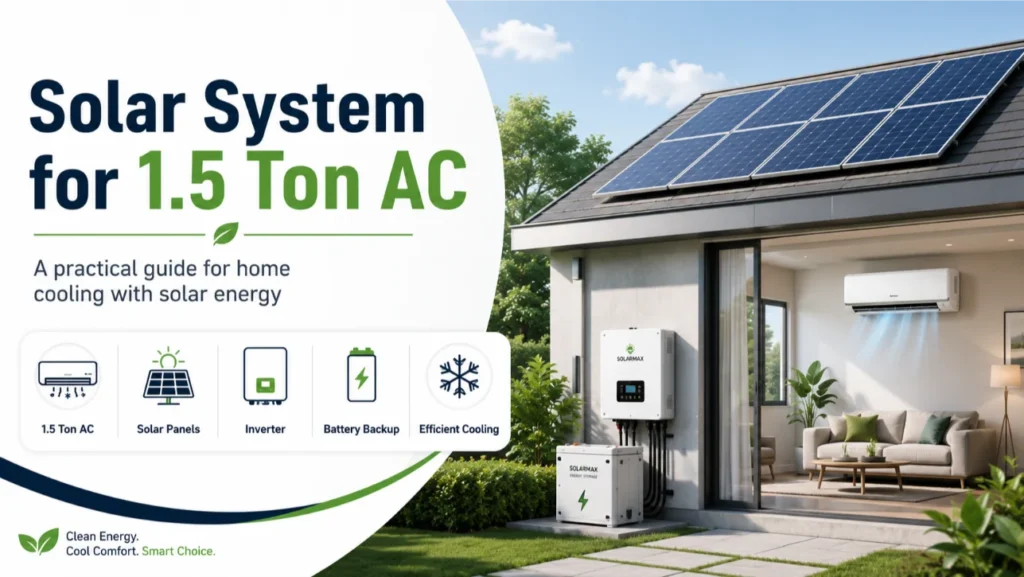
The 1.5-ton inverter AC is the most popular AC size in Pakistan — and the most common reason people go solar. A properly sized system runs it all day and powers your other appliances. This guide covers the exact solar system for 1.5 ton AC Pakistan requirements — sizes, costs, and savings for 2026.
Power Consumption of a 1.5-Ton AC
| AC Type | Rated Tonnage | Actual Running Watts | Daily Units (10 hr) |
|---|---|---|---|
| Inverter Split AC | 1.5 ton | 800–1,100W | 8–11 units |
| Non-Inverter Split AC | 1.5 ton | 1,500–1,750W | 15–17.5 units |
| DC Inverter (Pakistan-spec) | 1.5 ton | 850–1,050W | 8.5–10.5 units |
System Size for 1.5-Ton AC
| Scenario | Recommended System | On-Grid Price | Monthly Savings |
|---|---|---|---|
| AC only (daytime) | 2kW on-grid | Rs 170,000–190,000 | Rs 8,000–12,000 |
| AC + typical home | 3–4kW on-grid | Rs 255,000–360,000 | Rs 18,000–28,000 |
| AC + home + battery | 5kW hybrid | Rs 700,000–850,000 | Rs 25,000–35,000 |
What to Buy
- For a single 1.5-ton AC with basic home loads → 3kW on-grid system
- For AC + refrigerator + fans + lights → 4kW on-grid system
- If you have 4+ hours of load shedding → 4kW hybrid with 5kWh battery
- Always use an inverter-type AC — it uses 40% less power than a non-inverter
Frequently Asked Questions
Can a 2kW solar system run a 1.5-ton AC?
Technically yes, but barely. A 2kW system produces about 280W–350W per panel, and a 1.5-ton AC needs 800–1,100W. With 4–5 panels, you’ll cover the AC but have little headroom for other loads. A 3kW system is safer.
What brand 1.5-ton AC is most efficient for solar?
Gree, Haier, Dawlance, and Kenwood all offer INVERTER-class ACs with energy efficiency ratings of 5 stars. The Gree Fairy and Haier Pearl series are popular among solar users in Pakistan.
Get a Free Solar Quote for Your 1.5-Ton AC
Tell us your AC count and location — get an instant estimate.
Sources & references
Tariff, net-metering, and policy details on this page draw on the following official sources. Rates change often, so confirm current figures with the relevant authority or a licensed installer before you decide.
- NEPRA — National Electric Power Regulatory Authority: electricity tariffs and the 2026 shift from net metering to net billing.
- AEDB — Alternative Energy Development Board: solar policy, installer standards, and net-metering guidance.
- Your local distribution company (DISCO) — for example LESCO, K-Electric, IESCO, MEPCO, PESCO or QESCO — for area-specific tariffs and the net-metering application process.