پاکستان میں سولر پینل کے تازہ ترین ریٹس اور خبریں جانیں۔

How Solar Net Metering Billing Works in Pakistan — Simply Explained

Solar Net Metering Billing Pakistan

How Solar Net Metering Billing Works in Pakistan — Simply Explained

Net metering is the system that allows Pakistani solar owners to export surplus electricity to the WAPDA grid and receive credit on their bill. Many buyers install solar without fully understanding how net metering billing works — leading to surprises when bills arrive. This guide explains exactly how solar net metering billing Pakistan works — how units are counted, billed, and credited.

The Basic Concept

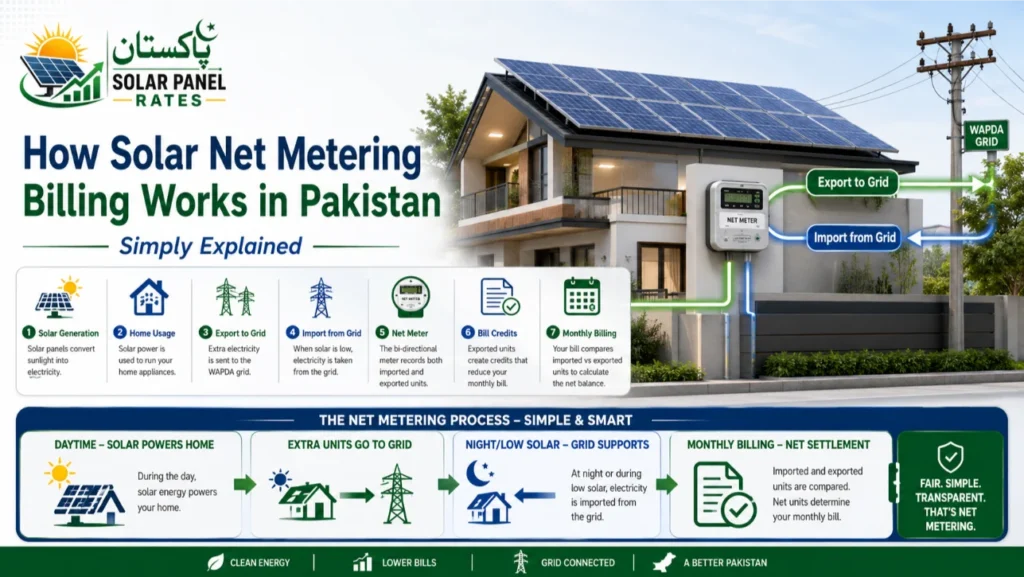
With net metering, your electricity meter measures two things: units you consume from the grid (import) and units your solar system exports to the grid (export). At the end of the billing period, your DISCO subtracts your exports from your imports. You pay only for the net difference — hence “net metering.”

How the Bill Calculation Works

ItemExample
Units imported from grid this month350 kWh
Units exported to grid from solar280 kWh
Net units billed (import − export)70 kWh
Applicable tariff slab101–200 unit rate (Rs. 10.06/kWh)
Energy charges70 × Rs. 10.06 = Rs. 704
Fixed charges + taxes (remain)~Rs. 1,500
Total bill~Rs. 2,204

The Quarterly Adjustment — Critical to Understand

Pakistan’s net metering policy has an important nuance: if your exports exceed your imports in a given month, the surplus is carried forward as a credit to the next month. However, at the end of each quarter, any remaining credit is purchased by the DISCO at the Avoided Cost Rate — which is significantly lower than the import tariff you pay.

⚠️ The import vs export rate gap: You pay Rs. 26–35/kWh to import electricity. WAPDA buys your surplus at the Avoided Cost Rate — approximately Rs. 14–19/kWh in 2026. This 40–50% rate gap means over-generating and exporting large surpluses gives poor returns. Size your system to cover your own consumption, not to export large surpluses.

Step-by-Step: What Happens Each Billing Cycle

  1. Your bidirectional (net metering) meter records both import and export kWh separately
  2. At your billing date, the DISCO meter reader records both figures
  3. The DISCO calculates net units: imports minus exports
  4. If net is positive (imported more than exported), you pay for net units at applicable slab rate
  5. If net is negative (exported more than imported), the surplus credit carries to next month
  6. At quarter end, accumulated export surplus is settled at Avoided Cost Rate — you receive credit on next bill

The Net Metering Connection Process

  1. Install AEDB-certified solar system with AEDB-certified inverter
  2. Submit net metering application to your local DISCO (LESCO, HESCO, MEPCO, etc.) with installation certificate, single-line diagram, and system specs
  3. DISCO conducts a site inspection (typically 4–8 weeks after application)
  4. DISCO installs the bidirectional meter (at applicant’s cost — Rs. 15,000–25,000)
  5. Net metering activation — usually 2–4 weeks after meter installation

Frequently Asked Questions

❓ How long does net metering approval take in Pakistan?
Total time from application to activation ranges from 6 weeks to 6 months depending on your DISCO and region. LESCO (Lahore) typically takes 8–16 weeks. HESCO (Hyderabad/Sindh) and MEPCO (Multan) have historically been slower. The biggest delays are in meter installation after inspection approval. Your solar system works as a self-consumption off-grid/hybrid system while net metering is pending — you don’t need net metering to use solar, only to get credit for exports.
❓ What is the maximum solar system size for net metering in Pakistan?
NEPRA allows net metering for systems up to the consumer’s sanctioned load (the maximum load on your electricity connection). Standard domestic connections in Pakistan typically have a 5–10 kW sanctioned load. You can apply to increase your sanctioned load to accommodate a larger solar system, though this involves additional DISCO fees and connection upgrade work.
❓ Can I do net metering without a hybrid inverter?
Yes — net metering works with grid-tied (string) inverters as well as hybrid inverters. The key requirement is that your inverter is AEDB-certified and grid-sync capable. String inverters export 100% of surplus directly; hybrid inverters store surplus in batteries first and only export what batteries can’t absorb. For maximum net metering exports, a string inverter with no battery is most straightforward. For load shedding backup, hybrid with battery is better.
❓ Will my WAPDA bill go to zero with solar net metering?
Your energy charges can go to near-zero or even result in a credit if your system generates more than you consume. However, your bill will never be truly zero — fixed charges (meter rent, minimum charges), electricity duty, and GST remain payable even with zero net consumption. Expect a minimum bill of Rs. 500–1,500/month even with a perfectly sized solar system.

Start your net metering journey

Net metering complete guide →  |  6kW system prices →

Sources & references

Tariff, net-metering, and policy details on this page draw on the following official sources. Rates change often, so confirm current figures with the relevant authority or a licensed installer before you decide.

  • NEPRA — National Electric Power Regulatory Authority: electricity tariffs and the 2026 shift from net metering to net billing.
  • AEDB — Alternative Energy Development Board: solar policy, installer standards, and net-metering guidance.
  • Your local distribution company (DISCO) — for example LESCO, K-Electric, IESCO, MEPCO, PESCO or QESCO — for area-specific tariffs and the net-metering application process.

Facebook
WhatsApp
About Solar Price Pakistan

Welcome to Solar Price Pakistan, your trusted source for the latest solar panel prices, solar system costs, and solar industry updates across Pakistan.

Recent Posts