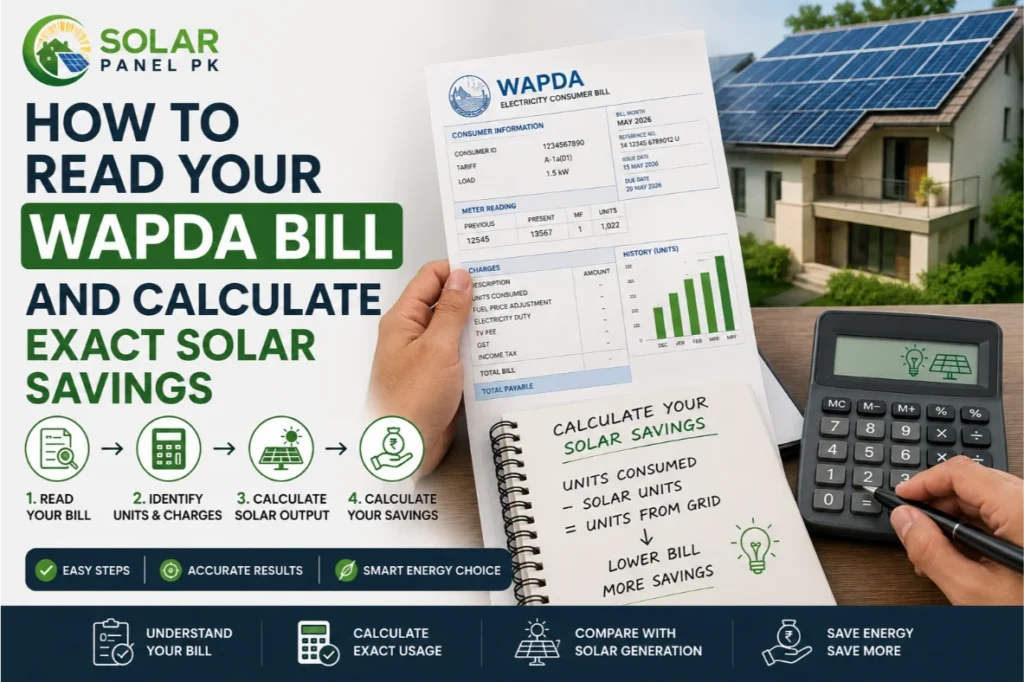
How to Read Your WAPDA Bill and Calculate Exact Solar Savings
Step 1 — Find Your Monthly Units Consumed
Look for the line labelled “Units Consumed” or “kWh” on your bill. This is the total electricity your home used during the billing period (usually 2 months for domestic WAPDA bills). Divide by 2 to get your monthly average.
Step 2 — Identify Your Per-Unit Rate
Pakistan uses a slab-based tariff — the per-unit rate increases as your consumption rises. As of 2026:
| Monthly Units | Rate (Rs./kWh) |
|---|---|
| 1–100 units | Rs. 22.44 |
| 101–200 units | Rs. 28.91 |
| 201–300 units | Rs. 33.10 |
| 301–400 units | Rs. 37.99 |
| 401–500 units | Rs. 40.22 |
| 501–600 units | Rs. 41.62 |
| 601–700 units | Rs. 42.76 |
| 700+ units | Rs. 47.69 |
High consumers (300+ units/month) pay the highest per-unit rates — which means they also get the highest solar savings per kWh generated.
Step 3 — Calculate Your Effective Per-Unit Cost
Don’t just look at the energy charges. Your bill also includes: fuel price adjustment (FPA), electricity duty, meter rent, and taxes. Divide your total bill amount by your units consumed to get the true effective rate you pay per kWh.
Example: Bill = Rs. 18,500 ÷ 550 units = Rs. 33.6 effective per kWh. This is the number to use for savings calculations — not the slab rate alone.
Step 4 — Estimate Your Solar System Generation
Pakistan averages 4.5–5 peak sun hours per day. Multiply your system size (kW) × 4.5 × 30 to get estimated monthly generation:
| System Size | Monthly Generation (est.) |
|---|---|
| 5 kW | 675 kWh/month |
| 6 kW | 810 kWh/month |
| 8 kW | 1,080 kWh/month |
| 10 kW | 1,350 kWh/month |
Step 5 — Calculate Monthly Solar Savings
Formula: Solar units generated × your effective per-kWh rate = monthly savings
Example: 6kW system generates 810 kWh × Rs. 33.6 effective rate = Rs. 27,216/month saved
Annual savings: Rs. 27,216 × 12 = Rs. 326,592/year
Step 6 — Calculate Payback Period
Formula: Total system cost ÷ annual savings = payback in years
Example: Rs. 900,000 system ÷ Rs. 326,592/year = 2.75 years payback
Frequently Asked Questions
⚡ Ready to go solar? Compare system prices in Pakistan
Sources & references
Tariff, net-metering, and policy details on this page draw on the following official sources. Rates change often, so confirm current figures with the relevant authority or a licensed installer before you decide.
- NEPRA — National Electric Power Regulatory Authority: electricity tariffs and the 2026 shift from net metering to net billing.
- AEDB — Alternative Energy Development Board: solar policy, installer standards, and net-metering guidance.
- Your local distribution company (DISCO) — for example LESCO, K-Electric, IESCO, MEPCO, PESCO or QESCO — for area-specific tariffs and the net-metering application process.