
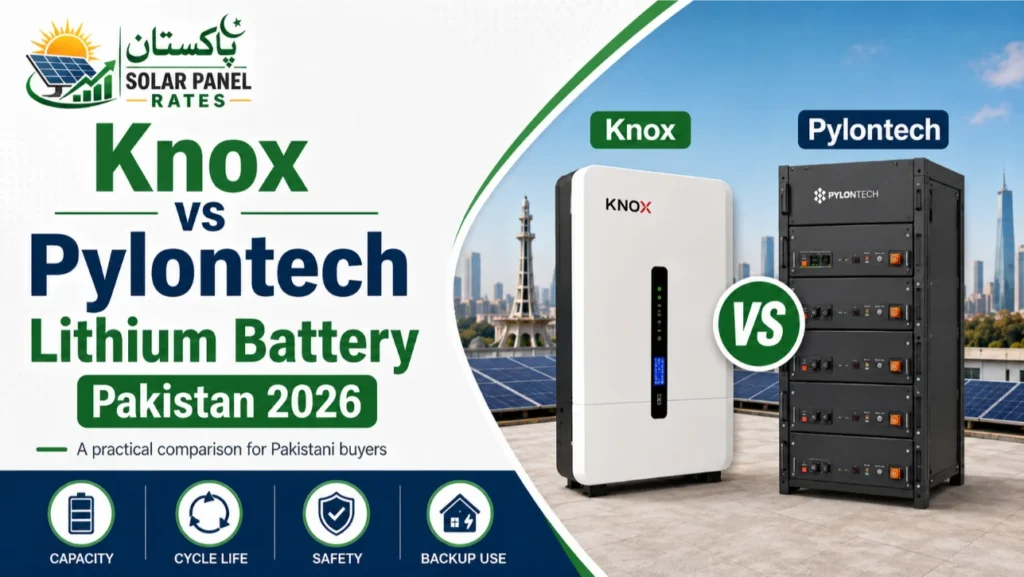
Knox vs Pylontech Lithium Battery Pakistan 2026 — Which to Buy?
Knox and Pylontech are two of the most popular lithium solar battery choices in Pakistan. Knox is a locally assembled brand; Pylontech is China’s leading LiFePO4 manufacturer. This guide compares them on price, performance, warranty, and value so you can make the right call for your solar system in 2026.
Knox vs Pylontech — Quick Comparison
| Feature | Knox Battery (Pakistan) | Pylontech (China) |
|---|---|---|
| Origin | Locally assembled (Pakistan) | Manufactured in China |
| Chemistry | LiFePO4 | LiFePO4 |
| Popular Models | Knox 5kWh, Knox 10kWh | US2000, US3000, UP5000 |
| Price (5kWh) | Rs 180,000–220,000 | Rs 230,000–280,000 |
| DoD (Depth of Discharge) | 80–90% | 95% |
| Cycle Life | 2,000–3,000 cycles | 6,000 cycles (at 95% DoD) |
| Warranty | 2–3 years | 5–10 years |
| Inverter Compatibility | Most hybrid inverters | Growatt, Deye, Sungrow, GoodWe (CAN) |
| BMS Communication | Basic | CAN/RS485 full BMS |
| Pakistan Availability | Widely available | Widely available |
Knox Battery — Pros & Cons
- Pro: Significantly cheaper — Rs 50,000–80,000 less than Pylontech per 5kWh
- Pro: Widely available across Pakistan — fast delivery
- Pro: Local support and repair — no import delays for warranty claims
- Pro: Compatible with most hybrid inverters on basic charge/discharge settings
- Con: Lower cycle life (2,000–3,000 vs 6,000 for Pylontech) — replaces sooner
- Con: Basic BMS — limited CAN communication with premium inverters
- Con: Shorter warranty period (2–3 years vs 5–10 for Pylontech)
- Con: DoD limited to 80–90% — less usable capacity per kWh
Pylontech Battery — Pros & Cons
- Pro: Industry-leading 6,000 cycle life at 95% DoD — outlasts Knox 2–3x
- Pro: Full CAN/RS485 BMS integration with Growatt, Deye, Sungrow, GoodWe inverters
- Pro: 5–10 year warranty — much stronger long-term protection
- Pro: Globally proven in millions of installations — reliability benchmark
- Pro: 95% usable DoD — more energy per kWh than most competitors
- Con: Rs 50,000–80,000 more expensive per 5kWh than Knox
- Con: Import-dependent — slight delays possible for warranty replacements
Total Cost of Ownership (10 Years, 5kWh System)
| Cost Item | Knox 5kWh | Pylontech US2000 (5kWh) |
|---|---|---|
| Purchase Price | Rs 200,000 | Rs 255,000 |
| Expected Replacements (10yr) | 1–2 replacements | 0 replacements |
| Replacement Cost | Rs 200,000–400,000 | Rs 0 |
| Total 10-Year Cost | Rs 400,000–600,000 | Rs 255,000 |
| 10-Year Verdict | More expensive long-term | Much better value over time |
Knox batteries offer attractive upfront pricing but the cycle life difference is significant. If you plan to use battery backup daily (as most load-shedding areas in Pakistan do), Pylontech’s 6,000-cycle life makes it cheaper over 10 years despite the higher initial cost.
Which Should You Buy?
- Buy Knox if: budget is very tight, you only need occasional backup (not daily cycling), or you need fast local availability
- Buy Pylontech if: you will cycle the battery daily (load shedding areas), want a 10-year system, or your inverter supports CAN communication (Growatt, Deye, Sungrow)
- For high load-shedding areas (6+ hours/day): Pylontech is strongly recommended
Frequently Asked Questions
Get Battery Prices from Installers
Compare Knox and Pylontech quotes from AEDB-licensed solar companies near you.
Sources & references
Tariff, net-metering, and policy details on this page draw on the following official sources. Rates change often, so confirm current figures with the relevant authority or a licensed installer before you decide.
- NEPRA — National Electric Power Regulatory Authority: electricity tariffs and the 2026 shift from net metering to net billing.
- AEDB — Alternative Energy Development Board: solar policy, installer standards, and net-metering guidance.
- Your local distribution company (DISCO) — for example LESCO, K-Electric, IESCO, MEPCO, PESCO or QESCO — for area-specific tariffs and the net-metering application process.