پاکستان میں سولر پینل کے تازہ ترین ریٹس اور خبریں جانیں۔

Global LiFePO4 Battery Supply 2026 — Why Prices Dropped and What Happens Next

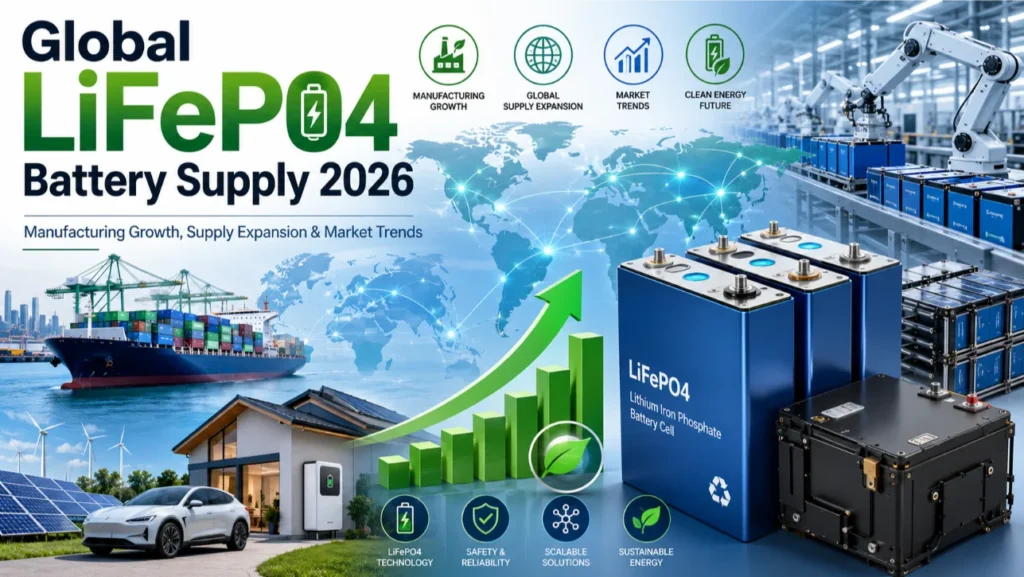
Global LiFePO4 Battery Supply 2026

Global LiFePO4 Battery Supply 2026 — Why Prices Dropped and What Happens Next

LiFePO4 (lithium iron phosphate) battery prices have fallen dramatically — a 5kWh home storage battery that cost Rs. 350,000–400,000 in 2022 now costs Rs. 175,000–220,000 in 2026. This 40–50% price drop has made solar-plus-storage accessible to far more Pakistani households. Understanding why prices fell helps buyers decide whether to buy now or wait for further reductions.

Why LiFePO4 Prices Fell So Dramatically

1. Chinese Manufacturing Dominance

China produces approximately 75–80% of the world’s lithium battery cells, with CATL, BYD, CALB, and EVE Energy dominating global supply. These manufacturers have invested hundreds of billions of yuan in new gigafactories over 2020–2025, dramatically expanding production capacity beyond current global demand.

2. Lithium Carbonate Price Collapse

Lithium carbonate — the primary raw material for LiFePO4 batteries — peaked at approximately $80,000/tonne in late 2022, driven by EV demand hysteria and supply constraints. By 2024–2026, new lithium mining projects in Australia, Chile, and China came online, crashing lithium carbonate prices to $8,000–12,000/tonne — an 85% fall. Since lithium is ~5% of battery cell cost, this translated directly into lower battery prices.

3. EV Market Slower Than Forecast

EV adoption in the US and Europe grew slower than manufacturers projected in 2021–2022. This meant battery production capacity outpaced actual EV demand, creating surplus that manufacturers redirected to stationary storage (home and grid) — increasing competition and lowering prices.

LiFePO4 Price History in Pakistan

YearPylontech US5000 (4.8kWh) — Pakistan Price
2022Rs. 320,000–380,000
2023Rs. 250,000–290,000
2024Rs. 200,000–240,000
2026Rs. 175,000–210,000

What Happens to Battery Prices Next?

💡 The consensus view: Battery prices will continue to fall gradually (5–15% per year) but the dramatic crash phase is likely over. Lithium prices have stabilized and some analysts expect a modest recovery as demand grows. The next step-change reduction may come when sodium-ion batteries achieve commercial scale (possibly 2027–2029) — they use no lithium and could be 20–30% cheaper than LiFePO4.
Scenario2027–2028 Battery Price Direction
Baseline (most likely)Gradual 5–10% annual decline
Sodium-ion breakthroughPossible 15–25% additional fall if Na-ion scales
Lithium supply tighteningPrices stabilize or modestly rise
Trade war escalationPossible 10–20% increase if China restricts exports

Should You Buy Now or Wait?

For Pakistani buyers, the calculus is straightforward: every month without a solar+storage system means paying WAPDA rates and enduring load shedding. At current prices, a complete solar system with battery storage pays back in 4–6 years. Waiting 1 year for a potential 5–10% further price reduction saves Rs. 30,000–60,000 on a system — but costs Rs. 80,000–150,000 in electricity bills and lost comfort from continued load shedding.

Frequently Asked Questions

❓ Why are LiFePO4 batteries cheaper than NMC batteries?
LiFePO4 (lithium iron phosphate) uses iron and phosphate in its cathode rather than nickel, manganese, and cobalt (NMC). Iron and phosphate are far more abundant and cheaper than cobalt (which is scarce and geopolitically concentrated in the DRC). LiFePO4 also has a longer cycle life and better safety profile. The trade-off is lower energy density — LiFePO4 batteries are heavier and larger per kWh, which matters for EVs but not for stationary home storage.
❓ What is sodium-ion battery technology?
Sodium-ion batteries work on the same principle as lithium-ion but use sodium ions instead of lithium. Sodium is far more abundant (essentially unlimited — it’s in table salt) and cheaper than lithium. CATL launched its first commercial sodium-ion products in 2023. Sodium-ion currently has lower energy density and cycle life than LiFePO4, but for stationary home storage (where size matters less than for EVs), it could be competitive by 2027–2029 at lower costs. This is the technology most likely to provide the next significant price reduction for home solar storage.
❓ Are cheaper LiFePO4 batteries less reliable than they were in 2022?
Not necessarily — price falls have come primarily from manufacturing efficiencies, raw material price drops, and scale rather than quality cuts. For established brands (Pylontech, Dyness, BYD, Knox), quality has remained consistent. The risk of quality degradation is higher with unknown brands entering the market on price. Stick to brands with verifiable 10-year warranties and proven global track records.
❓ How much do solar batteries cost in Pakistan in 2026?
In Pakistan in 2026: Pylontech US5000 (4.8kWh) costs Rs. 175,000–210,000; Dyness DL5.0 (5.12kWh) runs Rs. 200,000–255,000; Knox 5.12kWh lithium battery is Rs. 165,000–200,000; BYD Battery-Box HVS 10.2 (10.24kWh premium) runs Rs. 550,000–650,000. These are approximately 40–50% lower than 2022 equivalent prices.

🔋 Compare battery storage prices in Pakistan

Pylontech prices →  |  Dyness prices →  |  All battery brands →

Sources & references

Tariff, net-metering, and policy details on this page draw on the following official sources. Rates change often, so confirm current figures with the relevant authority or a licensed installer before you decide.

  • NEPRA — National Electric Power Regulatory Authority: electricity tariffs and the 2026 shift from net metering to net billing.
  • AEDB — Alternative Energy Development Board: solar policy, installer standards, and net-metering guidance.
  • Your local distribution company (DISCO) — for example LESCO, K-Electric, IESCO, MEPCO, PESCO or QESCO — for area-specific tariffs and the net-metering application process.
Facebook
WhatsApp
About Solar Price Pakistan

Welcome to Solar Price Pakistan, your trusted source for the latest solar panel prices, solar system costs, and solar industry updates across Pakistan.

Recent Posts