
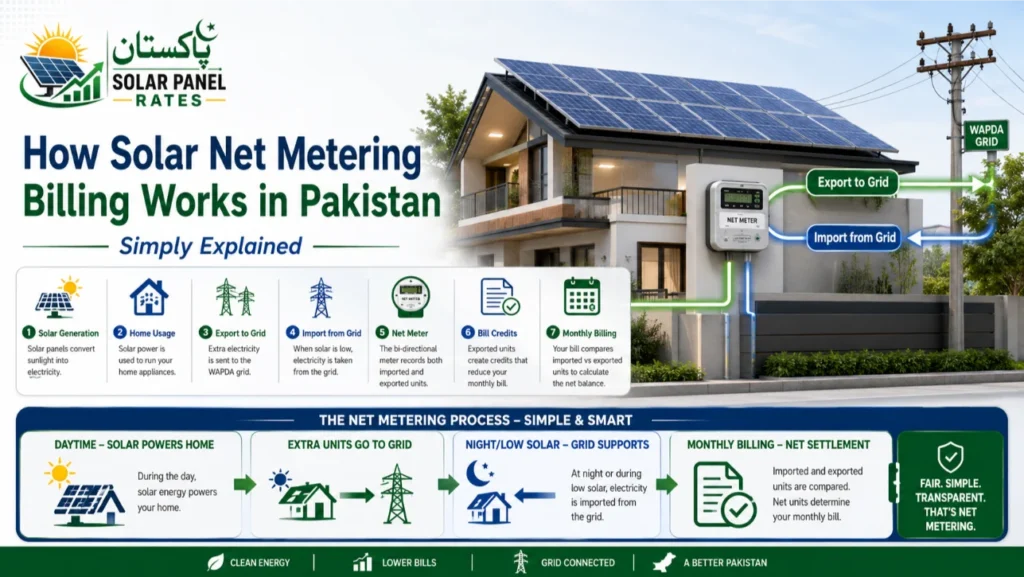
How Solar Net Metering Billing Works in Pakistan — Simply Explained
The Basic Concept
With net metering, your electricity meter measures two things: units you consume from the grid (import) and units your solar system exports to the grid (export). At the end of the billing period, your DISCO subtracts your exports from your imports. You pay only for the net difference — hence “net metering.”
How the Bill Calculation Works
| Item | Example |
|---|---|
| Units imported from grid this month | 350 kWh |
| Units exported to grid from solar | 280 kWh |
| Net units billed (import − export) | 70 kWh |
| Applicable tariff slab | 101–200 unit rate (Rs. 10.06/kWh) |
| Energy charges | 70 × Rs. 10.06 = Rs. 704 |
| Fixed charges + taxes (remain) | ~Rs. 1,500 |
| Total bill | ~Rs. 2,204 |
The Quarterly Adjustment — Critical to Understand
Pakistan’s net metering policy has an important nuance: if your exports exceed your imports in a given month, the surplus is carried forward as a credit to the next month. However, at the end of each quarter, any remaining credit is purchased by the DISCO at the Avoided Cost Rate — which is significantly lower than the import tariff you pay.
Step-by-Step: What Happens Each Billing Cycle
- Your bidirectional (net metering) meter records both import and export kWh separately
- At your billing date, the DISCO meter reader records both figures
- The DISCO calculates net units: imports minus exports
- If net is positive (imported more than exported), you pay for net units at applicable slab rate
- If net is negative (exported more than imported), the surplus credit carries to next month
- At quarter end, accumulated export surplus is settled at Avoided Cost Rate — you receive credit on next bill
The Net Metering Connection Process
- Install AEDB-certified solar system with AEDB-certified inverter
- Submit net metering application to your local DISCO (LESCO, HESCO, MEPCO, etc.) with installation certificate, single-line diagram, and system specs
- DISCO conducts a site inspection (typically 4–8 weeks after application)
- DISCO installs the bidirectional meter (at applicant’s cost — Rs. 15,000–25,000)
- Net metering activation — usually 2–4 weeks after meter installation
Frequently Asked Questions
⚡ Start your net metering journey
Sources & references
Tariff, net-metering, and policy details on this page draw on the following official sources. Rates change often, so confirm current figures with the relevant authority or a licensed installer before you decide.
- NEPRA — National Electric Power Regulatory Authority: electricity tariffs and the 2026 shift from net metering to net billing.
- AEDB — Alternative Energy Development Board: solar policy, installer standards, and net-metering guidance.
- Your local distribution company (DISCO) — for example LESCO, K-Electric, IESCO, MEPCO, PESCO or QESCO — for area-specific tariffs and the net-metering application process.