Next-Generation Inverter Technology 2026 — What’s Coming to Pakistan?
Key Inverter Technology Trends in 2026
1. Wide Bandgap Semiconductors (SiC and GaN)
Traditional inverters use silicon-based IGBTs and MOSFETs as switching components. Silicon carbide (SiC) and gallium nitride (GaN) semiconductors switch faster, generate less heat, and have lower switching losses than silicon. The result: higher efficiency (97–99% vs 95–97.5% for conventional), smaller size, and lower weight.
SiC-based inverters are already in premium products globally. In Pakistan, Growatt’s newer SPH series and Deye’s SUN-series incorporate SiC components — bringing efficiency above 97.5%. Expect SiC to become standard across all mid-range hybrids by 2027–2028.
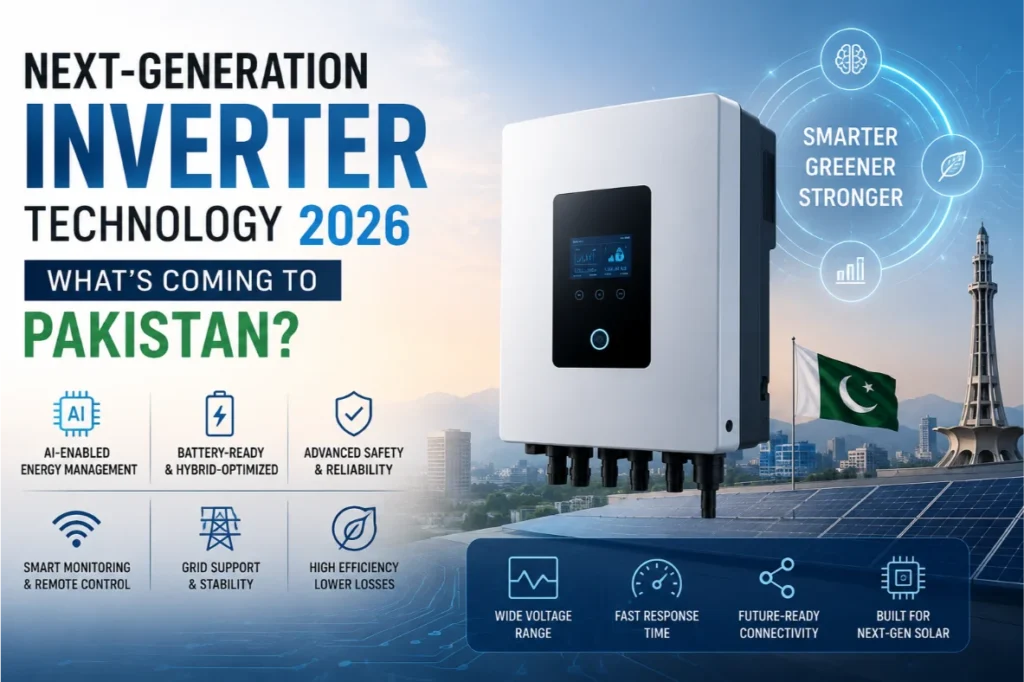
2. AI-Powered Energy Management
Modern inverters from Huawei, GoodWe, and Growatt now include AI load forecasting. By analyzing historical generation patterns, weather forecast data, and household consumption profiles, these systems optimize when to charge batteries, when to export to grid, and when to prioritize loads. In Pakistan’s context, AI can optimize battery charging around load shedding schedules — pre-charging batteries before known outage windows.
3. Virtual Power Plants (VPP) — Pakistan Future
In Australia, Germany, and the US, thousands of home solar+battery systems are being coordinated into Virtual Power Plants — essentially treating distributed home batteries as a single large power station that can be managed to support grid stability. Pakistan’s grid instability and load shedding problem is exactly the kind of challenge VPP technology is designed to address, though implementation is years away given grid infrastructure gaps.
4. EV Bidirectional Charging (V2H/V2G)
Vehicle-to-home (V2H) inverters can use an EV battery as home energy storage — charging from solar during the day and powering the home at night. Huawei’s LUNA2000 system, GoodWe’s EV charger integration, and SMA’s EV inverter already support this. As EVs grow in Pakistan (currently minimal but growing), bidirectional inverters will become increasingly relevant. Expect Pakistan dealers to stock V2H-capable inverters by 2027–2028.
5. Module-Level Power Electronics (MLPE) — Microinverters
Traditional string inverters mean partial shading of one panel reduces output from all panels in a string. Microinverters (one inverter per panel) and DC optimisers solve this by optimising each panel independently. Enphase microinverters are available in Pakistan at premium prices. For rooftops with shading issues (from water tanks, AC units, neighbouring buildings), MLPE adds meaningful generation value.
Inverter Features Available in Pakistan Right Now
| Feature | Available in Pakistan? | Brands |
|---|---|---|
| WiFi monitoring app | ✅ Standard on all hybrids | All major brands |
| Dual MPPT | ✅ Standard on premium hybrids | Deye, GoodWe, Knox, Sungrow |
| IP65 weatherproofing | ✅ Available | Deye, Knox, Sungrow |
| SiC high-efficiency | ✅ Available in newer models | Growatt SPH, Deye SUN series |
| AI load management | ⚠️ Limited — premium products only | Huawei SUN2000, GoodWe ES |
| EV bidirectional (V2H) | ⚠️ Very rare, special order | Huawei, SMA (imported) |
| Microinverters | ⚠️ Available but premium price | Enphase (special order) |
| Virtual Power Plant | ❌ Not available yet | Future — requires grid reform |
Frequently Asked Questions
⚡ Compare inverter prices in Pakistan
Sources & references
Tariff, net-metering, and policy details on this page draw on the following official sources. Rates change often, so confirm current figures with the relevant authority or a licensed installer before you decide.
- NEPRA — National Electric Power Regulatory Authority: electricity tariffs and the 2026 shift from net metering to net billing.
- AEDB — Alternative Energy Development Board: solar policy, installer standards, and net-metering guidance.
- Your local distribution company (DISCO) — for example LESCO, K-Electric, IESCO, MEPCO, PESCO or QESCO — for area-specific tariffs and the net-metering application process.