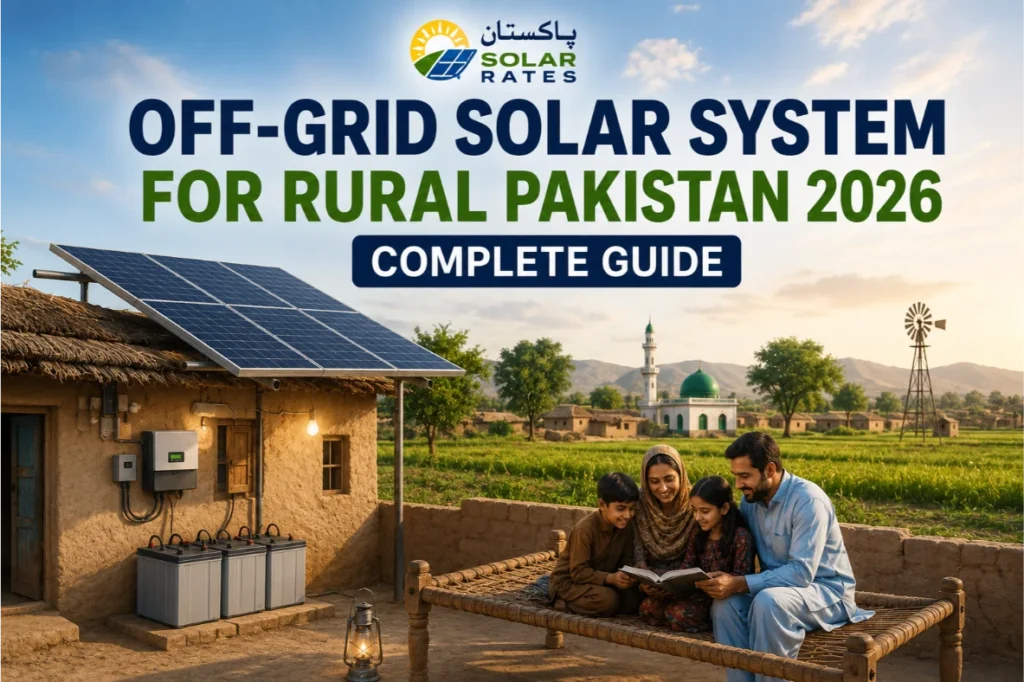
Off-Grid Solar System for Rural Pakistan 2026 — Complete Guide
Over 20 million Pakistanis live without reliable grid electricity — or with no grid connection at all. For rural villages in Balochistan, KPK’s mountain districts, Sindh’s interior, and southern Punjab’s remote areas, solar off-grid systems are the only practical path to reliable electricity. This guide covers everything rural buyers need to know about off-grid solar.
Off-Grid vs Hybrid — Understanding the Difference
| Feature | Off-Grid Solar | Hybrid Solar |
|---|---|---|
| Grid connection required | ❌ No — fully independent | ✅ Connected to WAPDA grid |
| Works when WAPDA is down | ✅ Always — 100% independent | ✅ Yes — on battery |
| Net metering possible | ❌ No | ✅ Yes |
| Battery requirement | Large (all storage) | Smaller (backup only) |
| Best for | No grid access at all | Areas with grid but load shedding |
Sizing an Off-Grid System for a Rural Home
Off-grid sizing is more critical than hybrid — you cannot draw from the grid when batteries run low. Design for 3–5 days of battery autonomy (cloudy days without solar input) and size panels to fully recharge batteries in 1 peak-sun day.
| Household Size | Daily Load | Panels | Battery | Approx. Cost |
|---|---|---|---|---|
| Basic (lights, fans, phone charging) | 3–5 kWh/day | 4 × 550W | 2 × 200Ah tubular | Rs. 250,000–400,000 |
| Standard (+ fridge, TV) | 8–12 kWh/day | 8–10 × 550W | 4 × 200Ah or 1 lithium 5kWh | Rs. 600,000–900,000 |
| Comfortable (+ 1 AC) | 18–25 kWh/day | 12–16 × 550W | 2 × lithium 5kWh | Rs. 1,200,000–1,800,000 |
Key Off-Grid System Components
- Solar panels: Same panels as grid-tied systems — LONGi, Jinko, or local brands
- Off-grid inverter: Pure sine wave inverter with built-in MPPT charge controller — Growatt SPF series, Fronus off-grid, Voltronic Axpert series are popular in rural Pakistan
- Battery bank: Tubular lead-acid (cheaper, requires maintenance) or lithium LiFePO4 (expensive, maintenance-free, longer life). For rural areas, lithium is worth the premium to avoid water maintenance challenges
- DC wiring: Heavier gauge DC cable runs between panels and controller — longer runs require larger cables to reduce resistance losses
- Mounting: Ground-mount is common in rural areas with land space — avoids roof structural concerns
Challenges Specific to Rural Off-Grid Pakistan
- Supply chain: Getting inverters, batteries, and cables to remote areas adds logistics cost. Factor in Rs. 15,000–40,000 for transport to remote locations
- Maintenance: Lead-acid battery water top-ups require distilled water — not always available in remote areas. Lithium batteries eliminate this
- Technical support: Remote locations have limited access to qualified solar technicians. Choose reliable brands with local dealer networks even if it costs more
- Dust: Rural areas often have very high dust levels requiring more frequent panel cleaning. Manual cleaning access (ladder, water supply) needs to be factored into siting
Frequently Asked Questions
❓ What is the best battery for an off-grid rural home in Pakistan?
For rural Pakistan, lithium (LiFePO4) batteries are strongly preferred despite higher upfront cost. Lead-acid requires monthly distilled water top-ups — difficult in areas without reliable supply. Lithium is completely maintenance-free, lasts 10+ years vs 3–5 for lead-acid in solar applications, and performs better in heat. Pylontech, Dyness, and Knox lithium batteries are available through national distributors who can arrange delivery to remote areas.
❓ How many days of autonomy should an off-grid system in Pakistan have?
Design for 2–3 days of battery autonomy for areas with generally clear skies (Balochistan, southern Punjab). Design for 3–5 days in areas with more cloud cover (KPK mountain districts, monsoon-affected zones). “Autonomy” means operating at normal load without any solar input — a safety buffer for extended cloudy periods. Over-sizing batteries is expensive; under-sizing leads to generator dependence during cloudy spells.
❓ Are there government programs for rural off-grid solar in Pakistan?
Yes — the PM Solar Scheme, AEDB rural electrification programs, and provincial Rural Support Programmes (RSPs) have all implemented off-grid solar projects in unelectrified villages. NRSP (National Rural Support Programme) and SRSP (Sarhad Rural Support Programme) coordinate village-scale off-grid solar in KPK and Punjab. Applications go through local RSP offices or Union Council offices. World Bank and ADB-funded projects also specifically target off-grid rural electrification.
❓ Can an off-grid solar system later be converted to grid-tied if electricity reaches the village?
Yes — with planning. If you buy an off-grid inverter that also has grid-sync capability (like Growatt SPF hybrid series or Victron Quattro), the system can be connected to the grid when it arrives without replacing the inverter. Pure off-grid-only inverters cannot be retroactively connected to the grid. If grid extension is planned within 5–7 years, invest in a hybrid-capable off-grid inverter from the start.
⚡ Power your home independently
Sources & references
Tariff, net-metering, and policy details on this page draw on the following official sources. Rates change often, so confirm current figures with the relevant authority or a licensed installer before you decide.
- NEPRA — National Electric Power Regulatory Authority: electricity tariffs and the 2026 shift from net metering to net billing.
- AEDB — Alternative Energy Development Board: solar policy, installer standards, and net-metering guidance.
- Your local distribution company (DISCO) — for example LESCO, K-Electric, IESCO, MEPCO, PESCO or QESCO — for area-specific tariffs and the net-metering application process.