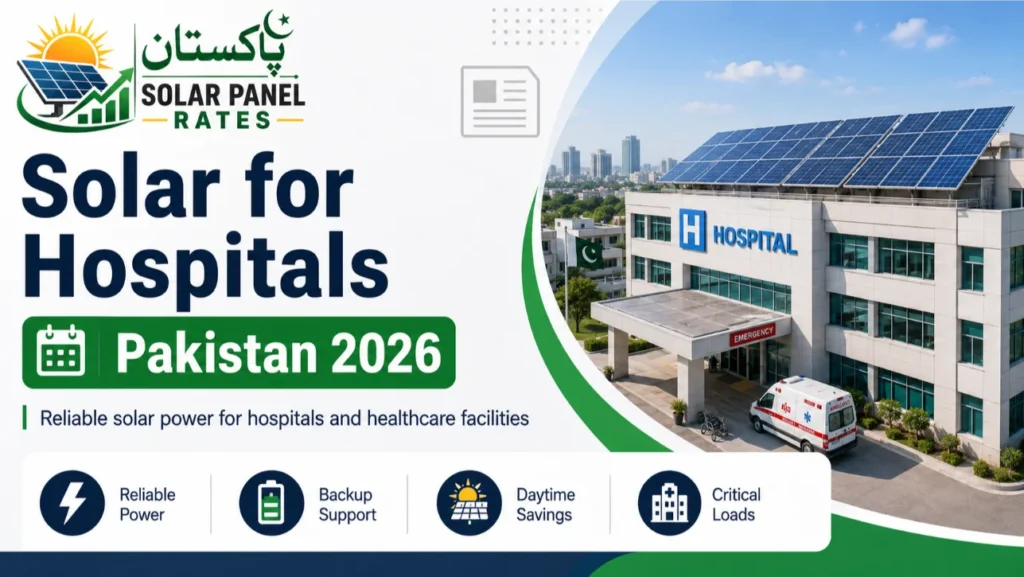
Solar for Hospitals in Pakistan 2026 — Complete Guide
Hospitals are among Pakistan’s highest electricity consumers — and solar offers massive savings potential. But medical facilities have unique requirements: critical loads, 24/7 uptime, and zero tolerance for power failure. This guide covers everything hospital administrators need to know about solar in Pakistan in 2026.
Why Hospitals in Pakistan Need Solar
- Hospitals typically pay Rs 200,000–800,000+/month on electricity — one of the highest commercial categories
- Commercial and industrial electricity tariffs (C1/C2/C3) are highest — Rs 50–80/unit including FCAs and taxes
- Load shedding severely impacts patient care — backup power is medically necessary
- Solar + battery hybrid eliminates diesel generator dependency — saving Rs 50,000–200,000/month in fuel costs
- Pakistan’s NEPRA net metering policy allows hospitals to offset 100% of daytime consumption
Recommended System Sizes for Hospitals
| Hospital Type | Typical Load | Recommended System | Est. Monthly Saving |
|---|---|---|---|
| Small clinic (5–10 beds) | 10–20 kW | 10–15kW on-grid | Rs 60,000–120,000 |
| Medium hospital (20–50 beds) | 30–60 kW | 30–50kW + battery | Rs 180,000–400,000 |
| Large hospital (100+ beds) | 100–300 kW | 100–200kW + battery bank | Rs 600,000–2,000,000 |
| Specialized facility/ICU | 50–100 kW | 50kW hybrid + UPS integration | Rs 300,000–600,000 |
Critical Load Planning for Medical Facilities
Hospitals must never experience power interruption to life-critical equipment. Solar systems for medical facilities must include: automatic transfer switches (ATS), UPS integration for ICU/OT, separate solar circuits for critical vs non-critical loads, and diesel generator as tertiary backup. Do not install solar-only systems in hospitals without battery and generator backup.
Sample System Design — 50-Bed Hospital
| Component | Specification | Estimated Cost |
|---|---|---|
| Solar Panels | 50kW (83 × 600W TOPCon) | Rs 1,500,000–1,800,000 |
| Hybrid Inverter | 50kW three-phase | Rs 600,000–800,000 |
| Battery Bank | 100kWh LiFePO4 | Rs 1,200,000–1,600,000 |
| Mounting + BOS | Commercial roof mount | Rs 400,000–600,000 |
| ATS + Protection | Medical-grade changeover | Rs 150,000–250,000 |
| Net Meter + PPIB | Commercial application | Rs 80,000–120,000 |
| Labour + Commission | Certified commercial installer | Rs 300,000–500,000 |
| Total | Rs 4,230,000–5,670,000 |
ROI for Hospital Solar in Pakistan
| Hospital Size | System Cost | Monthly Saving | Payback Period |
|---|---|---|---|
| Small clinic | Rs 1,200,000–1,800,000 | Rs 80,000–120,000 | 12–18 months |
| 50-bed hospital | Rs 4,200,000–5,700,000 | Rs 300,000–450,000 | 13–18 months |
| 100-bed hospital | Rs 8,000,000–12,000,000 | Rs 600,000–900,000 | 12–16 months |
Hospital solar ROI is excellent because commercial electricity tariffs are high (Rs 50–80/unit). Even with battery systems, payback periods of 12–18 months are achievable — after which the saving is pure profit for the facility.
PPIB/NEPRA Compliance for Hospitals
- Engage a PPIB-enlisted EPC contractor — mandatory for net metering approval
- File net metering application with your DISCO (LESCO/HESCO/IESCO etc.) — commercial category C1/C2/C3
- Ensure all solar equipment meets NEPRA technical standards
- Get electrical safety inspection from your provincial electrical inspection authority
- Commission the system and obtain net metering connection certificate
Get Hospital Solar Quotes in Pakistan
Consult PPIB-enlisted commercial solar companies for a free site assessment and proposal.
Sources & references
Where this page states a rule, a tariff or a registration requirement, it comes from the documents below. Links go to the document itself, not a homepage. Prices on this page come from our own daily rate feed, not from these sources.
- NEPRA (Prosumer) Regulations, 2026 — notified 6 August 2026. Sets the framework that replaced straight net metering with net billing. Under it, a prosumer facility of 25 kW or below does not need concurrence from the Authority.
- NEPRA net-metering licences — the register of issued distributed-generation and net-metering licences.
- Checklist for enlistment of installers under the AEDB (Certification) Regulations, 2021 — the actual requirements an installer must meet. Note that AEDB was dissolved and merged into PPIB in July 2023, so enlistment is handled by PPIB, even though the regulations still carry the AEDB name.
- Your distribution company — LESCO, MEPCO, FESCO, GEPCO, IESCO, PESCO, QESCO, HESCO, SEPCO or K-Electric — for the tariff that applies to your area and the net-metering application itself. K-Electric runs its own process, separate from the DISCOs.
Regulatory links last checked 4 October 2026. Rules change; confirm current figures with the authority or a licensed installer before you commit money.

Abubaker Jalil
Abubaker Jalil is an electrical engineer and a graduate of the University of Engineering and Technology (UET) Peshawar. He tracks panel, inverter and battery prices across Pakistan's wholesale solar markets and writes the buying guides on this site. If a dealer has quoted you a figure that does not match what you see here, write to info@solarpricepakistan.com.pk and it gets checked.