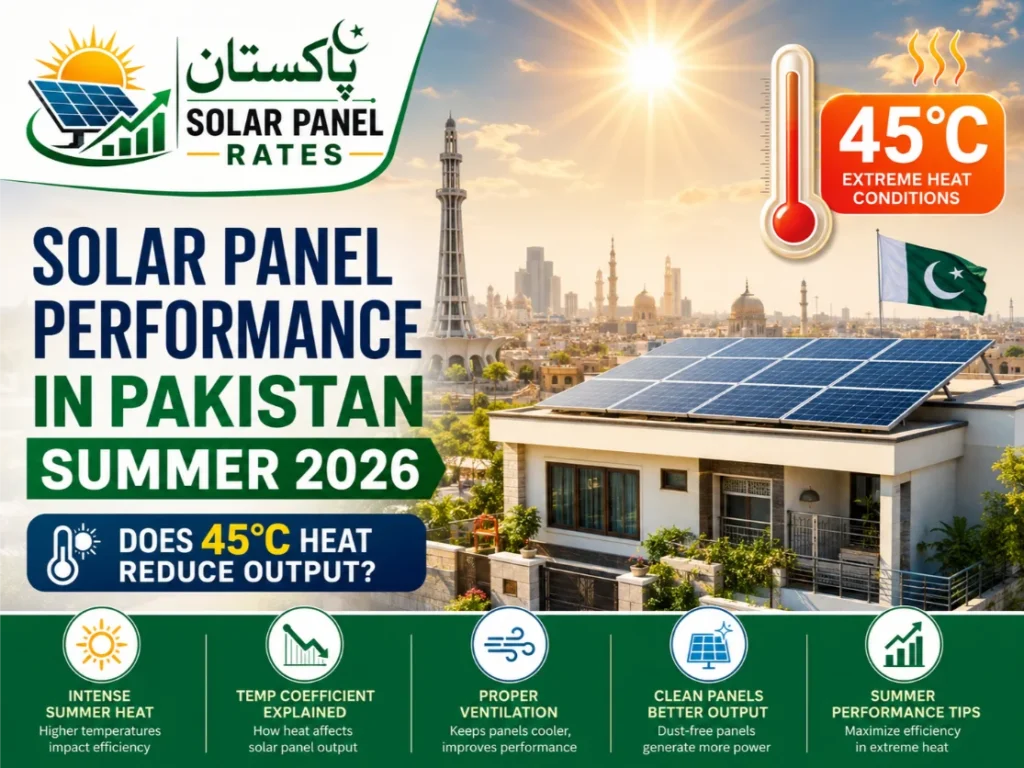
Solar Panel Performance in Pakistan Summer 2026 — Does 45°C Heat Reduce Output?
Why Heat Reduces Solar Panel Efficiency
Solar panels are rated at Standard Test Conditions (STC): 25°C cell temperature, 1,000 W/m² irradiance. In Pakistan’s summer, panels can reach 65–80°C on the cell surface — well above STC. Every 1°C above 25°C reduces output by the panel’s “temperature coefficient” (typically -0.34% to -0.45%/°C for standard silicon cells).
| Cell Temperature | Output vs Rated (mono PERC -0.38%/°C) |
|---|---|
| 25°C (STC — rated) | 100% |
| 45°C (mild summer) | 92.4% |
| 60°C (hot summer day) | 86.7% |
| 70°C (extreme heat) | 82.9% |
| 75°C (worst case Pakistan) | 81.0% |
The Offsetting Factor: Irradiance
Here’s what solar sellers and buyers often miss: Pakistani summers have dramatically higher irradiance (sunlight intensity) than the STC test condition. While Pakistan’s peak summer heat reduces efficiency by 15–20%, the longer days (14+ hours of daylight in June), higher sun angle, and lower atmospheric moisture in April–June produce more total solar energy hitting the panels than any other time of year. The net effect: summer generation is still 30–40% higher than winter despite the heat penalty.
January average: 22 kWh/day
June average: 32 kWh/day
The 10°C higher cell temperature in June costs 4–5% efficiency — but 2+ extra peak sun hours per day produces 45% more generation. Heat hurts, but daylight wins.
Panel Technologies and Heat Performance
| Technology | Temp Coefficient | Heat Performance |
|---|---|---|
| Standard Mono PERC | -0.38 to -0.40%/°C | Good |
| TOPCon (N-type) | -0.30 to -0.35%/°C | Better — recommended for hot Pakistan |
| HJT (Heterojunction) | -0.24 to -0.26%/°C | Best — significantly better in heat |
| Polycrystalline (old) | -0.40 to -0.45%/°C | Worst — avoid for Pakistan |
TOPCon panels (now widely available in Pakistan from Jinko, LONGi, Solarmax) are the recommended choice for Pakistani buyers — better efficiency, better heat coefficient, longer warranty, and comparable pricing to PERC in 2026.
How to Maximise Summer Performance
- Keep panels clean: Dust accumulation in summer (especially in Lahore, Karachi, Multan) can reduce output 15–30% before cleaning — far more impact than heat
- Ensure airflow under panels: Panels mounted directly on a flat roof with no gap trap heat. A 10–15cm mounting gap allows airflow and reduces cell temperatures by 5–10°C
- Choose TOPCon or HJT: Better temperature coefficient gives measurable real-world advantage in Pakistan’s climate
- Monitor generation: Use your inverter’s app to monitor daily generation — compare to expected output and clean panels if significantly below expectation
Frequently Asked Questions
☀️ Get maximum summer performance
Sources & references
Tariff, net-metering, and policy details on this page draw on the following official sources. Rates change often, so confirm current figures with the relevant authority or a licensed installer before you decide.
- NEPRA — National Electric Power Regulatory Authority: electricity tariffs and the 2026 shift from net metering to net billing.
- AEDB — Alternative Energy Development Board: solar policy, installer standards, and net-metering guidance.
- Your local distribution company (DISCO) — for example LESCO, K-Electric, IESCO, MEPCO, PESCO or QESCO — for area-specific tariffs and the net-metering application process.