US-China Solar Trade War 2026 — How It Affects Pakistan’s Solar Market
Timeline of US Solar Trade Actions Against China
| Year | Action | Impact |
|---|---|---|
| 2012 | First US anti-dumping tariffs on Chinese panels (30%) | Chinese manufacturers rerouted through Taiwan/Malaysia |
| 2018 | Section 201 tariffs — 30% on all imported panels | US solar prices rose; global supply redirected |
| 2022 | UFLPA (Uyghur Forced Labor) — banned panels using Xinjiang polysilicon | Major supply disruption; LONGi, Jinko, JA Solar affected |
| 2024 | Anti-circumvention tariffs on SE Asia-routed Chinese panels (50–250%) | Vietnam, Malaysia, Cambodia channels blocked |
| 2025–26 | Additional tariffs under new trade executive orders | Chinese panels effectively priced out of US market |
How This Affects Pakistan — The Key Insight
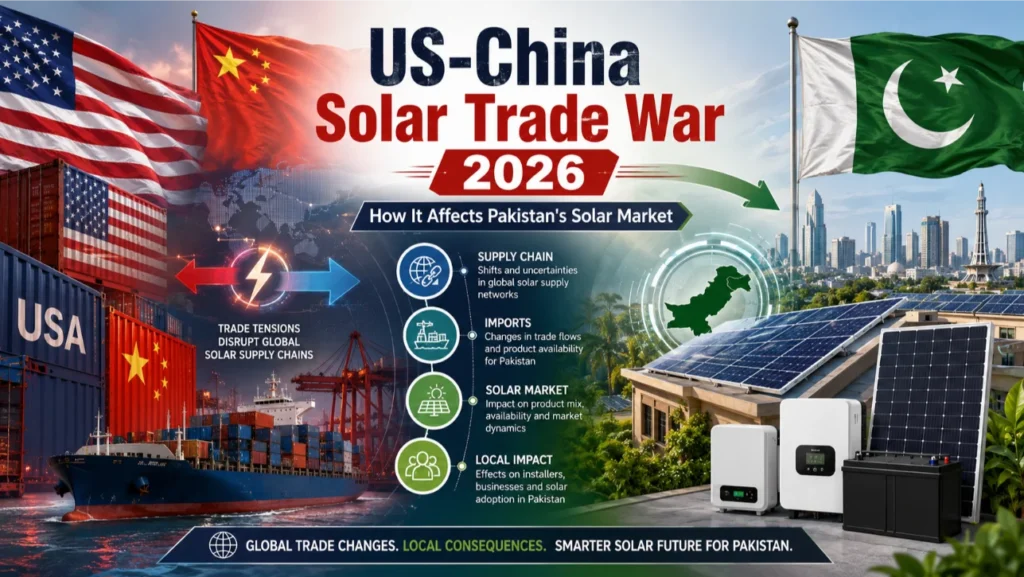
Pakistan has zero import duties on solar panels under its renewable energy import policy. Pakistan is one of the world’s most attractive markets for Chinese solar exports precisely because it imposes no tariffs. As US and EU markets become increasingly difficult for Chinese manufacturers, they redirect sales efforts to tariff-free markets like Pakistan, Bangladesh, Vietnam, and the Middle East.
This means: the more aggressive US trade restrictions become, the more aggressively Chinese manufacturers compete for Pakistan’s market — driving prices down and increasing product availability.
The UFLPA (Forced Labour) Issue in Pakistan’s Context
The US Uyghur Forced Labor Prevention Act targets solar panels using polysilicon from China’s Xinjiang province, where a significant portion of the world’s polysilicon is produced. US buyers must prove their panels contain no Xinjiang polysilicon — a complex supply chain audit requirement that has disrupted major brands including LONGi, Jinko, and JA Solar in the US market.
What Changed in Pakistan’s Market Due to the Trade War
- More aggressive pricing: Chinese manufacturers locked out of the US market with higher-margin sales have pushed for volume in Pakistan — contributing to 2023–2026 price declines
- Better availability of premium products: LONGi Hi-MO X6, Jinko Tiger Neo (TOPCon), and other premium products are now available in Pakistan that previously might have been preferentially sold to US/EU customers
- Faster technology adoption: Chinese manufacturers deploy their newest products in friendly markets — Pakistan gets access to TOPCon, bifacial, and higher-watt panels faster
- Warranty risk consideration: If US sanctions escalate to restrict Chinese company operations globally, warranty service from affected brands could theoretically be impacted — though this remains a theoretical rather than practical risk for Pakistani buyers today
Frequently Asked Questions
☀️ See current solar prices in Pakistan
Sources & references
Tariff, net-metering, and policy details on this page draw on the following official sources. Rates change often, so confirm current figures with the relevant authority or a licensed installer before you decide.
- NEPRA — National Electric Power Regulatory Authority: electricity tariffs and the 2026 shift from net metering to net billing.
- AEDB — Alternative Energy Development Board: solar policy, installer standards, and net-metering guidance.
- Your local distribution company (DISCO) — for example LESCO, K-Electric, IESCO, MEPCO, PESCO or QESCO — for area-specific tariffs and the net-metering application process.