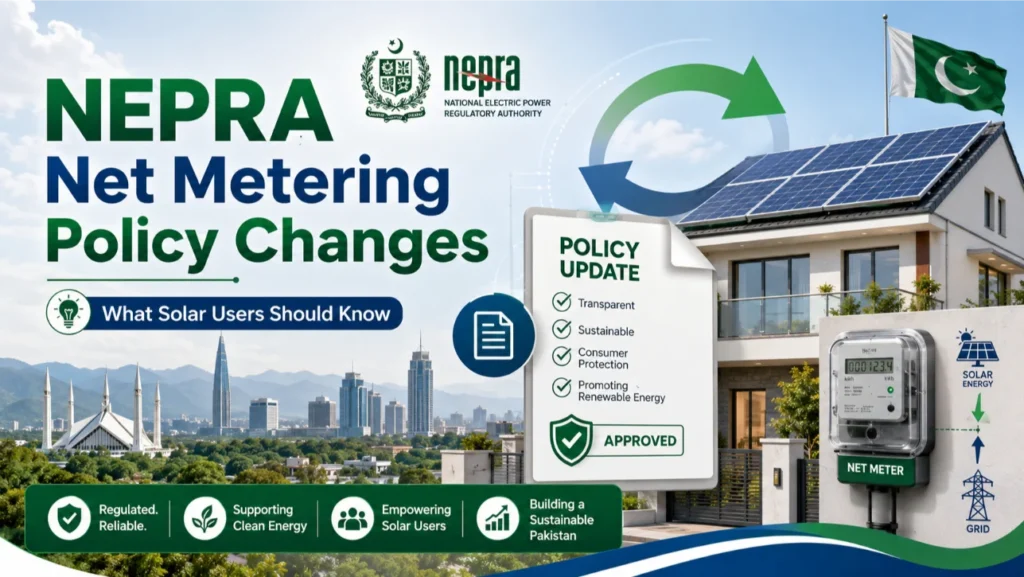
NEPRA Net Metering Policy Changes 2026 — What Every Solar Owner Must Know
What Is Net Metering in Pakistan?
Net metering allows solar system owners connected to the national grid to feed excess electricity back to their DISCO (Distribution Company) and receive credit on their electricity bill. Under Pakistan’s net metering framework, the exported units offset your imported units at the same tariff rate — meaning your bill is calculated on the net difference between what you consume and what you produce.
Key Net Metering Policy Points in 2026
| Parameter | Current Rule (2026) |
|---|---|
| Eligible system size | 1kW – 1MW (residential: typically 1kW–100kW) |
| Export rate | Same as import tariff (kWh for kWh offset) |
| Billing period | Monthly — net units billed |
| Rollover of excess credits | Excess units roll over month to month; annual settlement at Rs. 2/kWh buyback |
| Required inverter type | Grid-tied or hybrid with anti-islanding protection |
| AEDB certification | Mandatory for inverter — must be on AEDB approved list |
| Installer requirement | Must be AEDB-licensed installer |
| Application fee | Rs. 5,000–25,000 depending on DISCO and system size |
| Bidirectional meter | Supplied and installed by DISCO at owner’s cost |
What Changed in 2025–2026?
- Annual buyback rate revised — Excess annual generation credits are now settled at approximately Rs. 2/kWh (previously higher). Design your system to avoid large annual surpluses.
- Processing timeline enforcement — NEPRA has mandated DISCOs to process net metering applications within 60 days of complete document submission. Previously, backlogs stretched to 6+ months.
- Commercial category expansion — Commercial and industrial users up to 1MW can now apply, opening net metering to factories and large commercial buildings.
- Simplified documentation — Single-window facilitation at many DISCOs has reduced the number of offices applicants need to visit.
Net Metering Application Process (2026)
- Install your system — Use an AEDB-certified inverter and an AEDB-licensed installer. Keep all invoices and installation documents.
- Submit application to DISCO — Documents needed: CNIC copy, latest electricity bill, single-line diagram, inverter AEDB certification, installer license, property proof.
- Technical inspection — DISCO engineer visits to inspect the installation (anti-islanding, wiring standards, panel orientation). Typically scheduled within 2–4 weeks of application.
- Bidirectional meter installation — DISCO installs a bidirectional (import/export) meter at your property. You pay the meter cost (~Rs. 15,000–25,000).
- Connection agreement signing — Sign the Distribution Interconnection Agreement (DIA) with your DISCO. This formalizes net metering terms.
- First net metered bill — From your next billing cycle, bills will show both import and export readings — your bill is the net difference.
Which DISCOs Are Fastest for Net Metering in 2026?
| DISCO | Coverage Area | Avg. Processing Time | Online Portal |
|---|---|---|---|
| LESCO | Lahore division | 45–75 days | Yes |
| IESCO | Islamabad + Rawalpindi | 30–60 days | Yes |
| MEPCO | Multan, southern Punjab | 60–90 days | Partial |
| FESCO | Faisalabad division | 60–90 days | Partial |
| HESCO | Hyderabad, interior Sindh | 90–120 days | Limited |
| PESCO | Peshawar, KPK | 90–120 days | Limited |
| QESCO | Quetta, Balochistan | 120–180 days | No |
Frequently Asked Questions
🌞 Ready to go solar with net metering?
Check current inverter prices and system costs to plan your setup.
All inverter brands → | 5kW system guide → | Today’s panel prices →
Sources & references
Tariff, net-metering, and policy details on this page draw on the following official sources. Rates change often, so confirm current figures with the relevant authority or a licensed installer before you decide.
- NEPRA — National Electric Power Regulatory Authority: electricity tariffs and the 2026 shift from net metering to net billing.
- AEDB — Alternative Energy Development Board: solar policy, installer standards, and net-metering guidance.
- Your local distribution company (DISCO) — for example LESCO, K-Electric, IESCO, MEPCO, PESCO or QESCO — for area-specific tariffs and the net-metering application process.