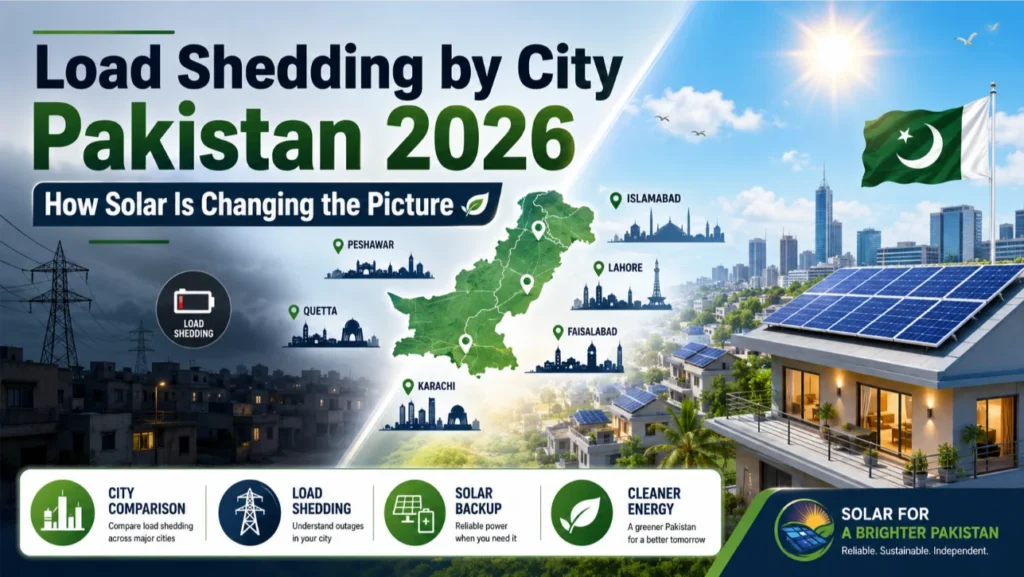
Load Shedding by City Pakistan 2026 — How Solar Is Changing the Picture
Load shedding remains one of Pakistan’s most persistent economic and quality-of-life challenges. In 2026, urban areas experience 4–10 hours of scheduled outages daily, while rural areas face 12–20 hours. Solar energy — particularly hybrid systems with battery backup — is now the most practical solution for most Pakistani households. This guide covers load shedding by city and how solar with storage eliminates the problem.
Load Shedding Hours by City — Pakistan 2026 (Estimated)
| City | DISCO | Urban Load Shedding | Rural Load Shedding |
|---|---|---|---|
| Karachi | KESC/KE | 2–6 hrs/day | 6–12 hrs/day |
| Lahore | LESCO | 4–8 hrs/day | 8–14 hrs/day |
| Islamabad | IESCO | 2–5 hrs/day | 6–10 hrs/day |
| Rawalpindi | IESCO | 4–8 hrs/day | 10–14 hrs/day |
| Faisalabad | FESCO | 6–10 hrs/day | 12–18 hrs/day |
| Multan | MEPCO | 6–12 hrs/day | 14–20 hrs/day |
| Peshawar | PESCO | 8–12 hrs/day | 16–20 hrs/day |
| Quetta | QESCO | 8–14 hrs/day | 16–22 hrs/day |
| Hyderabad | HESCO | 6–10 hrs/day | 14–18 hrs/day |
| Gujranwala | GESCO | 6–10 hrs/day | 12–16 hrs/day |
Note: Load shedding hours are indicative based on 2025–2026 patterns. Summer peaks (May–August) and winter peaks (December–January) often see higher than average outages.
⚠️ Unscheduled outages: In addition to scheduled load shedding, Pakistan experiences frequent unscheduled outages (faults, tripping, transformer failures). Rural areas especially face long restoration times. Solar + battery backup addresses both scheduled and unscheduled outages.
Why Hybrid Solar + Battery Is the Best Load Shedding Solution
- Automatic switchover — Hybrid inverters switch to battery power within milliseconds of a grid outage — no manual generator start, no UPS delay
- Silent operation — Unlike generators, solar+battery runs silently 24/7
- Zero fuel cost — No diesel or gas cost once installed
- Covers both day and night outages — Solar charges batteries during day; batteries cover nighttime load shedding
- Net metering during grid hours — When grid is up, export excess solar and earn credits on your bill
How Many Hours of Backup Does a Solar+Battery System Provide?
| Home Load | 1 Battery (5kWh) | 2 Batteries (10kWh) | 3 Batteries (15kWh) |
|---|---|---|---|
| Light (fans, lights, fridge only) ~500W | 8–10 hrs | 16–20 hrs | 24+ hrs |
| Medium (1 AC + basics) ~1,500W | 2–3 hrs | 5–6 hrs | 8–10 hrs |
| Heavy (2 AC + basics) ~3,000W | 1–1.5 hrs | 2.5–3 hrs | 4–5 hrs |
💡 Right-sizing tip: For cities with 8–12 hours of daily load shedding, most households need 2–3 batteries (10–15kWh). The solar panels recharge batteries during daylight — so the system is self-sustaining even through extended outages as long as there’s sun for recharging.
Solar Adoption Rate by City — Pakistan 2026
- 🥇 Lahore — Highest solar adoption nationally. LESCO area has most rooftop installations.
- 🥈 Islamabad/Rawalpindi — Highest average system sizes. High-income households, 10kW+ systems common.
- 🥉 Faisalabad — Industrial solar leader. Factory rooftop solar very common.
- 4️⃣ Karachi — Rapid growth despite KE (not WAPDA) grid. KE’s net metering is available.
- 5️⃣ Peshawar — Fastest growing market. High load shedding is a strong driver.
Frequently Asked Questions
❓ Can solar completely eliminate load shedding impact in Pakistan?
Yes — a properly sized hybrid solar system with adequate battery storage can provide uninterrupted power regardless of grid outages. For a typical 2-AC Pakistani home with 10–12 hours of daily load shedding, a 6kW–8kW system with 2–3 lithium batteries (10–15kWh) will eliminate the impact of outages for most of the day.
❓ What happens to a solar system during a grid outage?
A hybrid solar inverter automatically switches to battery + solar power within milliseconds of a grid outage. Your home continues running normally with no interruption. When the grid comes back, the inverter seamlessly reconnects and resumes exporting/importing as needed.
❓ Is solar better than a generator for load shedding in Pakistan?
For most households, solar+battery is significantly better than a generator. Solar has zero fuel cost (generators cost Rs. 3,000–8,000/month in diesel), silent operation, automatic switchover, and also saves on your electricity bill during grid hours. The only advantage generators have is unlimited runtime — solar batteries deplete if load shedding is very long and there’s been no sun. A combination of solar+battery as primary backup + small generator for emergencies is ideal for areas with 16+ hours of daily outages.
❓ Which Pakistani city has the worst load shedding in 2026?
Rural areas across Multan, Peshawar, Quetta, and interior Sindh and Balochistan consistently experience the longest outages — often 16–22 hours per day. Ironically, these high-irradiance areas are also where solar performs best, making the ROI case for solar extremely strong.
🔋 End load shedding with solar+battery backup
Check inverter and battery prices to build your backup system.
All inverter brands → | All battery brands → | Hybrid solar guide →

Written by
Abubaker Jalil
Abubaker Jalil is an electrical engineer and a graduate of the University of Engineering and Technology (UET) Peshawar. He tracks panel, inverter and battery prices across Pakistan's wholesale solar markets and writes the buying guides on this site. If a dealer has quoted you a figure that does not match what you see here, write to info@solarpricepakistan.com.pk and it gets checked.