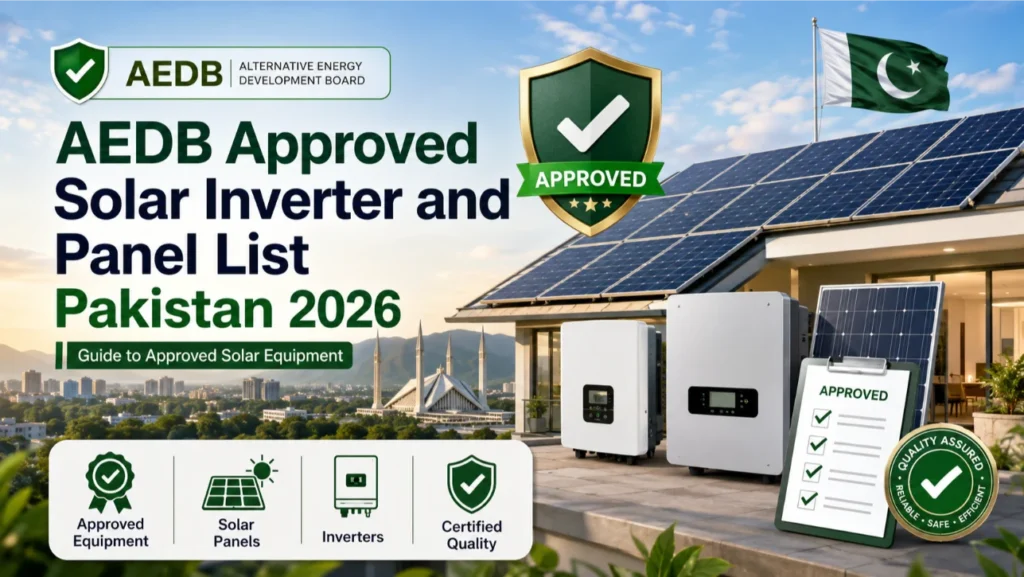
If you are looking for an official AEDB list of approved solar panels and inverters, there is a short answer: no current list exists, and the body that would have published it was dissolved in 2023. Here is what the rule actually said, what replaced it, and what to check before you buy.
What happened to AEDB
AEDB was the federal body set up to promote alternative and renewable energy in Pakistan. In July 2023 the government formally dissolved it and folded its functions into PPIB, which now administers the certification regime AEDB used to run, including the AEDB (Certification) Regulations, 2021.
The name has stuck. Installers still say “AEDB approved”, buyers still search for it, and plenty of websites still print lists under that heading. The term is now shorthand for something handled elsewhere.
The rule was about companies, not a catalogue of panels
This causes more confusion than anything else, and it was true even before the merger.
NEPRA’s Distributed Generation and Net Metering Regulations, 2015 set the framework for connecting a rooftop system to the grid. Under the standard operating procedures attached to it, only approved or empanelled vendors and service providers were eligible to carry out net-metering connections up to 250 kW, and AEDB was tasked with setting quality standards for panels and allied equipment.
So the requirement attached to the company doing the work. There was never a published catalogue of individual panel models or inverter part numbers you could look your purchase up in. A table of brands with ticks beside them is not a regulatory document — it is somebody’s opinion formatted to look like one.
Who actually decides today
| Body | What it does for a rooftop system |
|---|---|
| Your DISCO LESCO, IESCO, MEPCO, K-Electric and the rest | Receives the application and inspects the installation. For systems up to 250 kW the DISCO’s Sub-Divisional Officer is the final approving authority for design and technical feasibility. In practice this is the office that decides whether your equipment is acceptable. |
| NEPRA | Issues the generation licence or net-metering certificate once the application clears. |
| PPIB | Holds the certification records for solar companies under the AEDB (Certification) Regulations, 2021, since the 2023 merger. |
Note what is missing from that table: nobody publishes a public list of approved panel models for you to check a brand against. If a salesman tells you a specific panel is “on the approved list”, ask him which list, and who publishes it.
Net metering is being replaced by net billing
Separately, NEPRA notified new Prosumer Regulations in 2026 that move new connections from net metering to net billing, changing how your exported units are valued. If you are planning a system now, that affects your payback far more than any approval question. See net metering to net billing and the current NEPRA policy.
What to check before you buy
Since there is no list to look things up in, the checks that matter are documentary and local.
- Ask the company for its registration, in writing. A legitimate installer can produce a certificate with a number and an expiry date. Our guide on how to check whether a solar installer is licensed covers verifying it rather than taking their word.
- Ask your DISCO before you pay. The single most useful call you can make. The office that will approve or reject your application will tell you what it requires, and their answer beats anything written on a website, including this one.
- Ask for the inverter’s compliance documents. Grid-tie inverters sold for net metering are tested against international standards and the manufacturer issues certificates. Ask for the certificate covering the exact model you are quoted, not the brand in general.
- Check the panel’s own label. Certification marks such as IEC 61215 are printed on the back of the panel. Confirm the model on the label matches the model on the quotation.
- Get the quotation itemised. Panel model and count, inverter model, structure, cabling, protection and labour as separate lines. Vague quotations are where substitutions happen.
Frequently Asked Questions
Sources & references
Where this page states a rule, a tariff or a registration requirement, it comes from the documents below. Links go to the document itself, not a homepage. Prices on this page come from our own daily rate feed, not from these sources.
- NEPRA (Prosumer) Regulations, 2026 — notified 6 August 2026. Sets the framework that replaced straight net metering with net billing. Under it, a prosumer facility of 25 kW or below does not need concurrence from the Authority.
- NEPRA net-metering licences — the register of issued distributed-generation and net-metering licences.
- Checklist for enlistment of installers under the AEDB (Certification) Regulations, 2021 — the actual requirements an installer must meet. Note that AEDB was dissolved and merged into PPIB in July 2023, so enlistment is handled by PPIB, even though the regulations still carry the AEDB name.
- Your distribution company — LESCO, MEPCO, FESCO, GEPCO, IESCO, PESCO, QESCO, HESCO, SEPCO or K-Electric — for the tariff that applies to your area and the net-metering application itself. K-Electric runs its own process, separate from the DISCOs.
Regulatory links last checked 4 October 2026. Rules change; confirm current figures with the authority or a licensed installer before you commit money.

Abubaker Jalil
Abubaker Jalil is an electrical engineer and a graduate of the University of Engineering and Technology (UET) Peshawar. He tracks panel, inverter and battery prices across Pakistan's wholesale solar markets and writes the buying guides on this site. If a dealer has quoted you a figure that does not match what you see here, write to info@solarpricepakistan.com.pk and it gets checked.