
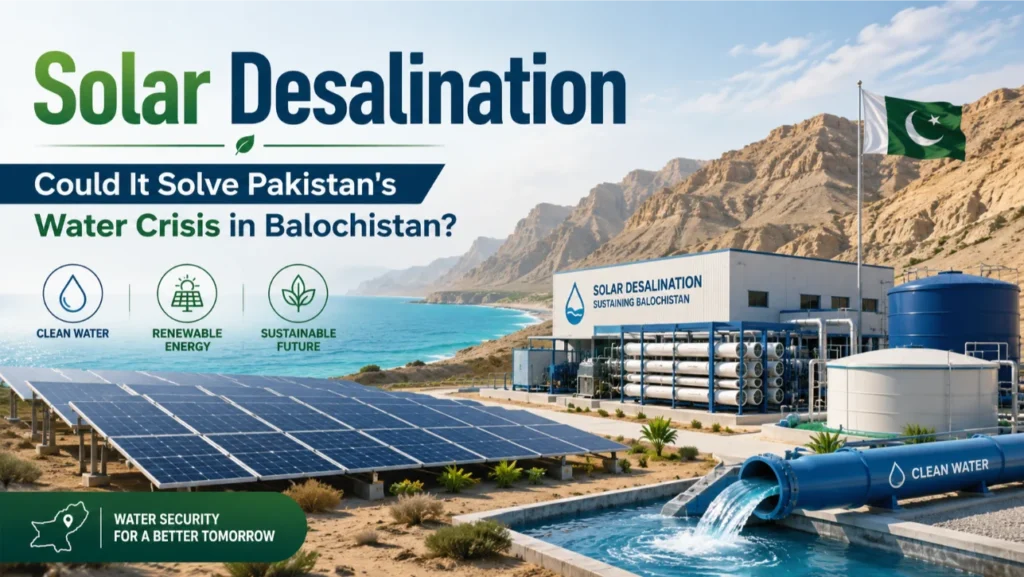
Solar Desalination — Could It Solve Pakistan’s Water Crisis in Balochistan?
Pakistan’s Water Crisis — The Numbers
| Metric | Pakistan | Context |
|---|---|---|
| Per capita water availability | ~860 m³/year | Below 1,000 m³ = water-scarce |
| Balochistan groundwater | Mostly saline / brackish | Not directly drinkable in large areas |
| Coastal Balochistan (Makran) | Arabian Sea access — 780km coastline | Seawater desalination potential |
| Balochistan solar irradiance | 5.5–6.5 kWh/m²/day | Among highest in Asia |
| Balochistan electrification rate | ~40–50% | Low grid access = solar-only viable |
Two Solar Desalination Technologies for Pakistan
1. Solar-Powered Reverse Osmosis (RO)
The most commercially proven approach. Solar panels power electric pumps that force saline water through semi-permeable membranes at high pressure, removing salt. Solar RO plants are modular, scalable from village-scale (1,000 litres/day) to city-scale (millions of litres/day), and are already deployed in coastal areas of Saudi Arabia, UAE, and India.
- Best for: Brackish groundwater treatment (lower salt content = less energy needed)
- Energy requirement: 3–10 kWh per m³ of water produced
- Already deployed in Pakistan: Small solar RO units exist in Thar (Sindh) and parts of Balochistan
2. Solar Thermal Distillation
Uses solar heat (concentrated solar or simple solar stills) to evaporate seawater, then condense the vapour as fresh water. Lower technology but lower output. More suitable for small community or household scale.
- Best for: Very small communities without electricity access
- Output: Limited — solar stills produce 3–5 litres/m² per day
- Advantage: No moving parts, minimal maintenance, ultra-low cost
What Solar Desalination Could Do for Balochistan
A 100kW solar system (approximately Rs. 10–12 million installed) powering a reverse osmosis plant could produce approximately 50,000–100,000 litres of fresh water per day — enough for a village of 500–1,000 people. Balochistan’s exceptional solar resource (6+ kWh/m²/day) means these systems run longer daily and produce more water per installed kW than in most other parts of the world.
Current Projects and Status (2026)
- AHAN (Agha Khan) and NRSP have deployed small solar-RO units in Balochistan’s Lasbela and Khuzdar districts
- CPEC’s Gwadar development includes desalination as a priority — a Chinese-funded desalination plant is under planning for Gwadar city
- Pakistan Navy has small-scale reverse osmosis units at remote coastal posts in Balochistan
- PCRWR (Pakistan Council of Research in Water Resources) has published feasibility studies on solar desalination for Balochistan’s interior
Frequently Asked Questions
⚡ Solar energy solutions for Pakistan — explore prices
Sources & references
Tariff, net-metering, and policy details on this page draw on the following official sources. Rates change often, so confirm current figures with the relevant authority or a licensed installer before you decide.
- NEPRA — National Electric Power Regulatory Authority: electricity tariffs and the 2026 shift from net metering to net billing.
- AEDB — Alternative Energy Development Board: solar policy, installer standards, and net-metering guidance.
- Your local distribution company (DISCO) — for example LESCO, K-Electric, IESCO, MEPCO, PESCO or QESCO — for area-specific tariffs and the net-metering application process.