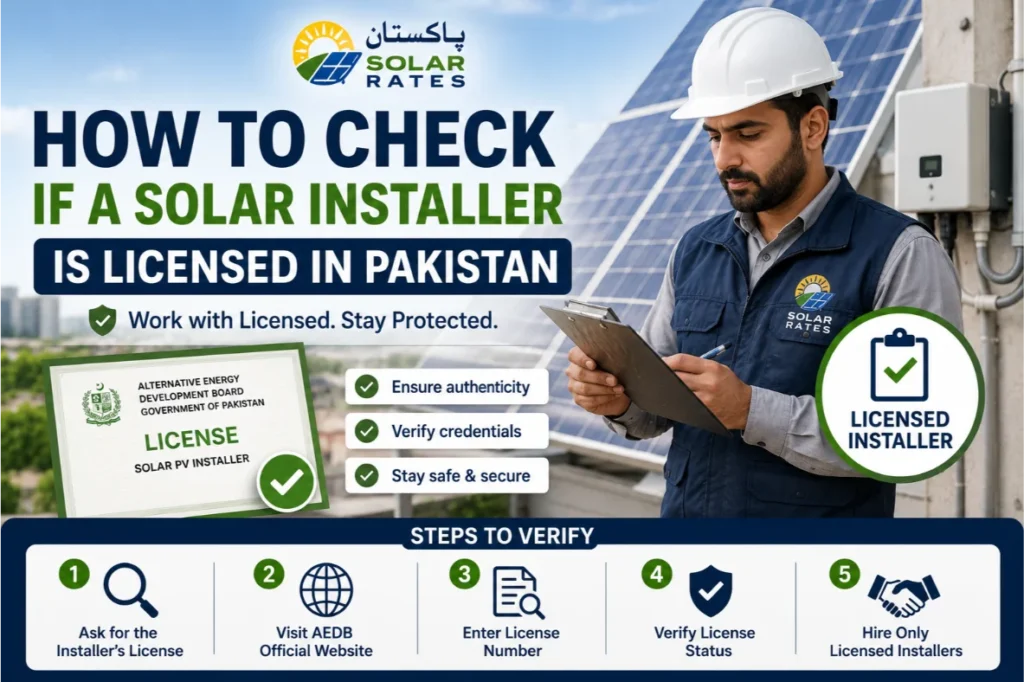
How to Check if a Solar Installer Is Licensed in Pakistan
Pakistan’s solar boom has created thousands of solar installation companies — ranging from highly professional licensed firms to unqualified individuals with a truck and a ladder. Hiring an unlicensed installer risks poor installation quality, electrical safety hazards, voided warranties, and net metering rejection. This guide tells you exactly how to verify an installer before you hire.
Why Licensing Matters
- AEDB-registered installers are required for net metering applications — unlicensed installations are rejected by DISCOs
- Licensed installers must follow AEDB’s installation standards — protecting your system from wiring faults and fire risk
- Manufacturer warranties often require installation by certified professionals — unlicensed installation can void panel and inverter warranties
- Electrical work on rooftops by unqualified persons is a significant safety risk — Pakistan has seen fatal accidents from improper solar installation
How to Verify an Installer — Step by Step
- Ask for their AEDB registration number: All legitimate solar installers should be registered with the Alternative Energy Development Board (AEDB). Ask for their AEDB registration certificate — it includes a registration number and expiry date.
- Verify on AEDB’s website: Visit aedb.org.pk and look for the “Registered Companies” or “Installer Directory” section. Search for the company by name or registration number to confirm their registration is current and valid.
- Check for NEPRA licensing (for larger systems): For systems above 25kW (commercial/industrial), the installer should also hold a NEPRA license for generation. For residential systems, AEDB registration is the primary credential.
- Ask for previous project references: A legitimate installer can provide 5–10 recent customer references in your area. Call 2–3 customers and ask about installation quality, timeline, and after-sales service.
- Request proof of technical staff qualifications: Ask whether the technical staff have electrical engineering diplomas or DAE (Diploma of Associate Engineer) in electrical technology. The team performing the work — not just the company director — should have technical qualifications.
- Verify the company is registered with SECP or a chamber of commerce: A formal company registration (SECP) or chamber membership adds legitimacy — though it’s not a substitute for AEDB registration.
Red Flags to Avoid
- Cannot provide AEDB registration number or certificate
- Offers unusually low prices (30%+ below market) — quality corners are being cut
- Refuses to provide a written contract with system specifications and warranty terms
- Cannot name the panel and inverter brands/models before installation — using “best quality” without specifics
- No fixed business address or office — operating only via WhatsApp
- Pressure tactics — “this price is only valid today”
- Cannot explain how they will handle net metering application if you want it
What a Professional Installer Contract Should Include
| Contract Element | What to Check |
|---|---|
| System specifications | Exact panel brand, model, wattage, quantity |
| Inverter details | Brand, model, capacity, AEDB certification |
| Battery (if any) | Brand, model, capacity, warranty |
| Installation warranty | Minimum 1 year on workmanship |
| Completion timeline | Specific dates — not “2–3 weeks approximately” |
| Payment terms | Never 100% upfront — typically 30–50% down, balance on completion |
| Net metering support | Whether installer handles NM application and what’s included |
Extra Vetting Checklist
- Get an itemized quote: panel brand/model, inverter brand/model, mounting structure, cable specs, labor cost, and warranty terms listed separately — reject unbroken lump-sum quotes.
- Ask for 3+ references: contact details of previous customers you can actually call.
- Check workmanship standards on site: properly rated DC cable (4mm² or 6mm², not undersized), weatherproof conduit, proper earthing, and professional-grade MC4 connectors — exposed bare wire or electrical tape is a red flag.
- Compare at least 3 quotes: a quote 15–20%+ below market for identical specs usually means inferior equipment or hidden costs.
- Avoid advance-payment traps: never pay 100% upfront — a standard structure is 30–40% advance, 50–60% on equipment delivery, 10% after commissioning and net metering approval.
- Ask for a written performance guarantee: a monthly generation estimate for your specific system. If the installer won’t provide one, they aren’t confident in their own design.
Frequently Asked Questions
❓ Is AEDB registration mandatory for all solar installers in Pakistan?
AEDB registration is required for net metering-eligible installations and for installers claiming to install AEDB-certified systems. In practice, many small informal installers operate without registration — legally this is non-compliant, and the practical consequence is that net metering applications from unlicensed installations are rejected by DISCOs. If you want net metering, always use a registered installer.
❓ How many AEDB-registered installers are there in Pakistan?
AEDB maintains a list of registered solar energy companies and installers. The number has grown significantly — hundreds of companies are now registered, with concentrations in Lahore, Karachi, Islamabad, and Multan. AEDB registration is relatively accessible for established companies, which means registration alone is necessary but not sufficient — always check references and track record alongside registration status.
❓ What recourse do I have if an unlicensed installer does a poor job?
With unlicensed installers, your recourse is limited — you can pursue civil claims through consumer courts, but collecting on a judgment from an informal operator is difficult. With a licensed, registered company, you have AEDB complaint mechanisms, consumer court protection, and the installer has a business reputation and registration to protect. This is a key practical reason to always hire licensed professionals.
❓ Should I hire the cheapest installer to save money?
No — installation quality directly affects your system’s lifetime performance and safety. A Rs. 50,000 saving on installation that results in suboptimal panel placement (wrong angle, shading), poor wiring, or voided inverter warranty costs far more over 25 years. Treat installation as part of the system investment, not a cost to minimize. The difference between a good and poor installer is often Rs. 30,000–80,000 — small relative to the total system cost.
⚡ Get your solar system installed right
Sources & references
Tariff, net-metering, and policy details on this page draw on the following official sources. Rates change often, so confirm current figures with the relevant authority or a licensed installer before you decide.
- NEPRA — National Electric Power Regulatory Authority: electricity tariffs and the 2026 shift from net metering to net billing.
- AEDB — Alternative Energy Development Board: solar policy, installer standards, and net-metering guidance.
- Your local distribution company (DISCO) — for example LESCO, K-Electric, IESCO, MEPCO, PESCO or QESCO — for area-specific tariffs and the net-metering application process.