Trina Solar vs AstroNergy Panels Pakistan 2026 — Which Is Better?
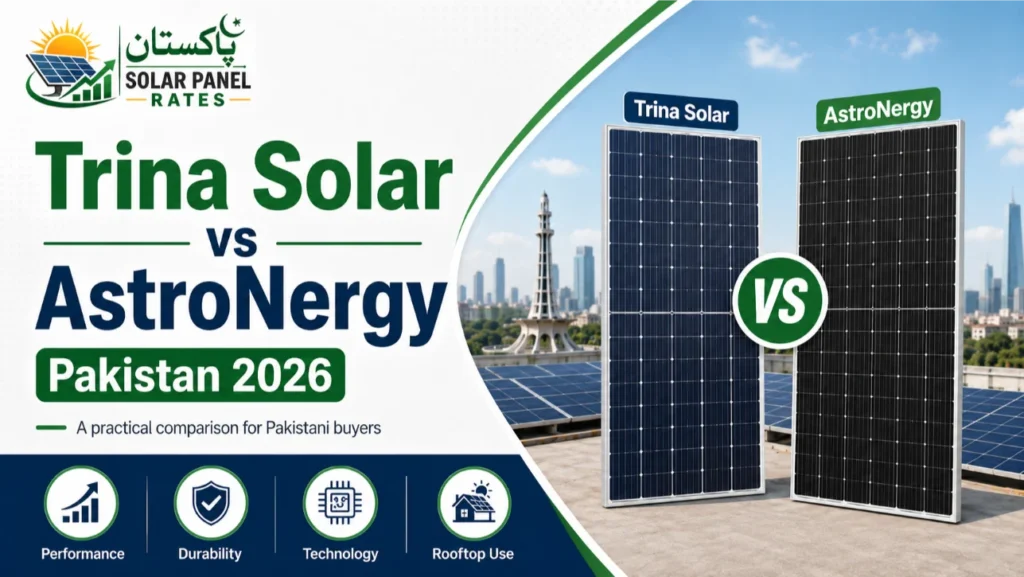
Trina Solar and AstroNergy (a CHINT Group brand) are both popular panel choices in Pakistan’s 2026 solar market. Trina is a long-established Tier 1 brand; AstroNergy offers strong value as a rising competitor. This guide compares both on price, specs, warranty, and Pakistan suitability.
Quick Comparison Table
| Feature | Trina Vertex S+ | AstroNergy ASTRO 6 |
|---|---|---|
| Parent Company | Trina Solar (independent) | CHINT Group (China’s largest EPC) |
| Bloomberg NEF Tier | Tier 1 | Tier 1 |
| Technology | N-type TOPCon | N-type TOPCon |
| Peak Efficiency | Up to 23.5% | Up to 23.2% |
| Price (600W, Pakistan) | Rs 16,000–20,000 | Rs 15,000–18,500 |
| Product Warranty | 12 years | 12 years |
| Performance Warranty | 30 years (87.4%) | 30 years (87.4%) |
| Pakistan Availability | High | Moderate–High |
Trina Solar Vertex S+ — Strengths & Weaknesses
- Strength: Bloomberg NEF Tier 1 since 2013 — one of the longest track records
- Strength: Vertex S+ N-type achieves 23.5% efficiency at competitive price
- Strength: Strong Pakistan installer familiarity — widely trained on Trina systems
- Strength: Consistent performance data across Pakistan deployments since 2018
- Weakness: Slightly higher price than AstroNergy for similar wattage
- Weakness: Fewer bifacial variants available in Pakistan market vs competitors
AstroNergy ASTRO 6 — Strengths & Weaknesses
- Strength: CHINT Group backing — one of China’s largest and most financially stable energy conglomerates
- Strength: ASTRO 6 N-type TOPCon offers 23.2% efficiency at lower price point
- Strength: Strong value proposition — typically Rs 1,500–2,000 cheaper per panel than Trina
- Strength: Growing Pakistan dealer network supported by CHINT’s regional offices
- Weakness: Less brand recognition among end consumers vs Trina
- Weakness: Pakistan installer training still catching up to Trina’s ecosystem
Performance in Pakistan’s Climate
| Metric | Trina Vertex S+ | AstroNergy ASTRO 6 |
|---|---|---|
| Summer output at 50°C | ~93.5% of rated | ~93.5% of rated |
| Low-light performance | Excellent (N-type) | Excellent (N-type) |
| Annual degradation | <0.4%/yr | <0.45%/yr |
| Year 25 retained output | 87.4% | 87.4% |
Both panels use N-type TOPCon — the dominant technology in 2026. Real-world performance difference is under 0.3%. Price, local support, and installer familiarity are more important differentiators.
Which Should You Buy?
| Your Priority | Recommended Choice |
|---|---|
| Best brand recognition & track record | Trina Solar Vertex S+ |
| Best price per watt | AstroNergy ASTRO 6 |
| Commercial project with financing | Either (both Tier 1) |
| Resale value considerations | Trina Solar |
If AstroNergy is more than Rs 2,000/panel cheaper than Trina, go AstroNergy — the specs are nearly identical. If within Rs 1,000, choose Trina for the installer ecosystem advantage.
Frequently Asked Questions
Get Trina and AstroNergy Quotes in Your City
Compare prices from AEDB-licensed installers — free, no commitment.
Sources & references
Tariff, net-metering, and policy details on this page draw on the following official sources. Rates change often, so confirm current figures with the relevant authority or a licensed installer before you decide.
- NEPRA — National Electric Power Regulatory Authority: electricity tariffs and the 2026 shift from net metering to net billing.
- AEDB — Alternative Energy Development Board: solar policy, installer standards, and net-metering guidance.
- Your local distribution company (DISCO) — for example LESCO, K-Electric, IESCO, MEPCO, PESCO or QESCO — for area-specific tariffs and the net-metering application process.