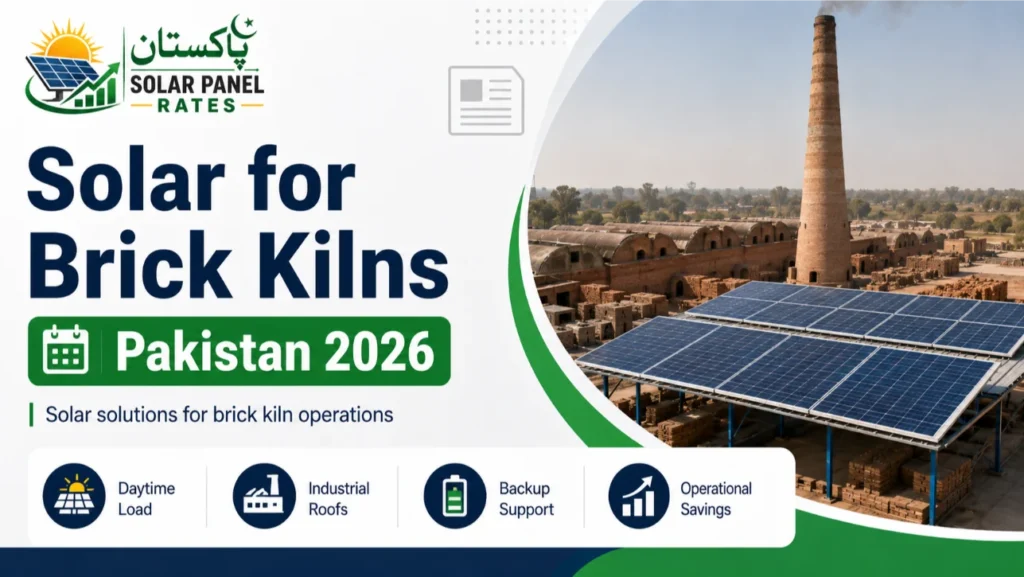
Solar for Brick Kilns Pakistan 2026 — Complete Guide
Pakistan’s brick kiln industry is one of the country’s largest energy consumers — and one of the least served by solar. But kiln owners running electrical operations like fans, conveyors, crushers, and lighting can cut costs significantly. This guide covers solar for brick kilns in Pakistan in 2026.
Brick Kiln Electrical Loads
| Load Type | Power Draw | Hours/Day |
|---|---|---|
| Exhaust / draft fans (large) | 5–30 kW each | 16–24 hrs |
| Crusher / pug mill | 15–50 kW | 8–12 hrs |
| Clay conveyor belts | 5–15 kW | 8–12 hrs |
| Water pump | 3–7 kW | 4–8 hrs |
| Office + lighting | 2–5 kW | 8–12 hrs |
| Coal/fuel handling equipment | 5–20 kW | 6–10 hrs |
Recommended System Sizes
| Kiln Size | Monthly Bill | Solar System | Monthly Saving |
|---|---|---|---|
| Small kiln (0.5M bricks/month) | Rs 80,000–150,000 | 30–50kW on-grid | Rs 50,000–100,000 |
| Medium kiln (1M bricks/month) | Rs 150,000–300,000 | 60–100kW on-grid | Rs 100,000–200,000 |
| Large kiln (2M+ bricks/month) | Rs 300,000–600,000 | 150–250kW on-grid | Rs 200,000–400,000 |
| Multiple kiln operation | Rs 600,000+ | 300kW–1MW+ | Rs 400,000–800,000+ |
Why Brick Kilns Are Good Solar Candidates
- Kilns operate during daylight hours for most operations — perfect alignment with solar generation
- Industrial tariff (I-1/I-2) electricity costs Rs 40–65/unit — significant per-unit savings
- Large kiln sites have open land and roof space for ground-mounted or shed-roof solar arrays
- Consistent, predictable electrical loads make solar system sizing straightforward
- Diesel generator costs for load shedding are high — solar hybrid eliminates this
- Punjab Environment Protection Department (EPD) offers incentives for kiln modernisation including solar
ZigZag Kiln & Solar: A Natural Fit
Pakistan’s shift to ZigZag technology kilns (mandated by Punjab EPD) reduced coal consumption but increased electrical demand for forced-draft fans. A 200kW fan load on a ZigZag kiln running 20 hrs/day = 4,000 kWh/day. A 100kW solar system offsets ~500 kWh/day — reducing the electricity bill by 12–15% directly.
Sample System — Medium Kiln (1M bricks/month)
| Component | Specification | Cost |
|---|---|---|
| Solar Panels | 80kW (133 × 600W TOPCon) | Rs 2,200,000–2,700,000 |
| On-Grid Inverter | 80kW three-phase | Rs 700,000–950,000 |
| Mounting (ground/shed) | Galvanised steel structure | Rs 400,000–600,000 |
| Wiring + BOS | DC/AC, surge protection | Rs 250,000–350,000 |
| Net Meter + AEDB | Industrial application | Rs 80,000–120,000 |
| Labour | AEDB-licensed EPC | Rs 300,000–450,000 |
| Total | Rs 3,930,000–5,170,000 |
At Rs 150,000/month saving, an 80kW kiln solar system pays back in 26–34 months. The system then generates free electricity for 22+ more years — a strong long-term industrial investment.
Get Brick Kiln Solar Quotes
Free site assessment from AEDB-licensed industrial solar EPC contractors.
Sources & references
Tariff, net-metering, and policy details on this page draw on the following official sources. Rates change often, so confirm current figures with the relevant authority or a licensed installer before you decide.
- NEPRA — National Electric Power Regulatory Authority: electricity tariffs and the 2026 shift from net metering to net billing.
- AEDB — Alternative Energy Development Board: solar policy, installer standards, and net-metering guidance.
- Your local distribution company (DISCO) — for example LESCO, K-Electric, IESCO, MEPCO, PESCO or QESCO — for area-specific tariffs and the net-metering application process.