Common Solar Panel Scams in Pakistan 2026 — How to Avoid Getting Cheated
The 8 Most Common Solar Scams in Pakistan
1. Counterfeit / Clone Panels Sold as Brand-Name
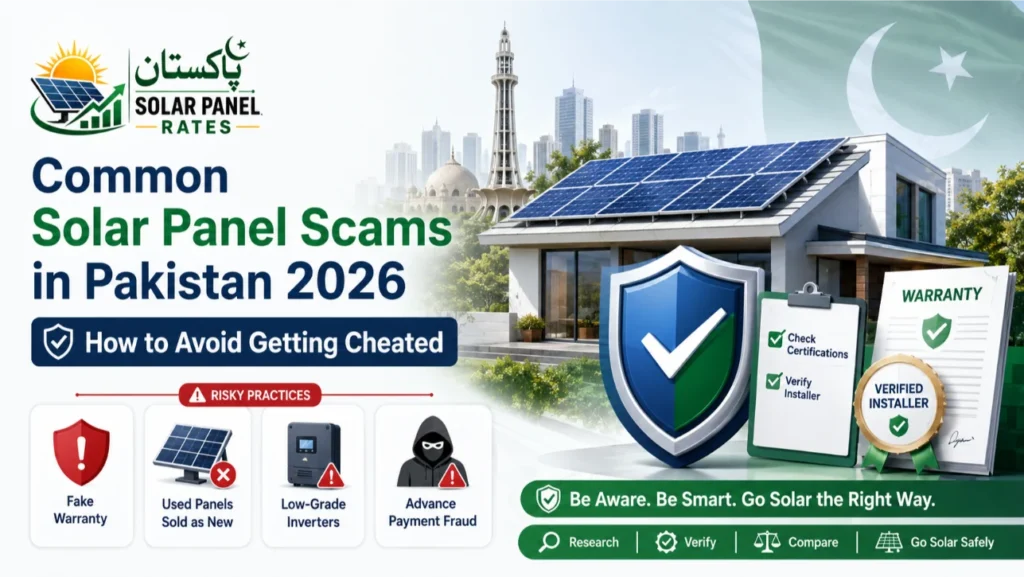
Fake LONGi, Jinko, and JA panels with counterfeit labels are imported and sold in Pakistan. They look identical to the real thing but use lower-grade cells and underperform by 20–40%. Detection: verify the panel serial number on the brand’s official verification portal (LONGi, Jinko, JA all have QR-code verification on genuine panels). Demand documentary import evidence and original packing crates from your installer.
2. Second-Hand / Used Panels Sold as New
Panels pulled from decommissioned projects (solar farms, expired leases) are cleaned up and sold as new in Pakistan’s informal market. Already degraded 15–30%, they’re sold at new-panel prices. Detection: inspect for micro-scratches on glass, frame discolouration, and faded label printing. New panels have pristine frames, sharp label printing, and protective film on glass.
3. Under-Sized Systems
A buyer pays for a 5kW system and receives a 3.5kW system — fewer panels than contracted, smaller inverter, or thinner cable than specified. Detection: verify all system components against your signed contract before handover. Count panels (550W × panel count = actual kW), check inverter nameplate, and verify wire gauge on cable runs.
4. Fake Net Metering Application Processing
Installers charge Rs. 30,000–80,000 “processing fees” for net metering applications that they never file, or charge multiple times for the same application. Detection: net metering fees are set by NEPRA and payable directly to your DISCO — not to your installer. AEDB application fees are fixed and nominal. Ask for the DISCO application receipt with your name and application number.
5. Disappearing Installers
Small fly-by-night solar companies collect upfront payment (50–100% advance) and disappear before completing installation, or complete shoddy installation then vanish when warranty issues arise. Detection: verify company registration (SECP), AEDB installer certification, and physical office address. Never pay 100% advance — use a milestone payment structure (30% deposit, 50% on equipment delivery, 20% on complete commissioning).
6. Inflated Inverter Capacity Claims
A 5kW inverter on paper may be rated for 5kW peak but only 3.5kW continuous — some cheap Chinese brands inflate peak ratings. Continuous output rating is what matters for actual use. Detection: check the inverter’s continuous rated output on its nameplate and verify against the manufacturer’s published specification sheet on the official website.
7. Missing or Watered-Down Warranties
Installers provide verbal 25-year warranties but written contracts offer only 1 year. Or the warranty is with the installer company (which closes) rather than the panel manufacturer directly. Detection: demand separate manufacturer warranty documents (not installer-issued) with the panel serial numbers registered to your name. LONGi, Jinko, and JA issue direct manufacturer warranties.
8. Government Scheme Fraud
Fraudsters impersonate government officials or PM Solar Scheme representatives, collecting “registration fees” or “taxes” for free solar schemes that don’t exist or aren’t available to the victim. Detection: the PM Solar Scheme never charges registration fees. All legitimate government solar applications are free and processed through AEDB or BISP — not through third-party agents who “guarantee” you a spot for a fee.
How to Verify an Installer in Pakistan
- Check AEDB’s certified installer list at aedb.org.pk
- Verify SECP company registration at secp.gov.pk/eservices
- Search for reviews on Facebook and Google for their business name
- Visit their physical office before signing any contract
- Get minimum 3 competitive quotes — extreme outliers (too cheap or too expensive) warrant scrutiny
- Never pay more than 30% advance payment before equipment delivery
Frequently Asked Questions
🛡️ Buy solar safely — use AEDB-certified installers
Sources & references
Tariff, net-metering, and policy details on this page draw on the following official sources. Rates change often, so confirm current figures with the relevant authority or a licensed installer before you decide.
- NEPRA — National Electric Power Regulatory Authority: electricity tariffs and the 2026 shift from net metering to net billing.
- AEDB — Alternative Energy Development Board: solar policy, installer standards, and net-metering guidance.
- Your local distribution company (DISCO) — for example LESCO, K-Electric, IESCO, MEPCO, PESCO or QESCO — for area-specific tariffs and the net-metering application process.