What Happens to Solar Panels After 25 Years in Pakistan?
How Solar Panels Age
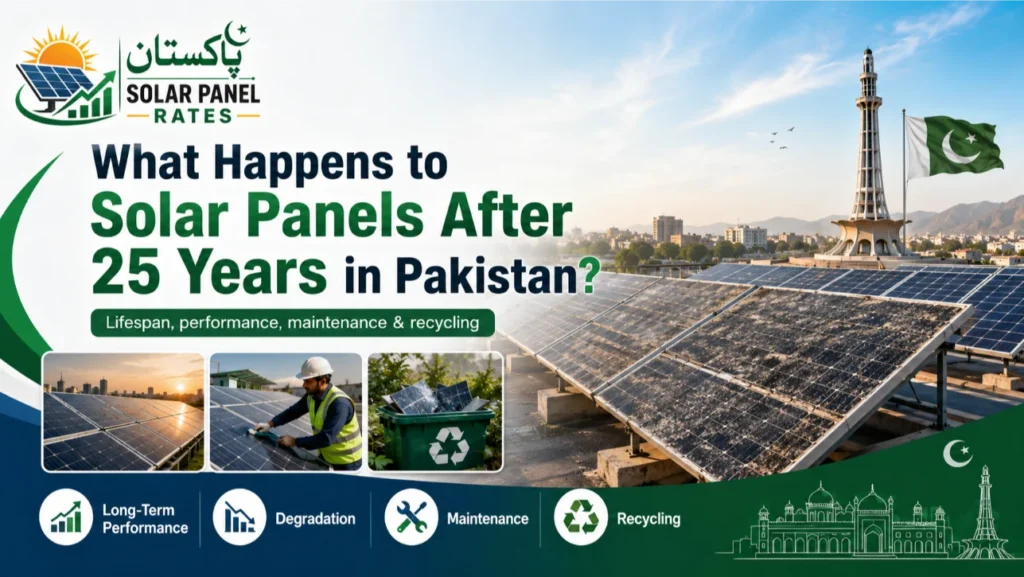
Solar panels don’t stop working at year 25 — they gradually lose efficiency over time due to degradation of silicon cells, EVA encapsulant browning, and contact resistance increases. The “25-year warranty” means the manufacturer guarantees a minimum performance level (typically 80% of rated output) at year 25. Most panels actually outperform their warranty.
| Year | Expected Output (% of year-1 rated) | 5kW System Generation |
|---|---|---|
| Year 1 | 100% | ~7,000 kWh/year |
| Year 5 | 97–98% | ~6,800 kWh/year |
| Year 10 | 94–96% | ~6,650 kWh/year |
| Year 15 | 90–93% | ~6,450 kWh/year |
| Year 20 | 87–90% | ~6,200 kWh/year |
| Year 25 | 84–87% | ~5,950 kWh/year |
| Year 30 | 80–83% | ~5,700 kWh/year |
Pakistan’s Climate and Long-Term Degradation
Pakistan’s hot climate accelerates EVA yellowing slightly compared to European conditions — a degradation rate of 0.5–0.7%/year is realistic for Pakistani conditions vs 0.4–0.5%/year in temperate climates. Even at 0.7%/year, panels at 25 years retain 84% output. Pakistan’s high irradiance (abundant sunshine) means even degraded panels generate more absolute kWh than new panels in cloudy northern European countries.
Should You Replace Panels at Year 25?
Not necessarily — panels at 84–87% output are still generating substantial electricity. The question is whether the cost of new panels is justified by the efficiency improvement:
Solar Panel Recycling in Pakistan
Solar panel recycling is an emerging industry globally. As of 2026, Pakistan has very limited formal recycling infrastructure for solar panels. The IEA estimates a global wave of solar panel decommissioning beginning around 2030–2035 (from early installations). By the time panels installed in 2024–2026 reach end-of-life (2049–2051), a Pakistan recycling industry will likely exist driven by regulatory pressure and valuable material recovery (silver, silicon, glass, aluminium).
What Wears Out Faster Than Panels
- Inverter: Lifespan 10–15 years — budget for 1–2 inverter replacements over 25 years (cost: Rs. 80,000–200,000 each)
- Lead-acid batteries: Lifespan 3–5 years — if you have lead-acid, multiple replacements needed (lithium: 10–15 years)
- DC cables and connectors: Quality UV-resistant cables last 25 years; cheap cables may need replacement at 10–15 years
- Mounting hardware: Galvanised steel lasts 25+ years; aluminium rails last indefinitely; roofing sealants may need resealing at 10–15 years
Frequently Asked Questions
☀️ Invest in 25+ years of solar savings
Sources & references
Tariff, net-metering, and policy details on this page draw on the following official sources. Rates change often, so confirm current figures with the relevant authority or a licensed installer before you decide.
- NEPRA — National Electric Power Regulatory Authority: electricity tariffs and the 2026 shift from net metering to net billing.
- AEDB — Alternative Energy Development Board: solar policy, installer standards, and net-metering guidance.
- Your local distribution company (DISCO) — for example LESCO, K-Electric, IESCO, MEPCO, PESCO or QESCO — for area-specific tariffs and the net-metering application process.